Tanks Designed for Urban Combat
By Michael McCabe
Article published on:
in the Armor Spring
2025 Edition of Armor
Read Time:
< 7 mins
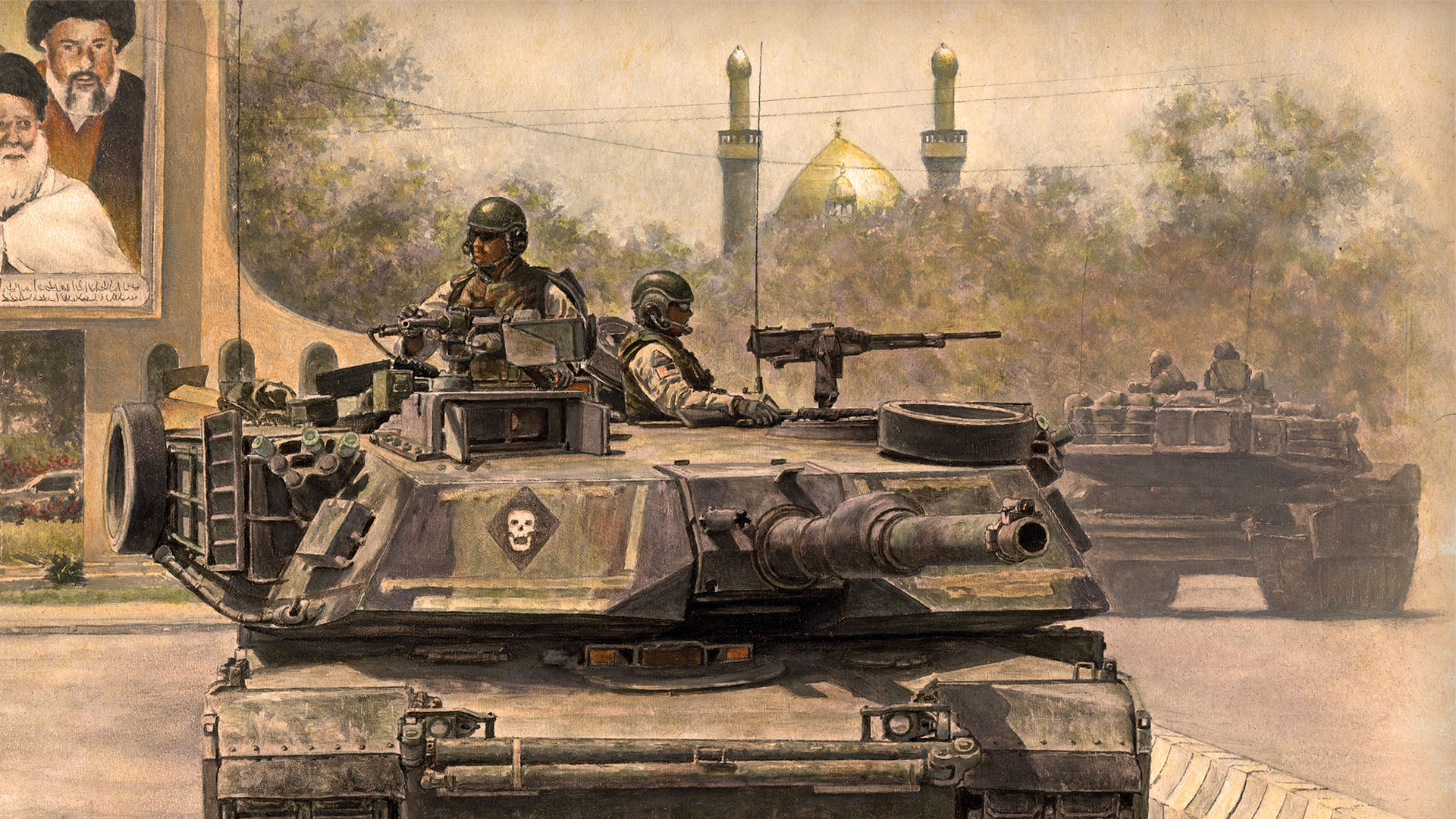
Image 1. U.S. Army M1 Abrams tanks maneuver in the streets in the city
of Tal Afar, Iraq, Feb 3, 2005.
(By Staff Sgt. Aar-on Allmon)
Traditionally, tanks are seen as being at an inherent disadvantage in
urban combat. In the 21st Century, however, the U.S. military must be
prepared for urban combat in large, densely populated cities. The Army
would do well to introduce heavy infantry divisions for this task, and
these divisions will need armored cavalry for scouting, escort duty, and
fire support. Developing a tank specifically for urban terrain will
therefore be necessary, both for practical and doctrinal reasons.
A tank designed for urban terrain would have radically different design
requirements than a main battle tank designed for open warfare. Main
battle tanks rely primarily upon their speed and long-range firepower and
are willing to sacrifice extra armor to retain mobility. In urban combat,
however, the reverse is true: fights are at much closer ranges, mobility
is measured by the ability to navigate sharp turns and tight/narrow
streets, and speed can be sacrificed to retain maximum armor protection.
Other unique requirements are the ability to shoot in multiple directions
at once, shoot around 90-degree corners, increased importance on the
ability to shoot at high and negative elevations, and designing the hull
to carry cage armor and/or active protection systems.
This article will go through these and other design principles for an
urban tank, dividing them between “hard factors” which are easily
measured, and “soft factors,” which are less cut-and-dry. Soft factors are
what war-winners excel at and will consequently be given more attention.
Hard factors
The first, most important, hard factor in an urban tank is its armor.
Urban tanks will routinely fight at close range, and so every trick in the
book will be necessary to ensure safety and survivability. Armor should be
uniformly thick on the front, sides, and rear, since attacks from every
angle are to be expected. A pentagon-shaped hull can offer the benefits of
sloped armor and V-hulls for protection from mines. A slightly more
complex alternative is an octagon-shaped hull, which can offer more angles
and smaller flat surfaces for increased shot deflection. Additional armor
modules, like cage armor and active protection systems, will not replace
or reduce the hull armor’s thickness, and the chassis must be designed to
carry them all at once without overloading.
The second hard factor, relating directly to the first, is the vehicle’s
engine and mobility. Rather than being built for speed, a tank’s engine
will instead resemble a bulldozer engine. An urban tank will be a very
heavy vehicle, and so a bulldozer-style engine will be capable of both
handling the sheer weight of the vehicle and will allow the tank to
overpower obstacles.
Obstacle clearing must be an expected, routine occurrence for urban tanks,
and the ability to smash through them and other man-made fortifications
without requiring a separate armored bulldozer will be advantageous.1
The third hard factor is the tank’s guns. An urban tank will use
short-barreled guns, since longer barrels are difficult to maneuver in
tight spaces and the tank is less likely to engage in long-range shooting.
As a bonus, short-barreled guns are quicker to acquire targets.2
High-elevation and negative-elevation shooting also benefits from this
quicker target acquisition.
An urban tank would have a mixture of gun calibers for its main turret and
side turrets/sponsons, since it will need to be capable of firing in
multiple directions at once. Side turrets and sponsons will not
necessarily require large-caliber guns, but they will require rapid-fire
guns. These will often be fired around street/building corners and into
buildings from the street to provide flanking fire in support of advancing
infantry. Urban tanks may also incorporate a flamethrower in front. The
flamethrower would be desirable for covering a tank’s underbelly from
attackers in spider holes, tunnel entrances such as manholes, and/or
basement windows. It can also thwart attempts to drag mines into the
tank’s path and reduce ground-level enemy gun positions designed to
provide grazing fire.
Soft factors
A major development in modern tank design is the unmanned turret. As
mentioned before, urban tanks must expect enemy fire from multiple
directions simultaneously, and thus would benefit from having multiple
turrets like a 1920s tank3
or a pre-dreadnought battleship. The 1920s designs were a failure because
the turrets needed to be manned. Thus, they could not effectively balance
the following needs:
- Armor protection
- Interior cubic volume for the men and the ammunition
- Ergonomics
- Accessibility for operation, reloading, and clearing jams
- Optics and fields of view
- Power supply
- Preventing the turrets from getting in each other’s way
The advent of World War II also favored main battle tanks, which displaced
the 1920s designs for the same reason dreadnoughts displaced
pre-dreadnoughts: longer-range guns, better speed, etc.
Unmanned turrets, however, allow modern side turrets/sponsons to be much
smaller and more compact than their 1920s ancestors, and keep the
operators at a safe distance in the event of a direct hit and/or
ammunition cook-off. Unmanned turrets can also be placed farther forward
on the hull than manned turrets, since they weigh less and thus pose less
risk of causing balance/center-of-gravity issues. Placing side turrets
further forward, in turn, enables urban tanks to fire around 90-degree
corners while exposing as little of its hull as possible. The controls for
these would ideally be constructed like the A-10 Warthog’s controls, with
redundancy and mechanical backups for all automated systems.
A second soft factor design element is the inclusion of escape hatches on
all sides and the rear of the tank, a move that necessitates placing the
engine and side turrets/sponsons towards the front of the vehicle.
These are not new concepts; the WW2-era Churchill4
heavy tank had side exits, while rear exit doors are included in the
design of the Israeli Merkava tank, itself a product of Israel’s
experiences in dense urban terrain. The logic behind them is simple: if
the tank is knocked out, the crew will need escape hatch options in all
directions, not just the top of the tank. Classic urban antitank tactics
involve firing down onto the tank from above; while this will be less
damaging to an urban tank than a main battle tank on account of its
uniformly thick armor, limiting urban tankers to exiting via top hatches
noticeably reduces their likelihood of escaping safely when bailing out
under fire. This survivability need will also affect the design and
employment of cage armor; cage armor designs must not block escape routes,
and the escape routes must not widen the cage armor profile any more than
is necessary. If the tank becomes too wide, then its usefulness in narrow
streets declines rapidly.
Placing the engine in the vehicle’s front, along with the flamethrower,
side turrets, and sponsons, increases the safety of the crew from the fuel
as well as the ammunition. The crew in the rear of the tank can be
physically separated from the fuel tanks and ammunition by a protective
thermal/blast-proof barrier and pilot the tank’s weapons remotely. Placing
the fuel tank in front instead of a driver or gunner also allows the front
of the tank to be any shape; thus, the front can be a steeply sloped nose
for maximum deflection of oncoming frontal or flank shots.
Visibility in urban terrain is another traditional difficulty for tanks.
In addition to using the 360-degree cameras already available to M1 Abrams
tanks, an urban tank would carry drones for reconnaissance. The 360-degree
cameras can only provide ground-level vision, whereas drones can offer the
commander a bird’s-eye view and aid in spotting targets in high-rise
buildings.
These should be digitally linked, so that data can be shared in real time
between tanks and commanders. Lateral communication is difficult in urban
terrain, and anything which can ameliorate this should be incorporated.
Closing thoughts
Urban tanks will always be a niche role, but their niche will become more
prevalent in a future war. Urban combat without the presence of armored
vehicles is extremely hazardous to the infantryman, and the side which
develops a purpose-built tank for urban combat will enjoy a marked
advantage over one that continues to use main battle tanks. Many of the
technological hindrances to developing such tanks in the past no longer
exist, and it is no longer a matter of “if,” but rather “when” these new
tanks will appear on the battlefield.
Notes:
1. Heavy Infantry
Divisions would likely possess both armored bulldozers and urban tanks,
as sappers and engineers have use for both.
2. Stagecoaches in the
Old West used sawed-off shotguns rather than full-barreled guns for this
same reason.
3. Many factors in the
trench warfare of World War 1 are like those in urban combat: the
terrain was linear, yet the battlefield was a 360-degree battlefield. An
attacker could expect to be fired upon from multiple directions at once,
defenses were arrayed in depth, etc. The 1920s tanks were designed for
such scenarios.
4. The Churchill tank
was a heavy tank designed to maneuver in difficult terrain and survive
intense fire. It offers an ideal starting point for an urban tank
design.
Author
Michael McCabe is as a draftsman/designer at Newport News Shipbuilding
in the Hampton Roads area of Virginia. He has been published in Small
Wars Journal under the pen name Michael Gladius, and some of his essays
have been reposted on RealClearDefense. He holds a bachelor’s of arts
degree in biochemistry-molecular biology from Carroll College.