Austere Resuscitative And Surgical Care Teams
Supporting Far-Forward Trauma Care On The Future Battlefield
By 2nd Lt. Mason H. Remondelli, 2nd Lt. Joseph Rhee, 2nd Lt. Isaiah Gray, 2nd Lt. Ryan M. Leone,
Col. Jay B. Baker,and retired Lt. Col. Dan S. Mosely
Article published on: March 16th, 2025 in the Special Warfare 2025 E-edition
Read Time:< 20 mins

Special Operations Surgical Team (SOST) members assigned to the 24th Special Operations Wing
perform a field cricothyrotomy on a simulated patient at Northeast Alabama Regional Airport, Alabama, Mar.
17, 2022. The SOST team is an extremely lightweight, mobile, and rapidly deployable element that is
medically and tactically trained to provide trauma resuscitation and life-saving surgical care on or near
the battlefield. (U.S. Air Force photo by SrA Christopher H. Stolze)
INTRODUCTION
Over two decades of conflict in the Middle East, deployed military medical capabilities have made significant
advancements in tactical combat casualty care, damage control resuscitation, and damage control surgery. Among
these improvements include the austere resuscitative and surgical care (ARSC, pronounced ärsk) teams, whose
history extends back to Operation Eagle Claw in 1980 when special operations forces (SOF) identified a need for
far-forward surgical teams. The concept of ARSC teams expanded to conventional forces in the 1990s, later
proving crucial during Operation Enduring Freedom and Operation Iraqi Freedom.
The ARSC can be defined as an “advanced medical capability delivered by small teams with limited resources, often
beyond traditional timelines of care, and bridges gaps in roles of care to enable forward military operations
and mitigate risk to the force.”01
The recent deployment of these highly skilled teams closer to the front lines has made combat surgical
capabilities readily accessible in the most restricted operational environments.
Military operational and medical planners now focus on understanding the future battlefield landscape.02 Potential conflicts with near-peer
adversaries could result in large-scale combat operations (LSCO), as demonstrated in the ongoing Russo-Ukrainian
War, which carries significant challenges for casualty care and austere surgical assets as they involve daily
mass casualty events, a lack of timely aeromedical evacuation, and the need for prolonged field care.03,04 These issues highlight the austere environment
where access to clean water, electricity, and a fixed or mobile medical facility is significantly degraded or
denied, and where diagnostic and treatment resources and medical personnel are unavailable or limited for
extended periods.05
There are important lessons being learned from the ongoing military medical experiences in Ukraine. The ARSC
teams face challenges both currently and in the context of potential future battlefields. The training, skill
maintenance, and employment of ARSC teams remain critical, as they ensure the highest standards of far-forward
trauma care, especially in the demanding environment of LSCO.
TRAINING AND INTEROPERABILITY
Manning, training, and facilitating the relevant developmental experience for ARSC teams is presently inadequate
for managing the medical needs that future LSCO environments will impose on SOF and conventional forces. Adept
ARSC teams, much like SOF units, cannot be created after conflicts occur.06 Just as effective military operations necessitate
upfront commitments of time and resources, the same principle applies to ARSC teams. They require meticulous
preplanning, manpower allocation, equipment provisioning, and comprehensive training, well before any potential
need of an ARSC team. With proper training, ARSC teams can achieve a high level of tactical and clinical
proficiency and stand ready to swiftly mobilize at the commander’s discretion.
Currently, several “just-in-time” pre-deployment combat trauma training courses compensate for the limited
practice

A Special Operations Surgical Team member assigned to the 24th Special Operations Wing
applies a chest seal on a simulated patient to cover a gunshot wound at Northeast Alabama Regional Airport,
Alabama, Mar. 17, 2022. The SOST team is an extremely lightweight, mobile, and rapidly deployable element
that is medically and tactically trained to provide trauma resuscitation and life-saving surgical care on or
near the battlefield. (U.S. Air Force photo by SrA Christopher H. Stolze)
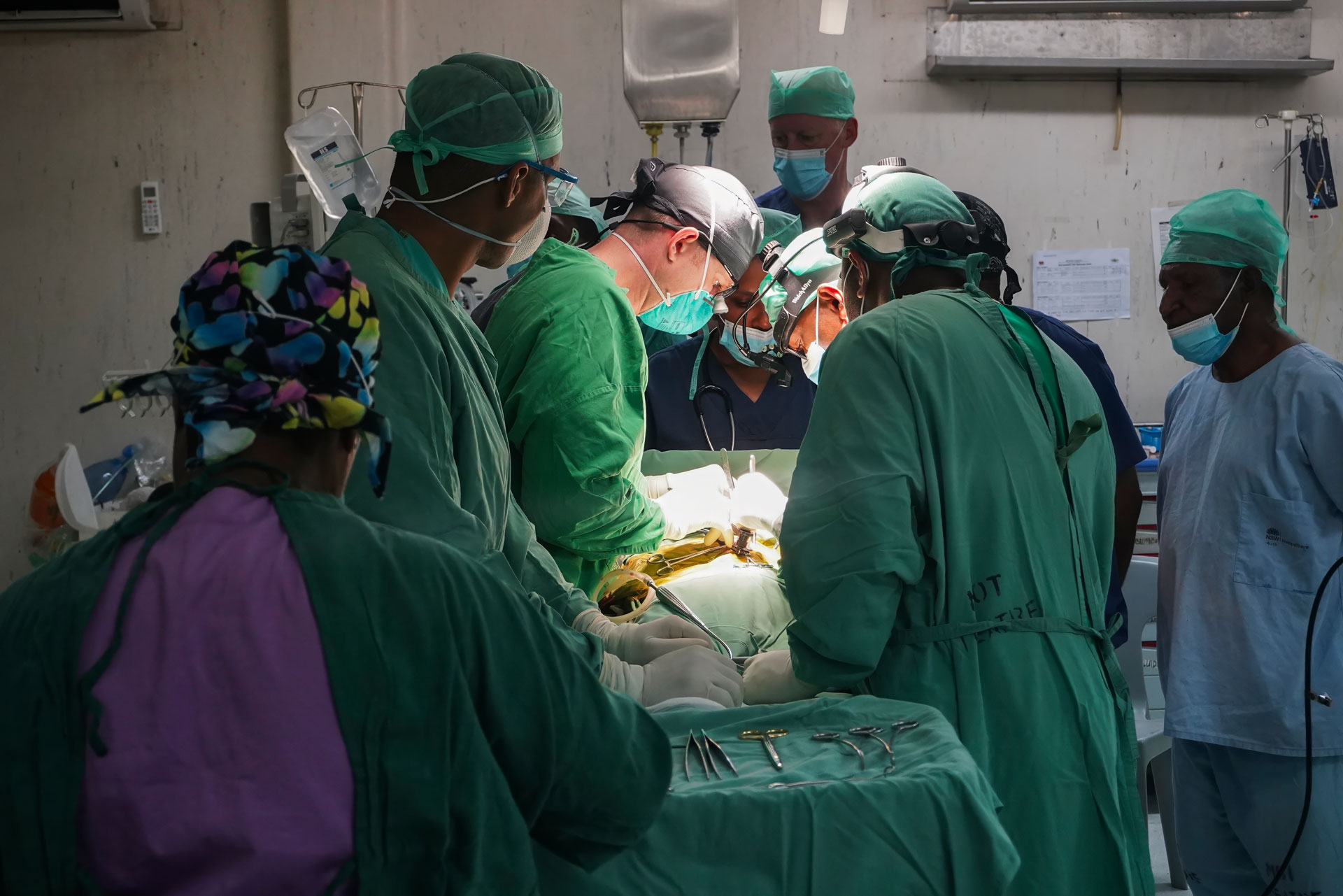
A U.S. Army medical team assigned to 8th Forward Resuscitative and Surgical Detachment, 18th
Medical Command, and a Port Moresby General Hospital surgical team conduct a surgical ligation of patent
ductus to correct a breathing abnormality due to a birth defect on a 2-year-old girl during the inaugural
Papua New Guinea Trauma Rotation in Port Moresby General Hospital at Port Moresby, Papua New Guinea, Dec.
10, 2023. The Trauma Rotation follows the recent signing of the Defense Cooperation Agreement between the
U.S. and Papua New Guinea; it is a first-of-its-kind engagement between the U.S. Army and Papua New Guinea,
which mutually offers parties a chance to exchange medical expertise and techniques in an austere
environment. (U.S. Army photo by Sgt. 1st Class Timothy Hughes/Released)
opportunities available in military treatment facilities. These training programs include the intensive week-long
Tactical Combat Medical Course, a concise three-day Emergency War Surgery course, and immersive two-week
rotations for forward surgical teams preparing for deployment at the Army Trauma Training Center, situated at
Ryder Trauma Center in Miami, Florida.07 The primary objective of these courses is to prepare forward
resuscitative surgical detachments for a relatively stable environment, such as a Role 2 facility focused on a
small quantity of surgical patients or a Role 3 theater hospital. However, there are currently no courses
offered as part of a readiness requirement that prepare small surgical teams to operate in the austere
environment.
Additionally, most deployable small surgical teams are manned by general surgeons, who do not take care of
surgical trauma cases in their daily practice. The dearth of experience in trauma management for general
surgeons in the Army is evident in the data. Currently, there are just 150 deployable active-duty Army general
surgeons with 50 having received specialized training in trauma, surgical critical care, or burn care.08
A shortage of qualified, trauma-trained surgeons is also evident in the Russo-Ukrainian conflict. A Global
Surgery report from 2014 concluded that Ukraine had approximately 87 surgeons per 100,000 citizens, though this
number could not be subdivided by specialty.09 The Global Surgical and Medical Support Group utilizing the American
College of Surgeons Military Clinical Readiness Curriculum “M-Course” has been teaching Ukrainian Surgeons
damage control resuscitation, surgery, and emergency wartime operations.04 While supplemental training from the Global
Surgical and Medical Support Group enabled the rapid acquisition and transfer of relevant surgical trauma
skills, Global Surgical and Medical Support Group must adapt from focusing exclusively on just-in-time surgical
care training to incorporating new concepts from recent war surgery experiences that will support the United
States in future conflicts.
The United States should learn from the challenges in Ukraine. Providing longitudinal sustainment training,
emphasizing exercises that ensure interoperability with line units, and drilling home tactical skills that can
elevate ARSC maneuverability on LSCO battlefields would go far in adapting ARSC for the future operating
environment. Including high-fidelity simulated practice under various lighting conditions and involving
intermittent transportation between or even during operations would be small contributions that could further
evolve ARSC operational prowess and tactical capacities.
SKILL MAINTENANCE AND READINESS
Across the Military Health System there is a well-documented challenge that is hampering the ARSC capability, as
well: Military surgeons often struggle to attain the required case volume and complexity necessary to maintain
trauma readiness.10 This challenge
may exacerbate the “Peacetime Effect” or the “Walker Dip,” a phenomenon observed in military medicine in which
combat casualty care improves during periods of armed conflict, only to see these advancements diminish once the
conflict subsides.11, 12 If lessons learned in war are
not reinforced during peacetime or non-deployed periods, they risk fading from practice and may need to be
relearned over time. Projections of casualty rates in possible future LSCO indicate that the price of overcoming
a “Walker Dip” during the next conflict could be extremely severe.
One effort to quantify the value of surgeon workloads comes from the Clinical Readiness Program, which explains
the knowledge, skills, and abilities of combat casualty care. For instance, from 2015 to 2019, the number of
general surgery procedures generating knowledge, skills, and abilities points at military treatment facilities
decreased by 19.1%.10 This trend is concerning since it is well-established that high-quality outcomes are often
a direct result of surgeons’ exposure to high-volume caseloads across various surgical specialties, including
trauma care.7,14,15 Similarly, civilian academic trauma centers have identified a robust
correlation between case volume and patient outcomes, observing a noteworthy reduction in both mortality rates
and hospital length of stay when the annual case volume exceeds 650 cases.16
Two primary strategies to increase provider knowledge, skills, and abilities currency are to either increase the
volume and complexity of surgical care at military treatment facilities or to send surgeons outside of military
treatment facilities to civilian centers with pre-existing volume and acuity through military-civilian
partnership medical programs.17
For the former, the recent military health system stabilization memo published in December 2023 directed the DoD
to improve staffing and recapture care within the military health system that has previously gone to the private
sector.18 However, military health
system-based training for small surgical teams is just one necessary component of the comprehensive training
required to maintain and advance surgical capabilities. There are other skills that must be cultivated and
refined to succeed in the contemporary military operating environment. The diverse set of situations an ARSC
team may find itself confronting requires a firm understanding of the principles of medical team
interoperability, advanced surgical planning, and operational flexibility. Military-civilian partnership can
help hone these principles for ARSC personnel training for a variety of missions. Combining military-civilian
partnership with lessons learned recapture strategies and adding on dedicated austere surgical team training
could support the appropriate skill balance.
Maintaining robust surgical proficiency in military medicine will be more critical than it has been in recent
memory if the U.S. continues facing the likelihood of full-scale war with another major power like the People’s
Republic of China, Russia, or Iran. Enhanced outcomes and increased survivability during Operation Enduring
Freedom, Operation Iraqi Freedom, and Operation Inherent Resolve set a new standard for delivering quality
trauma care that is likely unattainable in LSCO. Recent LSCO simulations projected staggering casualty numbers,
such as 50,000 casualties in battles involving 100,000 soldiers with daily estimates as high as or even greater
than 3,000.02 The Russo-Ukrainian
War, for example, has so far witnessed over 300,000 casualties, averaging around 500 per day.03 A lack of surgeon readiness due to
low case volumes will exacerbate such high casualty rates.
Moreover, past conflicts have benefited from the swift evacuation capabilities observed in the Global War On
Terror, which may be uncommon in future conflicts. Given the new challenges of providing prolonged care in
austere conditions, ARSC teams may find themselves operating near the front lines, often with limited resources
and confronting complex battle injury patterns.19 To meet the expectations of delivering complex polytraumatic care to
service members under these demanding conditions, ARSC teams must receive additional skill sustainment through
military-civilian partnerships and austere trauma training through dedicated courses.
EMPLOYMENT FLEXIBILITY, ADAPTABILITY, AND MOBILITY
With proper training and experience, ARSC teams are highly proficient in both tactical operations and far-forward
pre-hospital trauma support, making them irreplaceable assets in battlefield operations. During LSCO, ARSC teams
can become high priority targets of anti-access/area denial systems, long-range artillery, and unmanned combat
aerial vehicles.03 For instance,
Russian forces have previously targeted Ukrainian hospitals and medical facilities located approximately 400
kilometers from the Russian border.04

U.S. Army Soldiers assigned to the Austere Resuscitative Surgical Team perform a simulated
surgery during the U.S. Army Special Operations Command Capability Exercise 2024 at Fort Bragg, North
Carolina, April 5-12, 2024. The CAPEX is a week-long demonstration and immersive experience of the Army
Special Operations Forces’ capabilities and equipment. This exercise demonstrates how ARSOF transforms in
contact and practices innovation as a mindset. ARSOF’s small formation allows for quick development and
dissemination of new equipment, tactics, techniques, and procedures to support transformation in contact.
During CAPEX, guests had the opportunity to experience how ARSOF Soldiers from each of our units conduct
operations, as well as an opportunity to immerse in the technology that enables ARSOF Soldiers.
Maintaining continuous analytical and resource investments to find the right balance between operational risk and
the medical capabilities of ARSC teams is of utmost importance. These teams must exhibit exceptional
flexibility, mobility, and adaptability by seamlessly integrating into both conventional forces and SOF while
ensuring the highest level of casualty care.20 A prime example can be seen in Ukrainian ARSC equivalents, who often
receive and treat casualties within a mere 500 meters of the ever-shifting front lines.04 That fluidity of the frontline trace underscores
the critical need for the ARSC capability’s agility in rapidly changing combat situations. Likewise, in
situations where ARSC elements need to provide extended care to a patient, they must possess the capacity to
swiftly relocate to secure, hardened areas or structures to minimize potential risks.21
CONCLUSION
The significance of ARSC teams in modern warfare cannot be overstated as they represent an irreplaceable medical
advantage on the battlefield. Balancing tactical and clinical competence is essential for ARSC teams to
seamlessly integrate into conventional and SOF orders of battle to provide far-forward trauma care. As is seen
in Ukraine, the need for rapid access to high-quality trauma care is evident, underscoring the importance of
continuous investment in manpower, training, and readiness well before conflicts arise. Like SOF, ARSC teams
require robust resource investments, standardized skills sustainment strategies, and cooperative multinational
education to address future battlefield demands.

U.S. Army Soldiers assigned to the Austere Resuscitative Surgical Team perform a simulated
surgery during the U.S. Army Special Operations Command Capability Exercise 2024 at Fort Bragg, North
Carolina, April 5-12, 2024. The CAPEX is a week-long demonstration and immersive experience of the Army
Special Operations Forces’ capabilities and equipment. This exercise demonstrates how ARSOF transforms in
contact and practices innovation as a mindset. ARSOF’s small formation allows for quick development and
dissemination of new equipment, tactics, techniques, and procedures to support transformation in contact.
During CAPEX, guests had the opportunity to experience how ARSOF Soldiers from each of our units conduct
operations, as well as an opportunity to immerse in the technology that enables ARSOF Soldiers.
End Notes:
01. Baker JB, Northern DM, Frament C, Baker DA, Remick K, Seery J,
Stephens L, Shackelford S, Gurney J. “Austere resuscitative and surgical care in support of forward
military operations—joint trauma system position paper”. Military Medicine. 2021 Jan 1;186(1-2):12-7.
02. Fandre M. “Medical changes needed for large-scale
combat operations: observations from mission command training program warfighter exercises”. Mil Rev.
2020 May:37-45.
03. Remondelli MH, Remick KN, Shackelford SA, Gurney JM,
Pamplin JC, Polk TM, Potter BK, Holt DB. “Casualty care implications of large-scale combat operations.”
Journal of Trauma and Acute Care Surgery. 2023 Aug 1;95(2S):S180-4.
04. Epstein A, Lim R, Johannigman J, Fox CJ, Inaba K,
Vercruysse GA, Thomas RW, Martin MJ, Konstantyn G, Schwaitzberg SD. “Putting medical boots on the
ground: lessons from the war in Ukraine and applications for future conflict with near-peer
adversaries.” Journal of the American College of Surgeons. 2023 Aug 1;237(2):364-73.
05. U.S. Army. “A Beginner’s Guide to Army Healthcare
System.” Congressionally Directed Medical Research Program. Retrieved from:
https://cdmrp.health.mil/vrp/pdf/A%20Beginner’s%20Guide%20to%20Army%20Healthcare%20System.pdf
06. U.S. Special Operations Command. “SOF Truths”.
Retrieved from: https://www.socom.mil/about/sof-truths
07. Baker JB, Modlin RE, Ong RC, Remick KN. “The SOF
Truths for Army Special Operations Forces Surgical Teams.” Journal of Special Operations Medicine. 2017
Jan 1;17(4):52-5.
08. Text Communication, COL John Horton, Deputy
Consultant to the Army Surgeon General for Surgery.
09. Holmer H, Lantz A, Kunjumen T, Finlayson S, Hoyler
M, Siyam A, Montenegro H, Kelley ET, Campbell J, Cherian MN, Hagander L. “Global distribution of
surgeons, anaesthesiologists, and obstetricians”. The Lancet Global Health. 2015 Apr 27;3:S9-11.
10. Dalton MK, Remick KN, Mathias M, et al. “Analysis
of Surgical Volume in Military Medical Treatment Facilities and Clinical Combat Readiness of US Military
Surgeons.” JAMA Surg. 2022;157(1):43–50. doi:10.1001/jamasurg.2021.5331
11. Cannon JW, Gross KR, Rasmussen TE. “Combating the
peacetime effect in military medicine.” JAMA surgery. 2021 Jan 1;156(1):5-6.
12. Walker AJ. “The ‘Walker dip’.” Journal of The
Royal Naval Medical Service. 2018 Dec 21;104(3).
13. Holt DB, Hueman MT, Jaffin J, Sanchez M, Hamilton
MA, Mabry CD, Bailey JA, Elster EA. “Clinical readiness program: refocusing the military health system.”
Military Medicine. 2021 Jan 1;186(Supplement_1):32-9.
14. Chowdhury MM, Dagash H, Pierro A. “A systematic
review of the impact of volume of surgery and specialization on patient out-come.” British J Surg.
2007;94:145-161.
15. Haut ER, Chang DC, Efron DT, et al. Injured
patients have lower mortality when treated by “full-time” trauma surgeons vs. surgeons who cover trauma
“part-time.” J Trauma. 2006;61:272-279.
16. Nathens AB, Jurkovich GJ, Maier RV, et al.
“Relationship Between Trauma Center Volume and Outcomes”. JAMA. 2001;285(9):1164–1171.
doi:10.1001/jama.285.9.1164
17. Tadlock MD, Gavitt BH, Yelon J, Brown S. “Three
New Military-Civilian partnerships Combatting the Peacetime Effect.” American College of Surgeons.
Excelsior Surgical Society Newsletter. 2022. Retrieved from:
https://www.facs.org/for-medicalprofessionals/membership-community/military-health-system-strategic-partnership/ess/about/newsletters/2022/three-new-military-civilian-partnershipscombatting-the-peacetime-effect/
18. Mincher M. “Military Health System Stabilization:
Rebuilding Health Care Access is Critical to Patient’s Well-Being.” U.S. Department of Defense MHS
Communications. January 22, 2024. Retrieved from:
https://www.defense.gov/News/News-Stories/Article/Article/3652092/military-health-system-stabilization-rebuildinghealth-care-access-is-critical/
19. Schauer SG, April MD, Knight RM, Maddry LC,
Stallings LJ, Crowder AT, Gurney CJ, Fisher MA. “Opinion: the risks of prolonged casualty care for
conventional forces in large-scale combat operations.” Task & Purpose. 2023. Retrieved from:
https://taskandpurpose.com/opinion/risks-prolonged-casualty-care-large-scale-combatoperations/
20. Beldowicz BC, Bellamy M, Modlin R. “Death ignores
the golden hour: the argument for mobile, farther-forward surgery”. Mil Rev. 2020 Mar(100 (2)):39-48.
21. Remick KN. “Operating at the Decisive Point.
“Presentation. Surgical Combat Casualty Care- Joint Trauma System. October 15, 2020. Retrieved from:
https://deployedmedicine.com/market/29/content/1770
Author's
2nd Lt. Mason H. Remondelli, 2nd Lt. Joseph Rhee, 2nd Lt. Isaiah Gray, 2nd Lt. Ryan M. Leone, Col. Jay B.
Baker,and retired Lt. Col. Dan S. Mosely