Why All Army Civilians Should Explore Deploying Under the Army’s
Expeditionary Civilian Workforce Program
By Garry Christman
Article published on: August 1st, 2025 in the Army
Civilian Professional Journal August 2025, Vol. 1, No. 2 Edtion
Read Time:
< 5 mins
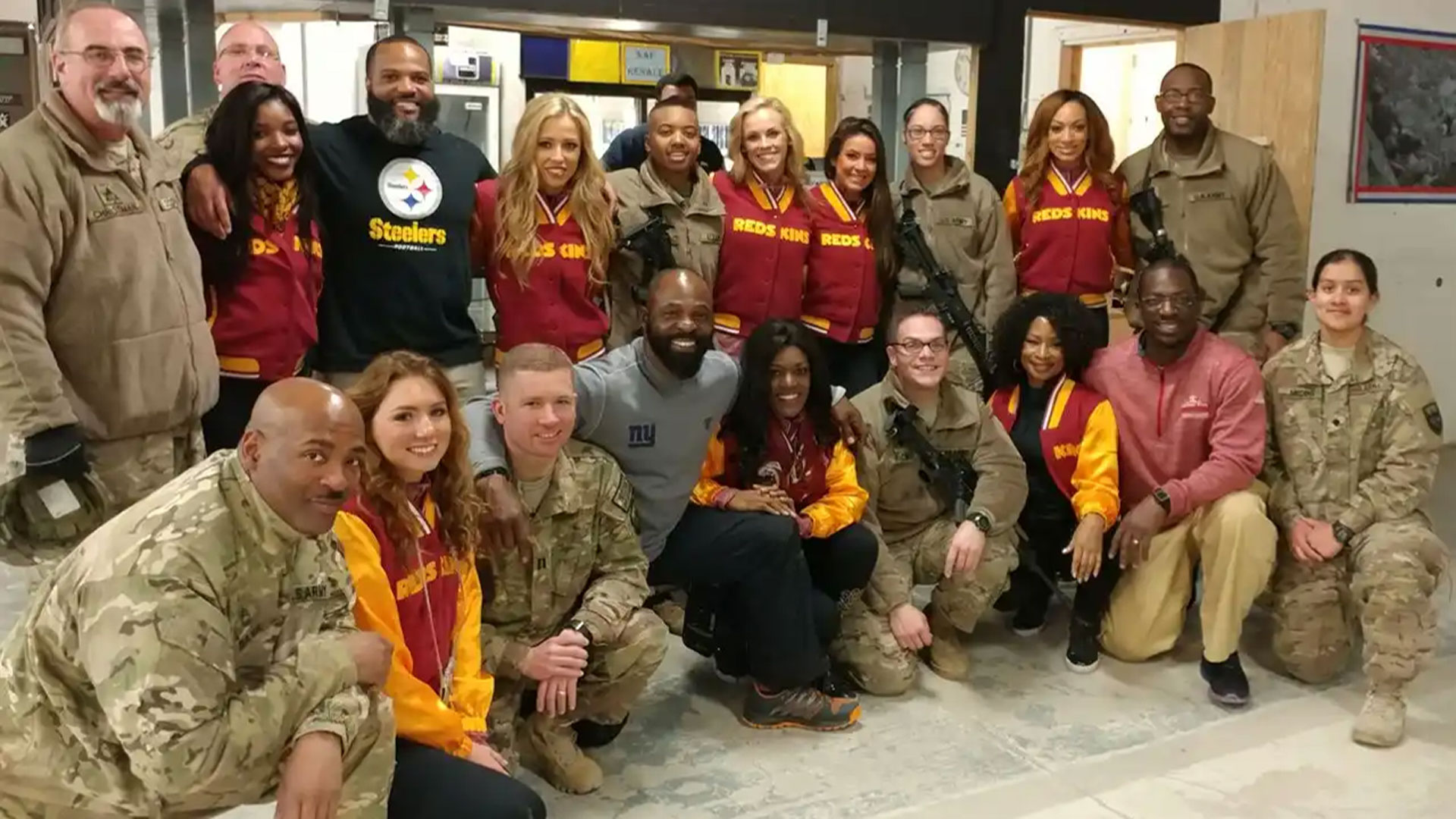
The Washington Redskins (now Commanders) cheerleaders visit
Afghanistan for the Super Bowl 9 February 2017. (Photo courtesy of
U.S. Forces Afghanistan PAO)
Back around 2010, I started entering a bad period in my life. I retired
from the active Army in October 2008. I missed being in uniform badly
and felt I was starting my mid-life crisis, something we all dread. It
became so bad in fact, that I was worried that it would end my marriage.
To help deal with the situation, I entered counseling with my parish
priest. After counseling, I still felt no relief and became desperate
for help. I began to pray constantly, asking God to show me the way.
Around that time, a friend told me about the Civilian Expeditionary
Workforce, which later became the Expeditionary Civilian Workforce. I
discovered that I could deploy as an Army civilian, helping my craving
to feel like what I did for the Army mattered. My prayers had been
answered!

Marc Bourdeau, an Army Expeditionary Civilian Workforce (AECW)
employee with the 405th Army Field Support Brigade, conducts a basic
issue item inventory on an M113 Armored Personnel Carrier at the
Coleman Army Prepositioned Stocks-2 worksite in Mannheim, Germany, 18
July 2023. Bourdeau is a quality assurance specialist with Army Field
Support Battalion-Mannheim while on AECW status, but his regular job
is located at Tobyhanna Army Depot, Pennsylvania. (Photo by Kevin
Grimm; photo courtesy of DVIDS)
I applied for deployment in 2013. Due to several personal situations, I
couldn’t deploy until April 2016. At that time, the process to deploy
was controlled by the U.S. Central Command out of MacDill Air Force
Base. Applying was extremely easy. I filled out a request for
deployment, submitted it through the first O6/GS15 in my chain for
approval, then sent it and my resume to U.S. Central Command. U.S.
Central Command officials reviewed the application and compared it to
current Civilian Expeditionary Workforce openings (at that time, most
were in the Mideast region). If your skills matched those of a vacant
position, U.S. Central Command would send you a letter of acceptance.
I received my letter of acceptance with a projected assignment as a J3
plans officer, U.S. Forces Afghanistan. I was extremely excited for
several reasons when I received that letter. First, I knew Afghanistan
was a combat area, something I found to be extremely challenging.
Second, I spent twenty- seven years on active duty with the U.S. Army.
One of my dreams that went unfulfilled was to work in a battalion or
brigade S3 shop. Seeing I would be working in J3 plans gave me a feeling
that this was an assignment meant for me. Before I would deploy though,
I’d have to go through two weeks of pre-deployment training at Camp
Atterbury, Indiana.
While I was training in Indiana, I received several emails from the
personnel office in Afghanistan. Most emails focused on in-processing
and what I needed to do when I arrived. A few days before I left Camp
Atterbury, I received an email saying the position I was being assigned
to changed. I was no longer going to be a J3 plans officer. I was
assigned as director, Plans and Operations, J1, U.S. Forces Afghanistan,
a vacant GS-14 position (I was a GS-12 at the time). I was a bit
depressed when I learned I wouldn’t go to J3 Plans. Once I arrived, I
found my new assignment an exciting experience that I would never
forget.
I had served in a combat zone previously while I was an active-duty
soldier. I deployed with the 1st Battalion, 7th Air Defense Artillery,
Fort Bliss, Texas, to Jordan in February 2003. Part of my duties within
the S2 shop included force protection. I traveled across Jordan with
staff personnel conducting force protection inspections of our units.
Operating in Jordan was a unique challenge. No PATRIOT unit had operated
in the country previously. Our firing batteries were deployed at the
king’s palace, Amman’s international airport, and three Jordanian
military bases across the country. Communications and logistics were a
constant challenge. A month or two into the war, our unit was redeployed
to Fort Bliss.
As I stated earlier, the main reason I volunteered for deployment was
because I missed my life in uniform. I found the experience to be the
most rewarding personal and professional endeavor I could imagine.
That’s why I recommend Army civilians explore the opportunity to deploy.
Experiencing a challenging, real-world deployment stimulated my
professional growth as an Army civilian. My deployment benefitted me in
ways I never imagined.
-
Financial Benefits: My earnings from Afghanistan provided
financial security my family had not experienced before. My wife and I
remodeled our home, paid off our auto loans, traveled with our
grandchildren, visited family, and much more. We experienced financial
peace and balance for the first time in a long time.
-
Spiritually Uplifting: I am Roman Catholic and have been my
whole life. While I was deployed, I oversaw volunteer services at our
church on Bagram Air Base. I coordinated the schedule for our ushers,
readers, and those who distributed the body and blood of Christ. It
was the first time in my life I had dedicated so much of myself to the
church. In return, I felt a closeness to God I’d never experienced.
I’m fortunate that I still feel extremely close to God today.
-
Mental Well-Being: As I got closer to God, I found myself
worrying less and less. I find it hard to explain how my anxiety
levels dropped when I deployed to a combat zone, but they did. A
coworker looked at me during leave from Afghanistan and told me I
looked younger than I did before I left! Even now, almost seven years
since I returned from Afghanistan, I feel my mental well-being has
never been better.
-
Physical Health: My deployment to Afghanistan made me realize
I had to take better care of myself physically. It also helped me
accept the fact that I can’t do some of the things I did in the past.
About a month after I arrived, I started running for the first time in
eight years. After two to three months, I realized I couldn’t continue
running, so I started going to the gym. After another two to three
months, I came to the decision the gym wasn’t for me. I wanted to
start something I could continue after I returned home. I started a
routine of walking four to five days a week, which I’ve been able to
continue. I feel better physically than I have since I was a soldier.
-
Proper Diet: For years, the four food groups to me were
candy, chips, sodas, and red meat. I realized I had to change my
eating habits if I wanted to live healthier and happier. I began
consuming more seafood and less beef, more vegetables and fewer
desserts, more water and fewer sodas. I ate meat twice a week. I still
made time for an occasional Subway sandwich or pizza from Pizza Hut.
By changing my eating habits, I’ve improved my quality of life.
I’ve been accepted to deploy twice since I’ve returned. Once, my
deployment was cancelled by the COVID pandemic. My next deployment was
canceled by the U.S. withdrawal from Afghanistan. If my health and
well-being remain good, I will volunteer for another deployment.
I strongly recommend deploying under the Expeditionary Civilian
Workforce for all Army civilians. Although you may be working in field
type conditions, eating in a chow hall, and living in a space the size
of a closet, you will find it one of the most enjoyable professional
experiences you can have.
Author
Garry Christman served in the U.S. Army from
September 1981 through September 2008, culminating his career as a
Master Sergeant, 14Z (Air Defense Senior Sergeant). Upon his
retirement, Christman began his career as an Army civilian
professional. He currently serves as the operations officer, Army
Management Staff College, Army University, Fort Leavenworth, KS.