Ritchie Boy Secrets
How a Force of Immigrants and Refugees Helped Win World War II
Review by Jack M Crossman
Article published on: June 1, 2024 in the Army History
Summer 2024 issue
Read Time:
< 4 mins
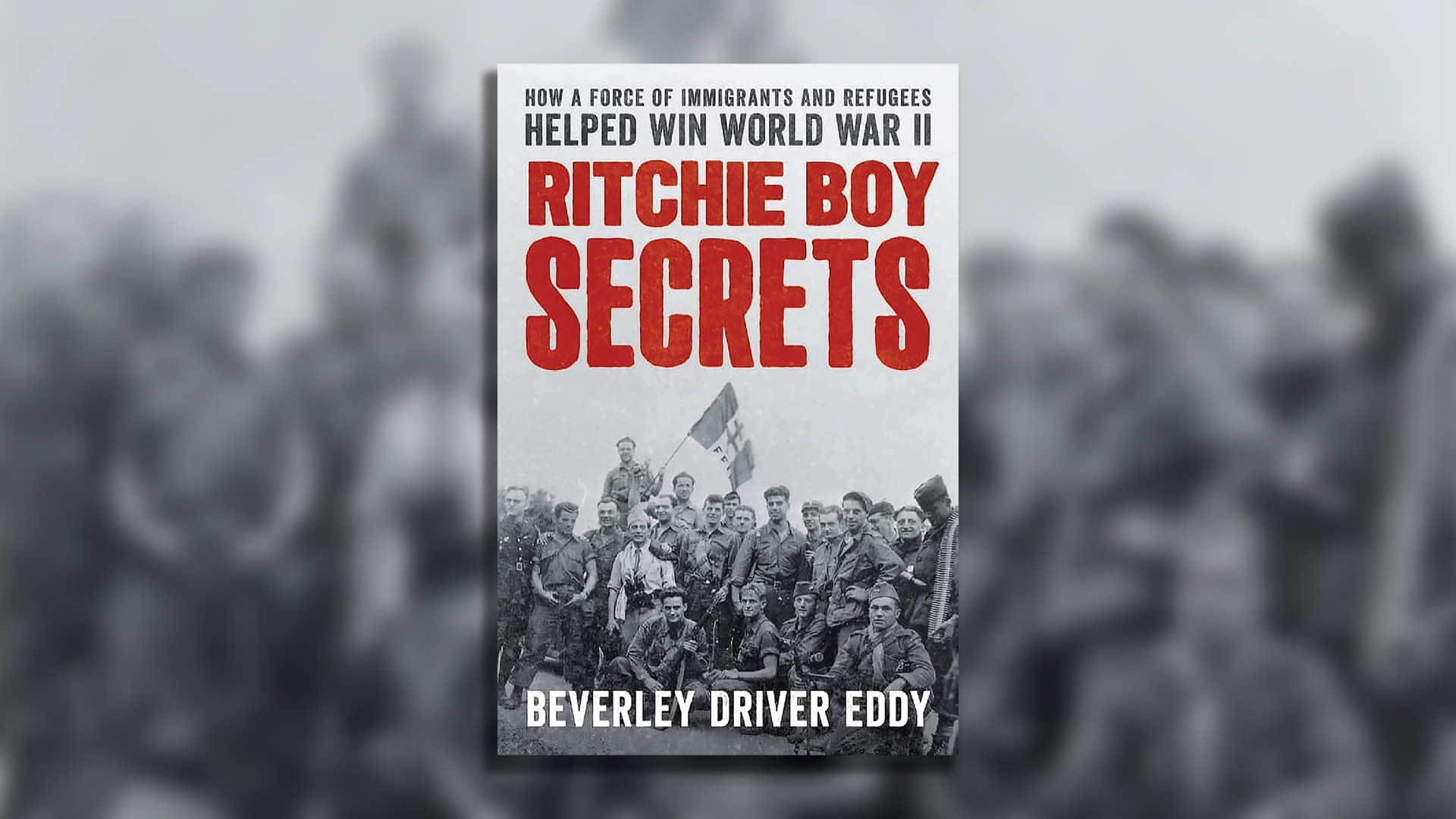
By Beverley Driver Eddy
Stackpole Books, 2021
Pp. viii, 428.
$28.95
Ritchie Boy Secrets: How a Force of Immigrants and Refugees Helped Win
World War II, by Beverley Driver Eddy, should be considered a continuation and
expansion of the ground-breaking, Academy Award–winning documentary The
Ritchie Boys (2004) directed by Christian Bauer and Bruce Henderson’s 2018
book Sons and Soldiers (William Morrow, 2018). All try to explain or relate
the wonderful story of the European nationals who, in World War II,
volunteered to use their intelligence, language, and culture as specialists
trained at the secret Military Intelligence Training Center at Camp Ritchie,
Maryland. From 1942 to the end of the war, the soldiers proved immeasurably
important to the war effort. Their talents led to the successful Allied
victory and to peace.
Eddy has compiled an exhaustive record of not only of Ritchie Boys’
training, but also of their employment in different theaters of war and
their engagement in the war crimes trials in Germany and Japan. Such
specialists! What a treasure of talent to aid us in our endeavors against
the Axis, and immense kudos to the folks who thought to bring their unique
assets to bear.
The soldiers, with their language and cultural experiences, leveraged both
to help wage psychological warfare against our enemies, interrogate
prisoners of war, and compile vital references about the Axis military to
aid the fighting forces in their fight to victory. Without them, who knows
how long or how different the war would have been?
Interestingly, when I was in the Army, after intelligence analyst training
at Fort Huachuca, Arizona, I was assigned to the U.S. Army Intelligence and
Threat Analysis Center–General Intelligence Production Division at Fort
Bragg, North Carolina (now Fort Liberty), part of the Intelligence and
Security Command (INSCOM). When I reported to the fort, no one knew what our
unit was or where it was located. I accidentally encountered someone from my
unit in a large parking lot during lunchtime and found out where it was. It
was diagonally across the parking lot from where we were speaking.
We conducted unclassified and classified research on countries’ commanders
to learn more about the world in the Middle East, Caribbean, and African
areas. I researched, wrote, copied, and typed reports and requests for
information on some of the same topics as the Ritchie Boys did (order of
battle, infrastructure, attitudes, personnel analysis, and more), just not
on the same geographic areas or enemies. So, from that perspective, I am
aware and familiar with the type of work these fine soldiers accomplished
through their work in World War II.
Eddy traces the founding of Camp Ritchie up through World War II and beyond,
illustrating it with a great amount of period photographs and diagrams. The
narrative moves from the first class to be trained at Camp Ritchie, to what
kind of troops trained there, through the various sections, interrogations
of prisoners of war, order of battle (the military intelligence research
section), the mobile radio broadcasting company, to the counterintelligence
corps of the Army, and the Office of Strategic Services.
The author does not ignore the Pacific Theater, outlining the unique talents
and experiences of the Nisei soldiers, and including the Ritchie Boys’
contributions to war crimes trials there and beyond. Their contribution to
dealing with the end of the war and the war crimes trials is detailed and
balanced.
The twenty appendices and voluminous bibliography are especially helpful and
noteworthy in a book whose subject occurred over fifty years ago. Eddy’s
exhaustive research is present on every page. Being the third book dedicated
to these overlooked heroes, it serves to bridge numerous gaps and
essentially acts as a textbook, aiding researchers and readers in
understanding these discreet professionals.
Author
Jack M. Crossman is a retired Army master sergeant with
more than thirty years of active and reserve service, including senior
assignments in intelligence, operations, and personnel. He served in the
continental United States, Germany, and Bosnia, and also served during
Operation IraqI Freedom with a Military Transition Team reporting to the
1st Infantry Division. After retirement, he taught at the Joint
Intelligence Combat Training Center at Fort Huachuca, Arizona, for three
years.