In Strange Company
In Strange Company: an American Soldier with Multinational Forces in the
Middle East and Iraq
Review by John P Ringquist
Article published on: June 1, 2024 in the Army History
Summer 2024 issue
Read Time:
< 6 mins
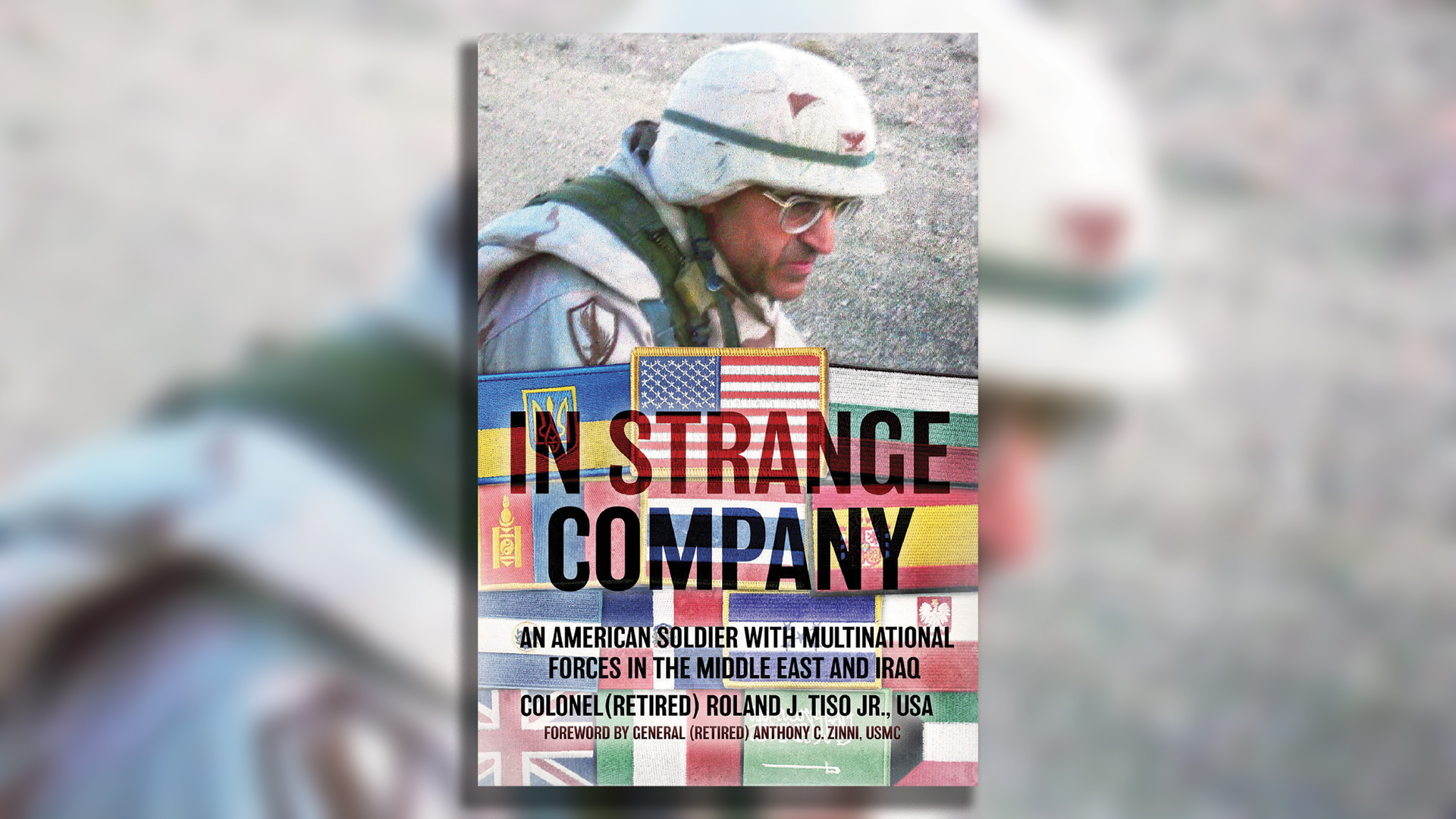
By roland J. tiso Jr.
Casemate Publishers, 2023
Pp. xi, 401.
$37.95
Winston Churchill is credited with saying, “There is only one thing worse
than fighting with allies, and that is fighting without them.”1
The U.S. Army has frequently worked with allies during United Nations (UN)
operations such as the Korean War and the interventions in Haiti, and in
NATO (North Atlantic Treaty Organization) operations like the peacekeeping
missions in Bosnia and Kosovo. An airborne infantryman with experience in
Korea and Panama, Col. Roland Tiso Jr. performed multiple successive UN
observer duties in Kuwait with the UN Iraq-Kuwait Observer Mission, then as
chief of staff of the Multinational Force and Observers in the United States
Task Force Sinai. Eventually, Colonel Tiso became the commander of Task
Force Sinai, part of the Multinational Force and Observers peacekeeping
organization in Egypt. Tiso’s final assignment with the international forces
as chief of staff and deputy chief of staff of operations (C–3) for the
Coalition Military Assistance Training Team assigned to build the new Iraqi
army, serving as the hallmark for his multinational service.
In his book In Strange Company, Colonel Tiso sheds light on the
underreported role that United States military personnel and their foreign
partners performed in peacekeeping and stabilization operations in the
Middle East, notably in the Sinai Peninsula, Kuwait, and Iraq. Uncovering
the complex relationship between the U.S. military and its allies with a
deft and precise hand, Tiso leaves few stones unturned in citing the
sometimes-ugly sources of friction and competition in these relationships.
The author recognizes his succession of assignments with allies and is quick
to ascribe his success in these environments as stemming from his youth in
racially and culturally diverse settings. It gave him an appreciation for
distinct cultures and languages and for people of different races.
Throughout his book, he reiterates how these early experiences translated
into the skills required for him to be successful in multinational
operations.
Colonel Tiso cites the keys to his success as arising from an ability to
adapt to new surroundings quickly and the mental awareness to appreciate the
nuances of new situations. The numerous stories and anecdotes that form the
substance in much of In Strange Company’s chapters add a personal
dimension to his descriptions of the plans and processes that went into
multinational operations—especially the 2003 invasion and postwar
stabilization operations in Iraq. The author’s recollections within In
Strange Company are equally professional memoir and personal revelations of
the pressures, political considerations, and internal staff processes that
shaped successful alliances.
Colonel Tiso’s leadership lessons start early in his story. His statement on
page fifteen that “change is not something with which multinational
organizations are comfortable” still rings true today— through the years of
multinational efforts to combat terrorism, to the control of violent
extremism across the Sahel, and even to the reaction to Russia’s invasion of
Ukraine. It quickly becomes apparent in In Strange Company that
Tiso is a systems person with a meticulous leadership philosophy and focus
on real-world mission readiness. First, in the Sinai narrative and then in
the Iraq stories, Tiso demonstrates through anecdotes how care for soldiers
and their welfare transcends nationality, race, culture, and language.
Readers cannot help but be impressed with how the author encourages actively
interacting with foreign troop contingents, a theme that he repeats
throughout In Strange Company.
The author does valuable service with his explanation of how world politics
drove the need for closer cooperation with allies and alliances worldwide in
the post–Cold War period as the United States planned to reduce its military
through a force drawdown. Reducing U.S. forces also affected the forces
available to confront regional threats in the Middle East, Korea, and
elsewhere. U.S. war plans for Iraq therefore focused on how to destroy
potential threats, despite advice to retain sufficient types and numbers of
U.S. forces to reconstruct and secure postwar Iraq. The lack of available
U.S. forces and two subsequent major political decisions made postwar
security difficult to attain: the choice to disband the Iraqi Regular Army
and the decision to bar former Ba'ath Party members from serving in the new
Iraqi government. Ultimately, these decisions, in tandem with the ongoing
U.S. campaign in Afghanistan, created the need to reconstitute the Iraqi
army and work with international allies to secure Iraq in the aftermath of
the invasion.
Colonel Tiso has captured masterfully the triumph and frustration of working
in a paradigm parallel to the U.S. military but with foreign forces. When
his story expands to cover the 2003 invasion of Iraq, the behind-the-scenes
explanation of the challenges that he faced while rebuilding the New Iraqi
Army is a sobering reminder of the effort required for any disarmament,
demobilization, and reintegration effort. These detailed and engaging
chapters offer gripping accounts of the unanticipated consequences of
disbanding the Iraqi government and army. The author’s efforts to build the
New Iraqi Army and his service with the Polish-led Multinational Division
(MND) offer thrilling accounts of Poland’s performance as the lead NATO ally
amid a twenty-three-member international contingent. The unfiltered
assessment of the MND’s command and organizational mix of languages,
cultures, and ways of conducting military operations would have challenged
any command. On top of it, the author reminds us of the national
contingents’ need to inform their own Ministers of Defense before following
MND orders. The author navigated those demands and imparts some lasting
words of wisdom for future advisers and staff members in the same position,
one of which resounds through the last part of In Strange Company:
the need to rely less on aggressive or kinetic behavior and more on a
passive approach in potentially tense situations involving civilians. His
service with the MND and its polyglot members is a brisk reminder that
allies do not have an obligation to think the same way about how to resolve
problems and the need for all leaders to have a common operating picture
informed by consensus and not unilateral action. Chapter 24’s recounting of
operations in the aftermath of the death of two American personnel is a
powerful argument for understanding planning, commander’s intent, and
civil-military considerations before any military response, especially in an
urban insurgency.
Throughout In Strange Company, there is a tone of humble
appreciation of the author’s opportunity to serve with international
partners. Colonel Tiso has written a fascinating memoir with all the
elements of a military travelogue while embedding plenty of professional
guidance for readers. His book serves as an excellent primer for any U.S.
military personnel considering being an adviser, staff in a multinational
unit, or a foreign area officer. The nature of any duty as an observer or
multinational staff member demands a baseline of personal discipline,
acuity, and diligence. Tiso amplifies this obligation with examples from his
service while remembering to honor the troops with whom he served.
Author
Lt. Col. John P. Ringquist, PhD is an instructor at the
Command and General Staff School in Fort Leavenworth, Kansas. His research
focuses on contemporary military affairs, technology, and African security
affairs. He is the author of articles on counterinsurgency, the
intersection of climate, technology, and security, and the African
American soldiers of the Kansas-raised 79th United States Colored Infantry
Regiment in the Civil War West. His duty assignments frequently have
involved working with NATO allies, foreign military partners, and the
delicate civil-military relations that Colonel Tiso referenced so well.