Who Is Your Master Gunner and What Do They Do For You?
By Retired CSM Greg Brobst
Article published on: April 1, 2025 in the Armor Spring
2025 Edition
Read Time:
< 7 mins
Editor’s Note: We are excited to reintroduce our
standing column, “From the Boresight Line.” This column will provide a
platform for Armor Master Gunners to discuss issues, concerns, and
solutions specific to the Armor community. I look forward to sharing
insights from Master Gunners across both the operational and instutional
force. Retired CSM Greg Brobst’s following article provides a great
starting point for what I expect will be a thoughtful and informative
dialogue.
Commanders, if there is one person standing in your formation that you
explicitly trust assisting you in decisions concerning lethality,
maintenance, and training, who is it?
If that Soldier is not wearing a Master Gunner Badge on their chest, why
not? If your master gunner has not approached you to describe in detail what
they can do for you, maybe it’s time to schedule an office call with them.
Here is what you should know, “Your master gunner is your advisor for all
things gunnery and the combat employment of your fleet.” Your master gunner
serves as your advisor for crew management, gunnery training and
certification records. Your master gunner advises you on the combat
employment and capabilities of all organic weapon systems, ammunition,
identification of enemy vehicles, and their combat capabilities and
vulnerabilities.
Your master gunner serves as your primary trainer for direct fire
employment, operation of organic weapon systems (both platform and
dismounted), conduct of fire, degraded operations, and a myriad of other
tasks associated with the employment and operation of the platforms and
weapon systems in your formation.
Your master gunner is trained to advise you on advanced maintenance and
troubleshooting of the fire control system and organic weapons and is your
subject matter expert for bore sighting, collimation of the Muzzle Bore
Device, plumb and sync procedures, Live Fire Screening Accuracy Test and
zero. Most notably, due to the rigors of the course, the master gunner
graduates with expert level knowledge of training management.
Understandably, your master gunner may also be serving as a vehicle
commander or even a platoon sergeant. However, I will ask you again, why not
your Mike Golf?
In May of 1973, GEN Donald Starry was selected to command Fort Knox and the
U.S. Army Armor School. His initial counseling session with the Army Chief
of Staff, GEN Creighton W. Abrams Jr., was direct and to the point. “Don’t
screw up the tank program. Just start with doctrine, describe the equipment
requirements, reshape the organization. And get the Army off its ass!”1
In 1974, the Army began its arduous recovery process from a nearly 11-year
conflict in Vietnam. For the duration of the conflict, much of the training
and combat preparations of the nearly 800,000 Soldiers focused on
jungle/guerilla warfare and counter-insurgency operations. With the “Cold
War” pending, the Army quickly needed to refocus its training and combat
preparations toward the communist threat in eastern Europe.
The concept of the master gunner dates to 1974 when a staff of senior
officers proposed the master gunner concept to commanders in the field. The
master gunner would provide the needed expertise to help tank crews with the
increased complexity of the modern tank fire control systems and the lack of
advanced gunnery knowledge. Approved in April 1974 by the U.S. Army Chief of
Staff, the U.S. Army (for a one-time execution) graduates 12 NCOs from the
first Master Gunner Course. When the new master gunners returned to their
units, they made immediate positive impacts.2
The Army of today looks very similar to that of 1974. We recently closed a
nearly 20-year counter-insurgency war which was fought on two fronts, mostly
without heavy armor. Additionally, we are once again facing a peer threat on
the plains of eastern Europe. There was a 20-year “train-up” for Operation
Desert Storm, but that 20-year window may not be available in preparation
for the next conflict. Therefore, we need to ensure we are ready now and
leverage every available asset to do it.
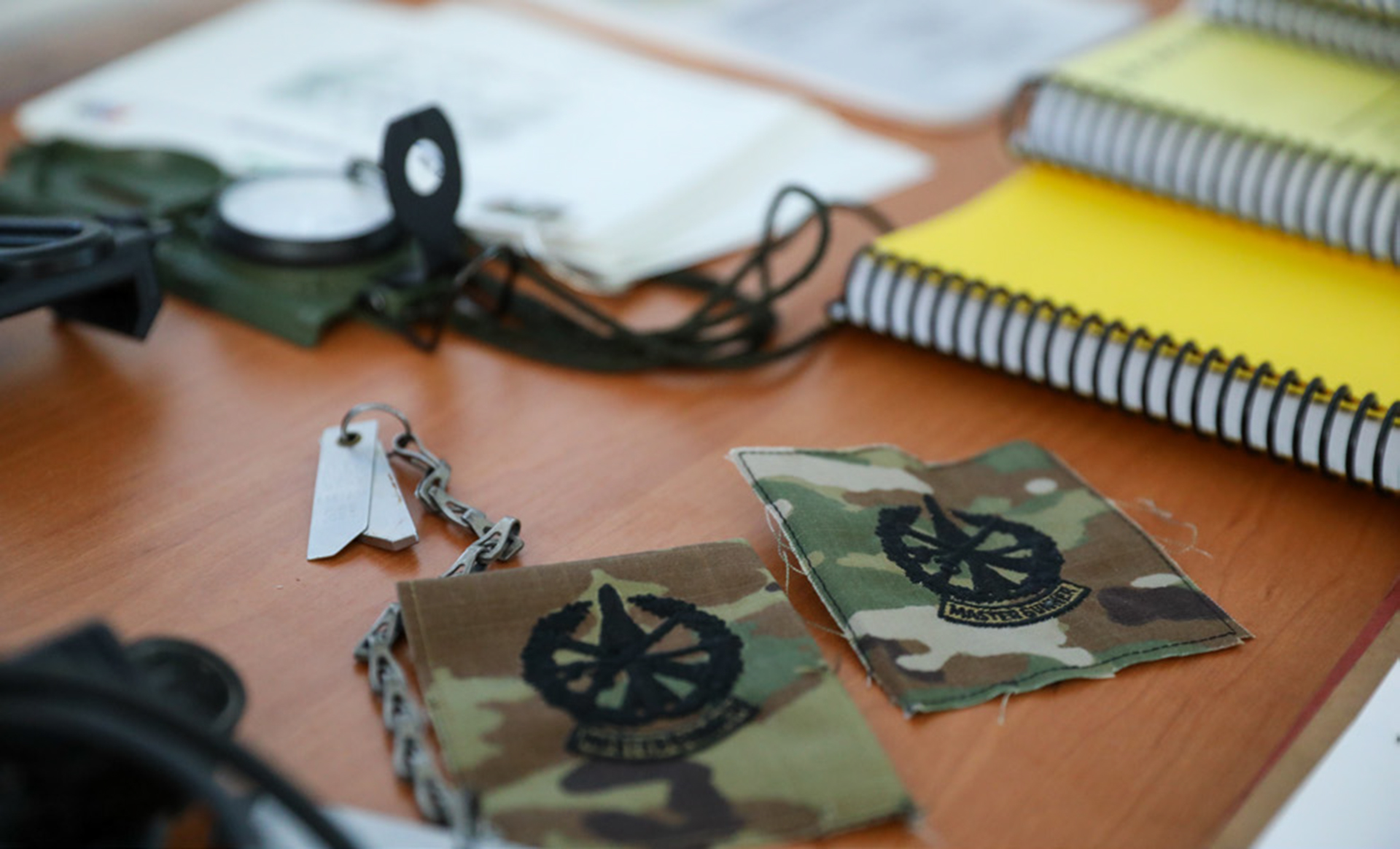
Figure 1. Master Gunner Badge, M2 .50 caliber head-space and timing gauge,
lenstatic compass, and notebooks
(U.S. Army National Guard photo by SGT Tara Fajardo Artea-ga)
Recently, we have changed our doc-trine from unified land operations to
multidomain operations, a significant change in the approach to combined
arms operations. Utilizing lessons from the second Nagorno-Karabakh war and
the Russo-Ukraine war, like how we utilized the analysis of the six-day war
and Yom Kippur war in the early ‘70s, our current doctrine has changed to
embrace emerging tech-nologies and capitalize on their ability to enhance
decision making while pro-viding overmatch against our adver-saries.
There is little room to argue that our next conflict will look nothing like
what we have experienced during the last 20 years in Iraq and Afghanistan.
There will be no patrol bases or com-bat outposts, our service and support
activities will be significantly further away from the front-line combat
orga-nizations, and any loss of combat pow-er will significantly affect the
security of the organizations area of opera-tions.
Under these conditions there can be no substitute for expert vehicle crew
members. All crew members must strive to keep their vehicle in the fight
because their vehicle is their home, it is their sanctuary, and their means
of survival. Crew members must under-stand how the vehicle was designed to
operate, what its capabilities are, what its limitations are, and most
im-portantly, how to overcome them.
Crew members, specifically gunners and vehicle commanders, must have
confidence in the weapon systems of their vehicle and understand how to
employ them. This understanding not only includes the employment of it
un-der ideal conditions when the vehicle is operating with no faults but
also, during conditions that are less than ideal or degraded. Fire control
system faults can and will happen, the ability of a crew to recognize them
and apply immediate action may be the differ-ence between life and death. In
direct fire combat, the opportunity to re-move oneself from an engagement
and retrograde to the field trains or brigade support area may not be
avail-able. When fighting a numerically su-perior foe, every combat vehicle
counts.
As experts, these crew members must be lethal. In simple terms, lethality
for an armored crewmember, as demon-strated in the Yom Kippur War, is the
tank that fired first with accuracy was the tank that usually won the
engage-ment. One shot, one kill; several years ago, this was the battle cry
for many tank companies as they embarked on their path to crew level
gunnery. Al-though it is still said, it is increasingly hard to believe. Our
vehicle crews, although qualified, have demonstrat-ed significant shortfalls
during qualifi-cation gunnery.
In September 2019, III Corps conduct-ed and published a lethality study3
that highlighted the decline of lethal-ity within the heavy force. At the
time of publication, the combat training centers observed a 30 percent
de-crease in targets hits during the past 20 years and crew qualification
rates below 60 percent (III Armored Corps, 2019). In March 2023, the
National Training Center (NTC) live fire team non-commissioned officer (NCO)
in charge said, “organizations simply do not train as well as they believe
they do prior to arriving to NTC.” Dragon 40 went on to identify most
organizations have continually produced low lethal-ity averages in both
offensive and de-fensive engagements.
For mechanized forces, lethality be-gins at the crew level; a graduate of
Master Gunner School is well equipped to assist Commanders at all echelons
with developing training plans that focus on refining or in many cases,
rebuilding lethality. For all mas-ter gunner courses (Abrams, Bradley,
Stryker, and Common Core), the unit training plan is the tie that binds.
Ev-ery graduate is evaluated on their abil-ity to process the information
provid-ed during the course and back brief a panel of instructors on how
they plan to implement the concepts trained during the course once they
return to their unit. During these briefings, nothing relevant to the course
is off limits. Students are required to not only know the material but know
how to implement it.
Training Circular (TC) 3-20.31,
Training and Qualification Crew4
defines the duties of the company master gunner as follows.
-
Develop and implement live fire gunner y standard operating procedures.
-
Track weapons system maintenance tasks and advise the commander on
maintenance status.
- Maintain weapon system firing data.
- Assist in the integration of newly assigned Soldiers.
-
Establish and conduct initial skills training for new vehicle commanders
and gunners.
- Assist in training new crew members.
- Train and certify vehicle crew evaluators.
-
Recommend placement of new arrivals to the commander and command sergeant
major or first sergeant.
- Recommend crew assignments for all platforms within the unit.
-
Assist all elements in the unit concerning direct fire training and
employment.
-
Forecast and manage ammunition through the Training Ammunition Management
Information System. Manages ammunition accounts for all subordinate units.
-
Resource and request training areas and ranges through the Range Facility
Management Support System.
-
Manage direct fire training documents, gunnery skills test records,
simulations training records, and crew rosters.
-
Establish and oversee gunnery skills test training and evaluating the
results.
-
Coordinate the pickup, training, use, installation, troubleshooting, and
turn-in of all Training Aids, Devices, and Simulations Systems (TADSS)
required for conducting effective training.
-
Certify and recertify other instructor/ operators, if senior instructor/
operator qualifies, to conduct crew direct fire training simulations
training.
-
Develop, validate, and manage games for training scenarios supporting the
unit training program and the gaming Gate to Live Fire exercises.
- Plan and manage crew direct fire training simulations training.
-
Train crews on TADSS device-based direct fire training systems
(installation, bore sighting, and troubleshooting procedures, point of
aim, and maintenance).
- Oversee all direct fire training and execution.
- Maintain live fire training standards on all ranges.
-
Advise the commander of the tactical capabilities and limitations of all
platform weapon systems against threat systems (while in a tactical
environment and in coordination with the intelligence staff officer
[S-2]).
For the duties of the battalion and brigade level master gunner, refer to TC
3-20.31.
Arguably, there is no one better equipped to coach, train, and mentor you on
lethality, maintenance, and training than your master gunner. The unit
master gunner has proven them-self to a panel of subject matter experts, why
are you not allowing your master gunner to prove themself to you? Sit down
with your “MG” and have a conversation about what they can do for you and
your organization.
NCO - non-commissioned officer
NTC - National Training Center
TADSS - Training Aids, Devices, and Simulations Systems
Endnotes
1. Sorley, Lewis.
“Prologue,” Press on! Selected Works of General Donn A. Starry, vol. 1,
Combat Studies Institute Press, U.S. Army Combined Arms Center, Fort
Leavenworth, KS, 2009, page IX.
2. Partridge, Ira L.,
“1975-2000: 25 Years of Master Gunner Training,” ARMOR magazine, 2000,
pages 19–21.
3. III Armored Corps.
“Lethality Report on State of the Armored Brigade Combat Team (ABCT)
Direct Fire Weapon Systems (M1 Abrams and M2 Bradley Family of Vehicles),”
Sept. 20, 2019, page 3.
4. Headquarters,
Department of the Army, Training Circular (TC) 3-20.31 Training and
Qualification, Crew, Chapter 2, Crew Training Program (2015).
Author
Retired CSM Gregory A. Brobst is the Future Large Caliber Ammunition
Liai-sion for Product Manager, Maneuver Ammunition Systems (PM-MAS). His
previous assignments include the command sergeant major of 3rd Squadron,
16th Cavalry Regiment, Fort Benning, GA; G-3/5/7 sergeant major, Combined
Arms Center, Fort Leavenworth, KS; G-3 sergeant major, 1st Infantry
Division, Fort Riley, KS; operations sergeant major, 5th Squadron, 4th
Cavalry Regiment, Fort Riley; Abrams Master Gunner Branch Chief, 1st
Battalion, 29th Infantry Regiment, Fort Benning, GA; and 1st Sergeant,
Headquarters and Headquarters Troop and Company C, 1st Battalion, 68th
Armor Regiment, Fort Carson, CO. CSM Brobst’s military schools include all
levels of NCO Professional Military Education, the Abrams Master Gunner
Course, Battle Staff NCO Course, Master Resiliency Course, and Combatives
Level 1. He has a bachelor’s of science degree in business from Mount
Saint Mary College and a master’s of science degree in management from
Troy University. CSM Brobst’s awards include the Legion of Merit (2nd Oak
Leaf Cluster), Bronze Star Medal (2nd Oak Leaf Cluster), Purple Heart,
Meritorious Service Medal (3rd Oak Leaf Cluster) and the Order of St.
George (Bronze).