Focus on Training for Army National Guard and Reserve Units
Difficulties with Pre-Deployment Medical Training
By SGM Sandra J. Johnson
Article published on: July 1, 2025, in the July 2025 Issue of The Pulse of Army Medicine.
Read Time: < 15 mins

Source: Photo provided by the Training Support Center / Dan Amburg.
ABSTRACT:
Medics and medical providers deployed under the U.S. Central Command (CENTCOM) area of responsibility (AOR) often face austere environments with minimal medical resources, limited life support, and restricted MEDEVAC and CASEVAC capabilities. Many National Guard and Reserve units deploy without updated training in Brigade Combat Trauma Team Training (BCT3) and Tactical Combat Medical Care (TCMC), increasing risks in high-threat theaters. The unfamiliarity of officers and enlisted soldiers with managing casualties in such conditions highlights the need for advanced pre-deployment training. BCT3 and TCMC provide essential trauma skills, including walking blood banks, live tissue labs, and prolonged casualty care. However, barriers such as lack of funding, limited class seats, and unclear pre-deployment requirements hinder accessibility. Making these courses mandatory and fully funded will enhance medical readiness, optimize combat medical capabilities, and reduce risks to deployed forces, ensuring Army medicine remains a decisive combat multiplier in austere operational environments.
A generation of officers and enlisted soldiers are unfamiliar with the medical realities of managing patients in high threat austere locations with limited medical and evacuation (MEDEVAC/CASEVAC) capability. Currently, BCT3 and TCMC are the only pre-deployment medical training classes available in the Army to prepare Reserve and National guard medical personnel with state-of-the-art trauma skills such as walking blood banks, live tissue labs, and prolonged casualty care. Historical barriers include the lack of mobilization funds, a shortage of available class seats, and BCT3 and TCMC not being clearly listed as a mandatory pre-deployment training prerequisite. Army medicine is a critical combat multiplier and must continue to modernize its efforts to meet the demands of the operational force. Limiting lifesaving pre-deployment medical training to support point-of-injury care places unnecessary risk of death of United States military members assigned to austere environments. Establishing BCT3 and TCMC as mandatory and fully funded pre-deployment course requirements optimizes the Army’s medical readiness and warfighting performance to meet future physical and cognitive demands of operating in austere degraded environments.
Problem One: Current 68W Medical Training for the Army Reserves and National Guard is not Sufficient for Deployments
Once the war in Ukraine began, the Army realized that current medical training for combat medics was no longer sufficient. According to COL Manuel Menendez, the Command Surgeon of the U.S. Special Forces Command, our combat medics are currently trained to provide excellent care in the first hour after injury, but they lack the skills, knowledge, and tools required to hold, monitor, and treat casualties afterward (Menendez, 2022). Lack of reliable air superiority in the future will restrict evacuation and will preclude the ability to provide advanced surgical support within the “golden hour” for many, if not most of those wounded (Remondelli et al., 2023). Injured service members will require prolonged far-forward care followed by delayed or lengthy evacuation to the next point of care (Remondelli et al., 2023). Medics may need to focus on the care of complex casualties for up to 72 hours with little support and resources, as arial MEDEVAC won’t be available for the forces on the front lines (Remondelli et al., 2023). This is already a problem in CENTCOM.
Within CENTCOM, several new austere bases have been established with no Medical Evacuation (MEDEVAC) by flight or ground capability, or only ground Casualty Evacuation (CASEVAC) options. Due to competing requirements, many of these bases only have one medic on post and no medical provider. A medic may have to care for a patient for several hours until they arrive at a local national hospital.
To date, no updated training is yet available from the active-duty Army based on the lessons learned in Ukraine. In fact, lessons learned from that combat area are not taught at the Medical Simulation Training Center facilities or by units at their home station drills or battle assemblies. Only in BCT3 or TCMC are the new medical techniques of walking blood banks, prolonged casualty care, and lessons learned from live tissue labs are being taught with these types of austere environments in mind. The live tissue lab is not taught in any other class except for BCT3 and TCMC. The danger of not sending medics and providers to these classes is assumed without understanding the full risk accepted.
Due to the evolving nature of the operational environment, commanders are required to send soldiers to isolated locations with no military hospitals and little to no civilian health care infrastructure for additional coverage.
Recommendation: Every 68W who deploys overseas must attend BCT3 or TCMC to be able to provide the best medical care possible for old and new emerging medical situations due to the change in warfare style.
Problem Two: Soldiers Are Not Sent to Medical Pre-deployment Training Due to Ambiguous Mobilization Requirements and a Shortage of Mobilization Funds
Previous mobilization preparation guidance stated that BCT3 and TCMC training is recommended but not mandatory. Because of this, only 50% of the medics and providers of deployed to the CENTCOM AOR had attended the training when I arrived in Kuwait in March 2024.
United States Army Forces Command (FORSCOM) produced Annex B: Command Guidance for FY24 pre-deployment training labeled “Recommended Mission Specific Training within Deploying Formations.” It states that “this annex provides mission dependent training information as part of mission analysis; unit commanders must review this annex for training recommendations that are applicable to it by unit type/mission.” In the healthcare training section, it states that level 10-40 medics assigned to a brigade combat team or flight medics assigned to a combined arms battalion should attend BCT3. BCT3 and TCMC were not labeled as being mandatory for deployment.
In May 2024, U.S. Army Forces Command published their FY25 pre-deployment training guidance, “Annex B: Recommended Mission-Specific Training Within Deploying Formations.” Annex B states that units must complete pre-deployment trauma training for no less than 90% of all medical personnel within 180 days of deployment. The guidance also declares that BCT3 training is required for all 68W10-40 medics in echelons below the division level. However, TCMC is available for all 68W4 medics and 68W30 Treatment NCOs when accompanied by a provider, and/or medical providers on their own. However, confusion between the annex being labeled “recommended” in the annex title and “required” in the body of the annex, has led to medics not having the proper training.
I have been informed that National Guard and Reserve units attend the Mission Command Joint Assessment (MCJA) one year prior to their deployments, where 1st Army helps them develop, plan, and execute training plans for success in support of worldwide operations. Army Medical Department mobilization planners brief the units with medical personnel on the requirements for pre-deployment training during this conference. The planners give personnel specific details on the classes and contact information for class enrollment. Several high-ranking medical personnel from the United States Army, Army Reserves, and National Guard Bureau have told me that everyone is aware that BCT3 and TCMC are now mandatory classes for deployment since the FY25 pre-deployment training guidance was published. If that is the case, then why are medical providers and medics still deploying to the CENTCOM theater without taking these classes?
In the fall of 2024, several months after publication of FY25 FORSCOM pre-deployment guidance, a Physician’s Assistant from the Nevada Army National Guard asked her state about attending TCMC before her deployment. She stated that the deployment officer had reached out to their chain of command on deployment requirements, and since she was not going into a “trauma” location, the class was not required. None of the medics were sent to BCT3 or TCMC as the units were purportedly told that the classes were not mandatory, and that there were mobilization funding issues. The unit arrived in theater in November 2024.
In November 2024, the 278th Armored Cavalry Regiment, Tennessee Army National Guard, arrived in Kuwait to take over as Task Force Reaper. Task Force Reaper, stationed out of Camp Buehring, Kuwait, is the designated Crisis Response Task Force for the region. Although they are stationed in Kuwait, their literal job is to respond to a crisis in the area of operations, much like Task Force Bastard, 1-194 Armor Regiment, Minnesota Army National Guard, did during the withdrawal from Afghanistan in 2021. None of the 278th Armored Cavalry Regiments thirty-two medics were sent to BCT3 or TCMC. The unit was told that classes were only recommended, not mandatory.
In April 2025, the Ohio Army National Guard arrived in Kuwait with thirteen medics as part of the 16th Engineering Brigade. None of these medics were sent to BCT3 or TCMC due to mobilization funding issues. If BCT3 and TCMC are now mandatory, then mobilization funds should be covering the cost of the classes.
1st Army states that they brief the updated BCT3 and TCMC requirements to all deploying units at the MCJA; however, they advise that commanders are ultimately responsible for their unit’s training resourcing. Army Medical Department mobilization planners state that they are discussing the planning of these courses and providing the units with all the contacts they need to schedule the courses as well as incorporating those courses into Mission Analysis Readiness Resource Synchronization (MARRS-N). The main checks and balances for this occur when the desk officers for each combatant command check in on the units periodically during 30-60-90 check-ins; however, but no other validation occurs until the unit arrives at the mobilization site.
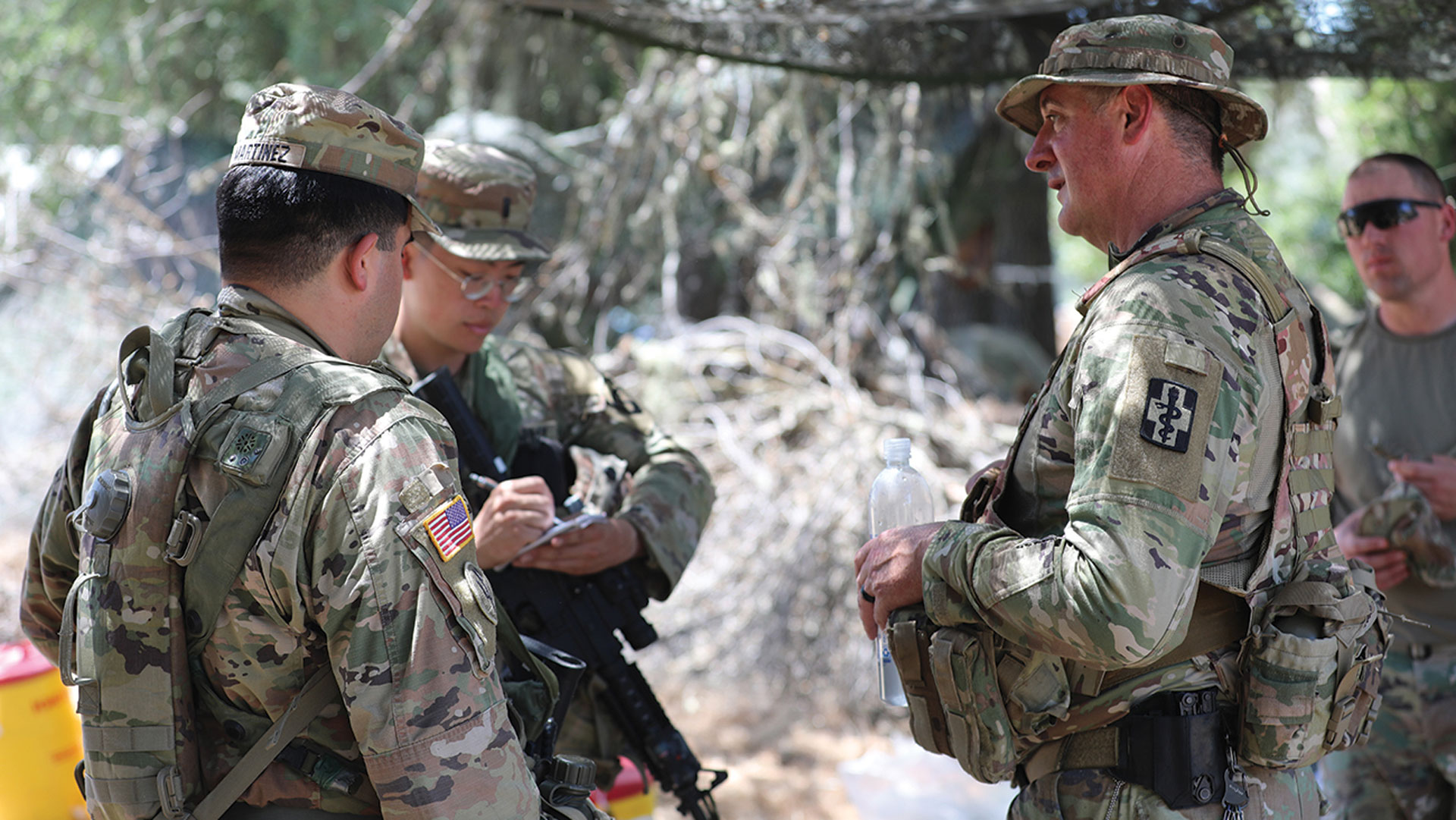
Source: Photos by U.S. Army Capt. William Stroud
According to Mr. Armand Fermin, the Training Program Coordinator at the Department of Operational Medicine at Fort Sam Houston, from 90 days out to the arrival at the mobilization site is too late to be checking on units to see if they completed their pre-deployment medical training (A. Fermin, personal communication, July 21, 2024). He stated that “requests submitted within 90 days are subject to disapproval due to the short notice” (A. Fermin, personal communication, July 21, 2024). All requests for BCT3 and TCMC must be made directly with the Department of Operational Medicine (A. Fermin, personal communication, July 21, 2024). Army Training Requirements and Resources System (ATRRS) applications submitted directly by a unit will not be accepted and will be removed by the Department of Operational Medicine administrators (A. Fermin, personal communication, July 21, 2024).
Since the FY25 pre-deployment training guidance was published in May 2024, there has not been an increase in mobilization funding for BCT3 or TCMC for National Guard and Reserve medics and/or providers.
Recommendations: The statement that all deploying units understand that BCT3 and TCMC classes are now mandatory for deploying medics and providers is not true. Changing the title of the Annex B: Recommended Mission-Specific Training Within Deploying Formations to mandatory will help end the confusion. 1st Army and AMEDD Mobilization planners should ensure that units understand pre-deployment medical training requirements and complete them before they arrive at the mobilization site. Integrating members of the Office of the State Surgeon with the G-3 and J3 Mobilization teams at the state level to understand and ensure medical training is completed may help. Additionally, commanders shouldn’t have to choose between lifesaving training and other pre-deployment training due to funding. Separate funding streams should be made available specifically for this training to ensure we arm our Soldiers with the best medical training possible.
Problem Three: There are not enough BCT3 Class Seats Available
As of October 2024, there were 31,500 combat medics in the United States Army among all of the components (A. Gardner, personal communication, February 18, 2025). There are currently not enough BCT3 class seats available at Fort Sam Houston, so even if medics are approved to attend the course, getting into the class is difficult. BCT3 and TCMC classes are not taught overseas due to the live tissue component.
Fort Sam Houston has five five-day classes scheduled in FY25 with a maximum of 147 seats per class primarily for Reserve and National Guard medics. Fort Sam Houston also runs mobile BCT3 Classes at locations such as Joint Base Elmendorf-Richardson, Fort Liberty, Fort Stewart, Fort Drum, Fort Campbell, and Fort Carson. However, per discussion with Mr. Fermin, these classes are targeted towards deploying active-duty Brigade Combat Team or Prepare to Deploy Order (PTDO) units. The host unit has priority fill.
According to Mr. Fermin, the biggest challenge for creating more BCT3 classes is getting qualified instructors, as teaching live tissue training is not for everyone (A. Fermin, personal communication, July 21, 2024). BCT3 instructors must be vetted and evaluated before they can teach the Point of Instruction (F. Armand, personal communication, July 21, 2024).
Recommendations: Fort Sam Houston needs to open more class dates for resident classes or hold classes at high tempo mobilization sites. A course of action may be to open more BCT3 classes at MSTC sites stationed around the country to get more medics trained in a quicker manner. Making BCT3 and TCMC classes available at high operational tempo mobilization sites, like Fort Cavasos and Fort Bliss, would solve the shortage of mobilization funds and seats problems by allowing units to send their medics and providers through once they get on Title 10 orders. Another course of action may be to open up live tissue instructor positions to National Guard and Reserve soldiers as Active-Duty Operational Support (ADOS) positions on Tour of Duty. The Mobile Training Teams (MTT) may also be an option if certain issues are mitigated. For example, they cost upwards of $150,000, you must fill 100 seats, and you must request the MTT team at least one to two years in advance of your deployment date.
Problem Four: Army Reserve Medics Assigned to Role III Hospitals Overseas Marked as TDA are Being Used as Line Medics and Therefore Need BCT3
FY24 pre-deployment mobilization preparation guidance for BCT3 stated that only medics assigned to a brigade combat team or flight medics assigned to a combined arms battalion should attend BCT3. This suggestion excludes medics assigned to Role III hospitals like United States Military Hospital-Kuwait. Army Reserve medics and active-duty Army medics assigned to the hospital are not offered seats in the courses. Medics from the 348th Field Hospital, Army Reserves thought that they were only being deployed to run United States Military Hospital-Kuwait.
In January 2024, the 348th Field Hospital and the Army Reserve 3rd Medical Command Deployment Support (3D MCDS) unit deployed sixteen medics, nine nurses, and eight physician assistants or doctors from the hospitals to bases outside of Kuwait for various operations to act as line medics or Role 1 medical providers. An active-duty Army unit, the 586th Field Hospital, which took over United States Military Hospital-Kuwait in September 2024, also did not send their medics to BCT3 and TCMC since it was not listed as a requirement.
COL John Spethman, the Command Surgeon of 3rd Medical Command in 2024, stated: “I can tell you that as a former Hospital Center Commander, it was not a requirement of the medical providers nor 68Ws to attend any of these should one of the two Field Hospitals under us need to deploy” (personal communication, May 11, 2024).
COL Spethman goes on to state, “Do I believe it is necessary? Absolutely! I have personally attended the C4, TCMC, and I am certified in Advanced Trauma Life Support. I believe it should be mandatory coming into this Theater. I would say the vast majority of the medical providers that come here do not have trauma training and need these courses given the kinetic nature of this AO. If placed in a situation where they are needed to provide trauma care or post-surgical care, they may be more of a liability than an asset” (personal communication, May 11, 2024).
Recommendation: All medics and medical providers deployed overseas, regardless of unit type and location, must attend BCT3 and TCMC pre-deployment medical training.
Problem Five: Army Reserve and Army National Guard Medical Providers may only have limited Trauma Training from their Civilian Jobs and none from the Army.
When medical provider officers take a direct commission, they attend the Basic Officer Leader Course (BOLC) at Fort Sam Houston but do not participate in any medical or trauma training during the course. The Army accepts medical degrees as proof of training but does not actually test medical providers to ensure that their skills are up to Army trauma standards. Not all medical providers work in an Emergency Room (ER) department environment in their civilian career. Many of the physician assistants that join the Army work in different specialties such as Orthopedics, Dermatology, Urology, or Obstetrics and Gynecology. While all Physician Assistants complete an ER rotation during their clinical hours for school, several years may have passed between that training and a military deployment.
The FY24 FORSCOM recommended pre-deployment mobilization preparation guidance stated, “Tactical Combat Medical Care – the following personnel assigned to a BCT or other MTOE unit must complete TCMC Course Number 6H-F35/300-F38: Physicians, Physician Assistants, Dentists, Nurses (including certified registered nurse anesthetists and nurse practitioners).” The word “recommended” made it sound as if TCMC is optional for medical providers and therefore, they have either chosen not to attend the class or their units would not send them. This means that Army Reserve and National Guard medical providers are deploying overseas with no military trauma training.
Medics and providers from the 411th Engineer Brigade, Army Reserves, who operated as Task Force Castle in the CENTCOM theater in 2024, admitted to never having heard of BCT3 or TCMC. One of their providers was a dermatology physician’s assistant with no recent trauma training. SSG Alexander Boyd further stated, “None of our medical personnel have attended nor were given the opportunity to attend either course for the same reasons you identified. The same issue was asked by the previous division as well. These have been courses that our personnel had hoped to attend” (personal communication, May 11, 2024).
Task Force Castle soldiers and medical providers stationed at Tower 22 in Jordan in January 2024 came under attack by one-way unmanned aerial systems (OWUAS), which resulted in the deaths of 3 soldiers and the wounding of 99 more. This event underscored the fact that units need to come in with the same baseline training as they may find themselves in a high-risk area of operations (AO) at any time. This mismatch in skills and duty expectation is evident across multiple task forces and units.
1SG Zocarlo M. Benologa from Charlie Med, 1-635th Armor Regiment, Kansas Army National Guard states, “Two- thirds of our current providers attended TCMC. The provider that didn’t attend is an in-theater Extension (ITE) and was told it was not a MOB requirement” (personal communication, May 13, 2024). The 1-635th Armor Regiment served in the CENTCOM AO for most of 2024 as Task Force Reaper. A crisis response force consisting of any medical provider without updated Army trauma training is an unacceptable risk to take.
Commanders may believe that the solution is swapping one properly trained medical provider for another. However, most non-medical commanders are not tracking the extent of military medical training that their soldiers have on a regular basis. Additionally, the number of available medical personnel in the AO has been significantly reduced in the recent years; many units must send their soldiers to host nation hospitals in Jordan, Kuwait, and Saudi Arabia for medical care because of the lack of available United States military medical resources.
If TCMC is not completed due to lack of funds or confusion on deployment requirements, the unit may not be able to find a medical provider who has recently completed Army trauma training on short notice. Medical doctors typically only deploy for three months, while Physicians Assistants deploy for six months. The constant revolving door of medical providers changes the level of trained personnel that a unit has access to at any given moment. In addition, all locations are getting more dangerous, so pulling out one highly trained provider to substitute a lesser trained one is taking another unacceptable risk.
Recommendations: All medical providers must attend TCMC before deployment. Military trauma training is not equivalent to civilian trauma training; thus, TCMC is needed and cannot be fully supplemented by civilian experience alone.
Putting the Safety of Soldiers First
We are failing our Soldiers. By not ensuring a well-trained, mission-ready medical component, we collectively accept the risk of Soldiers dying from potentially preventable causes. Due to confusion on pre-deployment medical training guidance and a shortage of mobilization funds and class seats, medics and providers are not attending BCT3 and TCMC classes. With operations in CENTCOM and the rest of the world changing at a rapid pace, the lives of all military members in the AO are at greater risk as their medical personnel can be sent anywhere, anytime, to complete any mission.
We are already seeing the signs of Large-Scale Combat Operations (LSCO) as Soldiers are deployed to locations without readily available rapid medical support. The lack of flight and ground MEDEVAC capabilities and new technology, like one way attack Unmanned Aerial Vehicles (UAVs), necessitate a higher level of medical training for medics. We need to start training our medics and medical providers to handle the injuries from new technologies now present in austere locations. The two objectives of all military leaders are to 1) complete their mission and 2) take care of their soldiers. By not ensuring that our medics and providers complete BCT3 and TCMC classes before they deploy, we are failing at both of those objectives.
References
COL Andreas Gardner, personal communication, February 18, 2025.
Mr. Armand Fermin, personal communication, July 31, 2024.
COL John Spethman, personal communication, May 11, 2024.
SSG Alexander Boyd, personal communication, May 11, 2024.
1SG Zocarlo M. Benologa, personal communication, May 13, 2024.
Menendez, Manual. (2022). Rethinking Combat Medic Training. Military Review. https://www.armyupress.army.mil/Journals/Military-Review/English-Edition-Archives/July-August- 2022/Menendez/fs/e/s/cl/
Remondelli, M. H., Remick, K.N., Shackelford, S.S., Gurney, J.M., Pamplin, J.C., Polk, T.M., Potter, B.K., & Holt, D.B. (2023). Casualty care implications of large-scale combat operations. The Journal of Trauma and Acute Care Surgery. 95(2): S180–S184. https://www.ncbi.nlm.nih.gov/pmc/articles/PMC10389308/
Author
SGM Sandra J. Johnson is the Chief Medical Noncommissioned Officer for the 34th Infantry Division in the Minnesota Army National Guard.