Less is More
An Analysis of Outdated Aviation Sustainment Distribution Support for Large-Scale Combat Operations
By CPT Nicholas D. Turner
Article published on: in the January-March 2025 Issue of the Aviation Digest
Read Time: < 14 mins
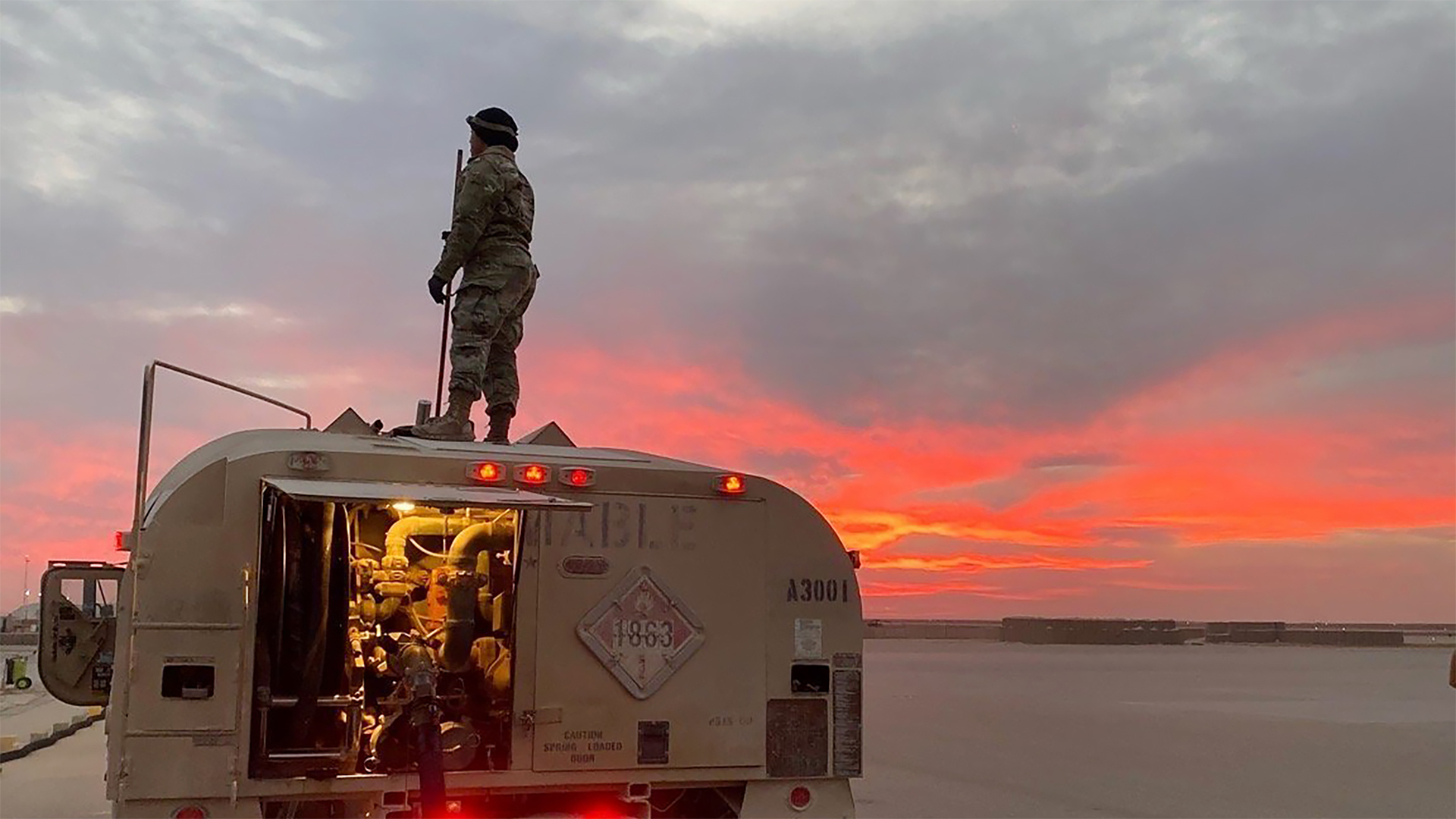
A U.S. Army petroleum supply specialist flushes the lines of a fueling truck while watching the sun rise at a FARP. U.S. Army photo by CPT Travis Mueller.
Army Aviation, now more than ever, serves as the catalyst for Army operations through its seven core competencies of Provide Accurate and Timely Information Collection; Provide Reaction Time and Maneuver Space; Destroy, Defeat, Disrupt, Divert, or Delay Enemy Forces; Air Assault Ground Maneuver Forces; Air Movement of Personnel, Equipment, and Supplies; Evacuate Wounded or Recover Isolated Personnel; and Enable Command and Control Over Extended Ranges and Complex Terrain (Department of the Army [DA], 2020, pp. 1-2 to 1-6). This role, however, does not come without complex challenges in a Large-Scale Combat Operations (LSCO) environment, specifically within the sustainment warfighting function. The considerable sustainment requirements expected in LSCO present a concerning challenge for sustainment professionals when focusing on the enablement of aviation operations throughout the widespread operational environment. Based on experiences and insight gained at combat training center rotations and field training exercises (FTX) across a multitude of echelons, it is clear that the current organic modification table of organization and equipment (MTOE) structure of forward support companies (FSC) and troops (FST) within each of the specialized aviation battalions lacks the ability to support the wide array of aviation missions, specifically regarding forward arming and refueling points (FARPs). The centralization of all FSC distribution sustainment assets within the aviation support battalion (ASB) will augment sustainment leaders with key tools to excel at all principles of logistics to better organize, train, and manage personnel in a LSCO environment.
Insight Into Sustainment In LSCO
As the U.S. Armed Forces has committed to the operational framework of LSCO, echelons of leaders have been assessing and adapting elements of doctrine, organization, training, materiel, leadership and education, personnel, and facilities (DOTMLPF). This is the decision-making framework for addressing gaps throughout the military to ensure preparedness for the future fight. All elements of DOTMLPF can be assessed throughout the following analysis and restructure solution of sustainment distribution support operations, but organization, training, and personnel are the key focus of this presented restructure solution.

The 12th Combat Aviation Brigade sharpens its skills at Saber Junction 2024. U.S. Army photo by CPT Lydia LaRue.
Sustainment professionals seek to maximize the efficiency of the sustainment warfighting function, defined as, "the related tasks and systems that provide support and services to ensure freedom of action, extend operational reach, and prolong endurance" (DA, 2019, p. 5-5). This definition, however, is a gross simplification of the requirements that will be placed upon the sustainment warfighting function in the complex LSCO environment. In conjunction with providing support and services, sustainment must operationalize in plans, execution, and survivability to endure and shape the LSCO fight. Field Manual (FM) 4-0, “Sustainment Operations,” further elaborates on the purpose of sustainment operations, summarizing that the endurance of Army forces is a primary function of sustainment and is essential to seizing, retaining, and exploiting the initiative (DA, 2024, p. ix). To accomplish this purpose, sustainment leaders develop tactics and train to excel at the principles of sustainment, which include integration, anticipation, responsiveness, simplicity, economy, survivability, continuity, and improvisation (DA, 2024). Additionally, as identified in Eagle Team newsletters from the National Training Center, the Eagle Team specifically highlights that “the sustainment WfF [warfighting function] is the determining factor that enables the depth and duration of [all] Attack Aviation operations … deliberate aviation sustainment planning and forecasting enables freedom of action by increasing the number of options available to the ground force commander” (Griffin & McQuinn, 2024, p. 2). When it comes to the crucial role Army Aviation plays through its seven core competencies, it becomes clear that sustainment, specifically FARP operations, is the lynchpin determining success or failure in LSCO. The centralization of all FSC distribution sustainment assets within the ASB would provide organizational continuity, create enhanced training opportunities to develop critical skills, and consolidate personnel for assignment to key sustainment tasks, ultimately enabling sustainment professionals to operationalize the principles of logistics for FARP functions in a LSCO environment.
Organization
The current task organizational structure of sustainment nodes in combat aviation brigades (CAB) is convoluted. Within a CAB, there resides an ASB whose purpose is overseeing all sustainment operations within the CAB, comprised of a headquarters and support company, distribution company, brigade signal company, and aviation support company (DA, 2024). Additionally, there are embedded sustainment nodes in the form of FSCs and aviation maintenance companies/troops within each of the attack, assault, and general support battalions, and cavalry squadrons with each FSC generally comprised of a headquarters platoon, distribution platoon, and ground maintenance platoon (DA, 2024). The distribution platoon specializes in aircraft refuel capabilities, transportation of supply classes, and logistical operations, including ammunition and water. As LSCO continues to develop, it becomes more evident that commanders who are closest to updated information must retain the ability to directly task distribution assets to achieve the sustainment principles of integration, anticipation, and responsiveness within a dynamic environment. Consolidation of distribution assets, which entails the transfer of each specialized battalion’s distribution platoon MTOE to the ASB, fills this gap for sustainment and operational commanders.
I analyzed current MTOEs between assault battalions and cavalry squadrons, which revealed a critical shortfall among current distribution asset allocation within CABs. This sample analysis is based on the FSC MTOE of an assault helicopter battalion (AHB) and air cavalry squadron (ACS).
In this example, the AHB is allocated up to 1x Palletized Loading System (PLS), 1x Load Handling System (LHS), 5x PLS trailers, and 10x M978 heavy expanded mobility tactical truck (HEMTT) fuel-ers, with a total of 30x petroleum supply specialist (92F) Soldiers compared to the ACS allocation of up to 1x PLS, 10x LHS, 13x PLS trailers, and 8x HEMTTs, with a total of 25x 92Fs.
The PLS, LHS, and PLS trailer systems provide the capability to move ammunition and the M978 system for fuel. The obvious difference in the MTOEs between LHS and PLS trailer capacity presents considerable challenges for cross-battalion support within CABs due to ammunition and fuel requirements outlined in Army Techniques Publication (ATP) 3-04.17, “Techniques for Forward Arming and Refueling Points,” for AH- 64 Apache mission sets (DA, 2018, p. 4-3). In simple terms, under the current organization of assets, assault distribution units can organically transport about 15 percent of an ACS’s basic ammunition allocation. This is a significant shortcoming in the enablement of cavalry capabilities across a LSCO operational environment for the CAB. Consolidation of distribution equipment and personnel under the single distribution company in the ASB provides flexibility to commanders, while allocating assets at respective FARPs when integrating with CAB and divisionlevel operational plans.
Training
How sustainment elements prepare to fight tactically and integrate into the larger concept of operations weighs heavily on leadership when preparing to fight in a LSCO environment. Further, the emphasis on developing the skills required to provide sustainment support across the Aviation Enterprise has never been more pressing. Consolidation of distribution assets within the ASB will immediately fill gaps in cross-training and allow for continuity in tactics, techniques, and procedures (TTPs) and standard operating procedure (SOP). The FARP is the primary logistical hub for aircraft during the execution of any operation. The Eagle Team reinforces the criticality of reducing downtime at FARP locations to increase survivability, requiring efficient cross-training of fuelers and ammunition specialists within the support company (Griffin & McQuinn, 2024, pp. 5–6). Organic FSCs currently train to meet the needs of their specialized battalions, but in LSCO, much more will be asked of sustainment nodes in aviation operations. Forward arming and refueling points must be able to provide continuous, simple, responsive, and survivable sustainment coverage across multiple platforms to allow commanders the ability to exploit the initiative on the battlefield and enable the utilization of Army Aviation assets throughout the operational environment at any time. Centralizing sustainment distribution assets at the ASB level, which is closely linked to the CAB operations cell, provides sustainers a wide variety of training opportunities across the array of missions. Therefore, training can be structured to encompass all mission-essential task list tasks required from the sustainment warfighting function in a CAB.

nest and forecast training requirements holistically allows sustainment professionals to focus on developing skills required to enable operations outside the narrow lens of the current task organization. Strong, integrated teams are required to ensure “the systems and processes that go into setting up and maintaining [the] FARPs [of various types], as well as the actions of those around them,” to improve FARP efficiency in refitting aircraft back into the fight (Griffin & McQuinn, 2024, p. 5). To achieve this, streamlined capture of roles and responsibilities through cohesive training across a multitude of platforms is necessary. Large-scale combat operations demand sustainment personnel to retain the ability to provide refuel and rearmament support across all platforms within the CAB at a precise time and place, quickly followed by rapid displacement to ensure survivability in a contested environment. Consolidation of the distribution assets within the ASB directs the focus of sustainment professionals toward establishing thorough training plans, with the objective of enhancing all skills required to support CAB operations.
Personnel
The assignment of qualified, professional experts to critical tasks increases the probability of mission accomplishment, especially when it comes to the planning and execution of sustainment operations in a LSCO environment. Centralization of distribution assets at the ASB brings sustainment leaders and Soldiers together with the goal of providing greater flexibility to integrate, anticipate, and respond in a dynamic operational environment. With each service member bringing unique experiences and solutions that would enable complex missions, this centralization would reduce the friction currently experienced in CABs relating to 92F shortages and mission command under the existing task organization structure.
The critical Army-wide shortage of the petroleum supply specialist military occupational specialty (MOS) presents a significant challenge for sustainers conducting FARP operations. According to ATP 3-04.17, “FARPs with eight service points, theoretically, require at least ten petroleum service specialist MOS 92F: eight to refuel aircraft and two manning the emergency shut-off valves. It also requires sixteen arming personnel (two per service point)” (DA, 2018, p.2-24). That results in a total of 26 personnel tooperate a single eight-point FARP, but the footprint eight-point FARP srequire, and their inability to displace quickly when in contact, poses challenges in a LSCOfight. Combined with this operational change, the eight-point FARP requirement compromises survivability in today’s FARP personnel structure. The availability of FARP personnel within the current MTOE allocation of 30 personnel in an AHB FSC and 25 personnel in an ACS FST, severely restricts the type and amount of FARPs that can be emplaced throughout the operational environment. The current requirements to successfully run a single eight-point FARP requires 85–95 percent of a current FSC or FST’s distribution personnel. Additionally, the MTOE does not account for lack of personnel assigned to each distribution section, nor whether the service members filling those positions are physically capable of conducting FARP operations at a particular time. Even regulation acknowledges the likely result of overextending FSCs based on total number and type of FARPs required for an operation. Army Techniques Publication 3-04.17 recommends cross-training ammunition specialists (89B), petroleum specialists, and even copilots to rearm and refuel operating aircraft (DA, 2018, p. 2-24). Regulation provides techniques to assist with shaping the way Army Aviation conducts FARP operations; however, it fails to identify shortcomings in the current MTOE structure of sustainment assets across battalions within the CAB. Therefore, the centralization of distribution assets at the ASB level would allow for flexibility to support CAB operations with the increased access to more personnel.

10th Combat Aviation Brigade petroleum supply specialists at Forward Operating Base Shank, Afghanistan. U.S. Army photo by CPT Peter Smedberg/Released.
Key sustainment personnel in leadership positions must exercise mission command across the warfighting function, and this proposed restructure enables a clear path for mission command to thrive. The proper institution of mission command, defined as “the Army’s approach to command and control that empowers subordinate decision-making and decentralized execution appropriate to the situation” (DA, 2019, p. 3-8), which emphasizes “seizing, retaining, and exploiting the initiative,” (p. 3-8) will be decisive in a LSCO fight. Most importantly, “mission command helps commanders capitalize on subordinate ingenuity, innovation, and decision making to achieve the commander’s intent when conditions change or current orders are no longer relevant” (p. 3-8). Under the current task organization, there is significant confusion regard-ing what echelon retains operational control of sustainment operations when planning, preparing, and executing operations in support of CAB missions. All logisticians assigned to specialized battalions within the CABs are managed by the ASB battalion commander, who acts as the senior logistician within the CAB, but each FSC and FST falls under the attack, cavalry, assault, or general support operational command of the battalion commander and their respective staffs. This dilemma faced by company- and troop-level leadership significantly weakens mission command and distracts the specialized battalions while carrying out Army Aviation’s seven core competencies. The centralization of distribution leadership personnel focuses mission command within the ASB, allowing for clear synchronization of sustainment support provided through FARPs across the CAB.
A restructure of leadership personnel focused within the ASB also presents the ability for sustainment staff to operationalize the sustainment warfighting function through enablement of a nested sustainment operations process. Today, the sustainment warfighting function lacks deliberate involvement in a thorough military decision-making process (MDMP) iteration, but the depth and duration of operations that will be instituted in LSCO require sustainment staffs to conduct the operations process with the same diligence as the operations staffs. Through observance of FARP operations, the Eagle Team identifies that “it’s essential to have distribution Platoon Sergeants, Platoon Leaders, and FARP NCOICs involved in the mission planning process at the task force level, [and that] their expertise and insights are essential for successful integration of FARP operations into the bigger picture” (Nice, 2023, p. 10). The leadership consolidated in the ASB, as proposed, must accept the responsibility to operationalize FARPs for CAB operations and run the MDMP and troop leading procedures process to support the various operations that will occur in LSCO. The ASB can then designate how to array leadership within that force structure and provide liaison officers, for example, to maneuver units to assist in sustainment synchronization based on their operational timelines.
Logistics leaders and FARP operators must have a thorough understanding of ATP 3-04.17 to provide consistent support, but they must also retain the foundational knowledge needed to improvise certain support capabilities based on mission requirements to meet success criteria. An ASB has the specialized personnel and staff required to implement techniques for unique circumstances quicker, compared to a singular FSC or FST. With this structure, further success can be pursued in proper preparation for critical inspections, such as the Directorate of Evaluation and Standardization Aviation Resource Management Survey (ARMS) inspection. Forward support companies consistently struggle to truly meet the foundational requirements outlined in the ARMS because of limited access to diverse training opportunities. Due to high operational tempo across maneuver units, they seldom receive opportunities in the pursuit of proficiency on critical ARMS tasks in the current structure. Overall, the movement of distribution leadership personnel within the ASB would allow logistics leaders to conduct thorough operations processes for sustainment operations, meet critical standards for proficient aviation sustainment operations, and promote the use of creative techniques to better support aviation missions in LSCO.
Change For the Betterment Of Battalions
With this proposed organizational consolidation, organic planning of logistics support within battalions would be restricted and require nested coordination with the ASB throughout each operation. However, this would enable the ASB to provide more thorough and complex solutions surrounding FARP planning, training, and execution in the operations process. The ASB’s assumption of this responsibility to support Army Aviation in a LSCO fight would free time for the battalions to intently focus on other warfighting functions. Aviation is expected to largely be used as a division asset, consistently tasked to various brigade combat teams across a vast area of operations. Therefore, the ASB, nested with CAB operations, must accept and lead the FARP effort for broad utilization across the LSCO domain. The consolidation of personnel and assets would require refinement once instituted, but giving sustainment professionals operational control and access to personnel would rapidly grow the warfighting function’s capability through diverse training opportunities.
Conclusion
In summary, the centralization of all FSC distribution sustainment assets within the ASB will augment sustainment leaders with key tools to excel at all principles of logistics to better organize, train, and manage personnel in a LSCO environment. The current task organization structure stifles decision-making and execution. Additionally, coupled with improper MTOE allocations when assessing cross-platform FARP operations, failure to achieve the sustainment principles of integration, anticipation, and responsiveness within a dynamic environment ensues. Consolidation of distribution assets provides a streamlined organizational structure and access to a wide array of equipment and personnel, resulting in fulfilling key sustainment principles in a LSCO environment. This centralization additionally streamlines training opportunities for all sustainment professionals across all CAB platforms, filling the shortfall of efficient FARP operations through shared TTPs and SOPs to ensure survivability in a contested LSCO fight. Lastly, reorganization of personnel, both with FARP personnel and key sustainment leadership, solves critical shortcomings seen in the current structure regarding lack of personnel, convoluted mission command, and the required role of sustainment staffs when conducting the operations process for sustainment support. Although this centralization would remove organic distribution assets from the various battalions within the CAB, this change would enable the sustainment leaders within the ASB to operationalize sustainment across the CAB, further enhancing the support required to continuously provide freedom of action, extend operational reach, and prolong endurance in a LSCO environment.
Endnotes
Department of the Army. (2018, June 4). Techniques for forward arming and refueling points (Army Techniques Publication 3-04.17). https://armypubs.army.mil/epubs/DR_pubs/DR_a/ARN32371-ATP_3-04.17-001-WEB-3.pdf
Department of the Army. (2019, July 31). Operations (Army Doctrine Publication 3-0). https://armypubs.army.mil/epubs/DR_pubs/DR_a/ARN18010-ADP_3-0-000-WEB-2.pdf
Department of the Army. (2020, April 6). Army Aviation (Field Manual 3-04). https://armypubs.army.mil/epubs/DR_pubs/DR_a/pdf/web/ARN21797_FM_3-04_FINAL_WEB_wfix.pdf
Department of the Army. (2024, August 14). Sustainment operations (Field Manual 4-0). https://armypubs.army.mil/epubs/DR_pubs/DR_a/ARN41683-FM_4-0-000-WEB-2.pdf
Griffin, W. and McQuinn, L. (2024, April). EAGLE 03 SENDS: Setting the conditions for Army Attack Aviation: Sustainment. The Eagle Eye: An Eagle Team monthly newsletter, (2)5, 2.
Nice, A. (2023). OUR FOCUS AREA: Sustainment and FARP lessons learned.
Author
CPT Nicholas Turner graduated from the United States Military Academy at West Point with a Bachelor of Science degree in Electrical Engineering. He was assigned to 4th CAB, 3-4 AHB in Fort Carson, Colorado, as a UH-60M Pilot. CPT Turner served as a Maintenance Company Executive Officer in the Aviation Maintenance Company, Assault Company Platoon Leader, Battalion Logistics Officer, and FSC Commander, and he conducted two rotations to the National Training Center in Fort Irwin, California. CPT Turner currently serves in Company D, 1-145th Aviation Regiment, as an Aviation Basic Officer Leader Course Instructor.