A Brief Overview of Other Transactions Authority
By Major Thomas J. Darmofal
Article published on: July 16, 2025 in the 2025 Issue 2 of Army Lawyer
Read Time: < 6 mins

President Trump signing executive orders in April 2025. (Photo courtesy of the White
House)
On 9 April 2025, President Donald J. Trump published an executive order directing the Department of Defense
(DoD) to submit a plan to reform the DoD acquisition process.
1 The order directed the DoD to employ, among other mechanisms,
“existing authorities to expedite acquisitions through the [DoD], including . . . a general preference for
Other Transactions Authority [(OTA)].” 2 On 30 April 2025, Secretary of Defense Pete Hegseth published a
memorandum, titled Army Transformation and Acquisition Reform, directing the “[e]xpan[sion] [of]
the use of [OTA] agreements to enable faster prototyping and fielding of critical technologies; this
includes software and software-defined hardware.” 3
Outside of the contract acquisition realm, many Army professionals and practitioners may not have
encountered OTAs. However, OTAs are important for all practitioners to understand as they represent a
powerful and streamlined acquisition tool.
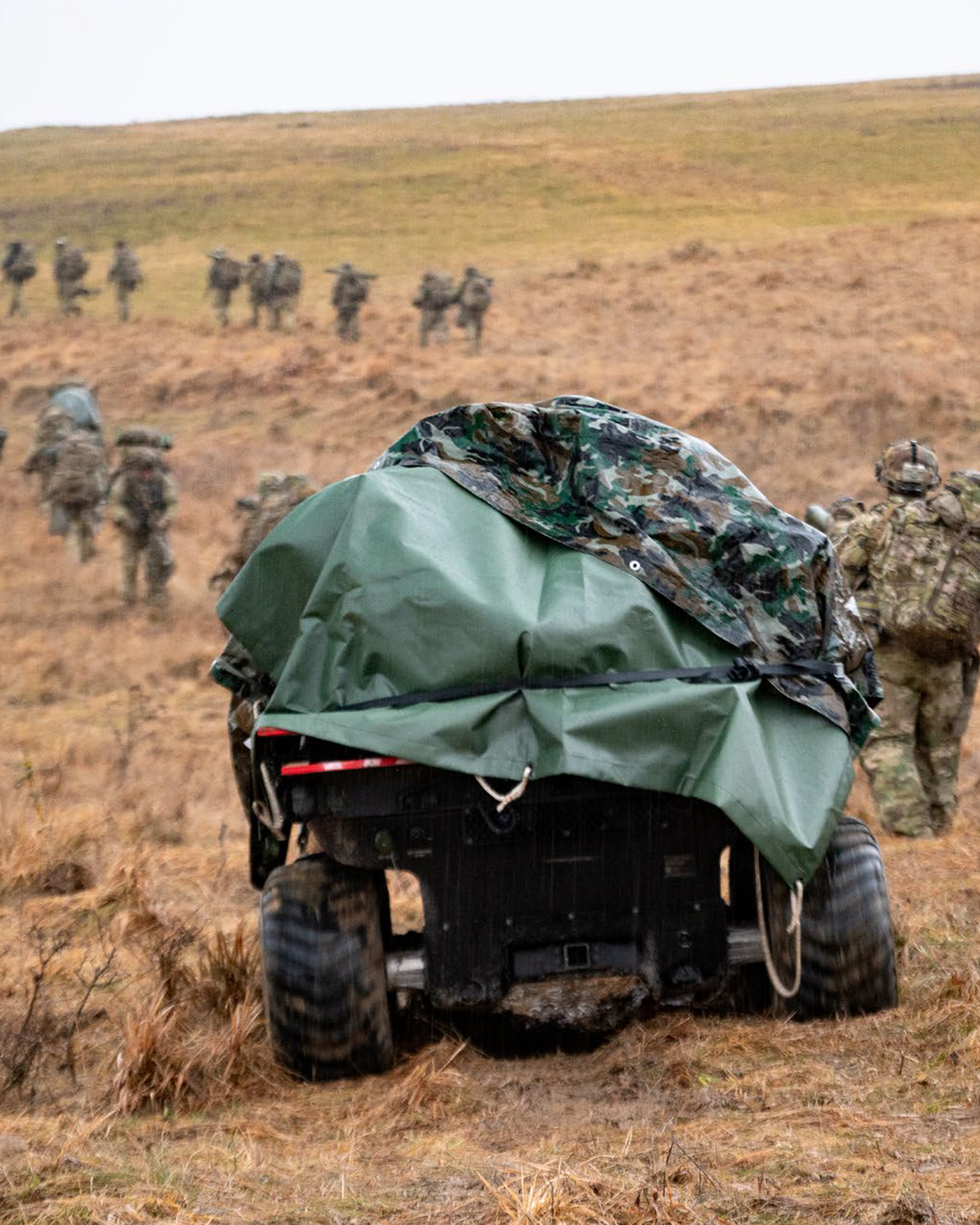
Soldiers use a Small Multipurpose Equipment Transport (SMET) to move equipment during
Exercise Combined Resolve 25-1 at the Joint Multinational Readiness Center in Hohenfels, Germany. The
U.S. Army has and continues to use OTAs to acquire SMETs. (Credit: SGT Donovon Lynch)
What Is an OTA?
An OTA—“Other Transaction Agreement” or “Other Transactions Authority”—is a term of art used in the
Government contracting realm to define a transaction between the Government and a private entity under the
statutory authority of OTAs. 4
OTAs “refer to the statutory authorities that permit a Federal agency to enter into transactions other
than contracts, grants, or cooperative agreements.”
5 In other words, the term OTA refers to a transaction between the
Government and a private party that occurs outside the traditional contracting process. OTAs are not subject
to the Federal Acquisition Regulation (FAR) or other acquisition requirements outside of the relevant
statutory authority currently codified under 10 U.S.C. §§ 4021–22. 6 The OTA under 10 U.S.C. § 4021 is titled
“Research Projects: transactions other than contracts and grants,” 7 and the OTA under 10 U.S.C. § 4022 is titled
“Authority of the [DoD] to carry out certain prototype projects.” 8
The OTA statutory authority allows Service Secretaries of the military departments and other authorized
officials to “carry out prototype projects that are directly relevant to enhancing the mission effectiveness
of personnel of the [DoD] or improving platforms, systems, components, or materials proposed to be acquired
or developed [or in use] by the [DoD].” 9 The statute is detailed and extensive, and expressly provides
guidance in the event of follow-on production contracts or transactions. 10 The detail extends to the applicability of
procurement ethics requirements. The statute specifically characterizes and states that “an agreement
entered under the authority of this section shall be treated as a Federal agency procurement for the
purposes of chapter 21 of title 41 [restrictions on obtaining and disclosing certain information].” 11 The statute also
explicitly references where competition requirements and other rules should apply. 12 Notable for contracts practitioners, the
detailed nature of the statute does not extend to the jurisdiction of any adjudicative entity. 13 As the Government argued
and the Court of Federal Claims noted in the Hydraulics case, “Both sections 4021 and 4022 are
silent on the Tucker Act, bid protests, judicial review, and the Court of Federal Claims.” 14
The History and Purpose of OTAs
The need for OTAs emerged during the infamous “Space Race” in 1957 between the Soviet Union and the United
States. 15 On 4 October
1957, the Soviet Union successfully launched the first orbital space satellite. 16 The Soviet Union’s success in beating the
United States into space took the country by surprise. 17 Losing the race to be the first nation to launch a space
satellite—especially to a near-peer—made the U.S. Government realize it needed a faster, more efficient
process to acquire competitive technology. 18

The Dolley Madison House, NASA’s Headquarters in Washington, D.C., from 1958 to 1961.
(Source: NASA)
Congress determined that the United States could not develop the critical technology quickly enough to
compete with the Soviet Union through the traditional Government procurement process. 19 Traditional Government contracting methods
reflect the red tape inherent in the bureaucracy that created them. 20 The loss spurred the U.S. Government to
create the National Aeronautics and Space Administration (NASA), and equipped the new agency with the
authority to enter into “other transactions.” 21 The OTAs “allow[ed] NASA to move quickly and avoid the bureaucratic
torpor of Federal acquisition processes, the agency was given broad authority ‘to enter into and perform
such contracts, leases, cooperative agreements or other transactions as may be necessary’ to carry out its
mission.” 22 NASA’s
successful utilization of OTAs “prompt[ed] many other agencies to seek congressional approval for OTA[s],”
23 including the DoD.
The DoD’s Use of OTAs
The popularity of OTAs within the DoD has continued to rise since Congress bestowed the authority on the
agency in 1989. 24 In
particular, this popularity spiked after Congress expanded the authorities in the National Defense
Authorization Acts of 2015 and 2016. 25 According to industry experts and Congress, the expansion occurred
to:
‘support [DoD] efforts to access new sources of technological innovation’ by making OTAs
‘attractive to firms and organizations that do not usually participate in Government contracting due to the
typical overhead burden and one size fits all rules.’ Congress’s expansion of OTA powers coincided with
increased DoD interest in utilizing more flexible contracting vehicles to speed acquisition, as well as with
a push to carry out the development of major weapons systems outside the traditional weapons systems
acquisition pipeline and the policy regime this entails. 26
Speed, flexibility, and efficiency set OTAs apart from traditional contracting vehicles. These qualities are
appealing to both Government and industry, especially commercial entities, which are non-traditional
customers. 27 OTAs are a
powerful tool the DoD can leverage in accordance with President Trump’s order to achieve the intent of
“accelerat[ing] defense procurement and revitalize[ing] the defense industrial base.” 28 TAL
Endnotes
1. Exec. Order 14265, 90 Fed. Reg. 15621 (Apr. 9,
2025).
2. Id. at 15621.
3. Memorandum from Sec'y of Def. to Sr. Pentagon
Leadership, subject: Army Transformation and Acquisition Reform (30 Apr. 2025).
4. See Off. of Under Sec'y of Def. for
Acquisition & Sustainment, Other Transactions Guide 4–7 (July 2023).
5. Id. at 4 (emphasis added).
6. See Hydraulics Int'l, Inc. v. United
States, 161 Fed. Cl. 167, 175–76 (2022).
7. 10 U.S.C. § 4021.
8. 10 U.S.C. § 4022.
9. 10 U.S.C. § 4022(a)(1).
10. See 10 U.S.C. § 4022(f).
11. 10 U.S.C. § 4022(h).
12. See 10 U.S.C. § 4022(f).
13. See 10 U.S.C. § 4022(a)(1).
14. Hydraulics Int'l, Inc. v. United States, 161 Fed.
Cl. 167, 176 (2022).
15. See id. at 175.
16. Michelle Bradley, Sputnik and the Space Race:
1957 and Beyond, Rsch. Guides: Lib. of Cong. (July 10, 2019), https://guides.loc.gov/sputnik-and-the-space-race [https://perma.cc/GB9E-XVE7].
17. See Hydraulics Int'l Inc., 161 Fed. Cl.
at 175.
18. See id.
19. See John Dobransky & Patrick O'Farrell,
Other Transaction Authority: Acquisition Innovation for Mission-Critical Force Readiness, Cont.
Mgmt., July 2018, at 50 (stressing the importance of OTAs in the development of technology to compete
with near-peers throughout history).
20. See Darrell M. West, Reforming
Federal Procurement and Acquisition Policies, Brookings Inst. (Apr. 3, 2023), https://www.brookings.edu/articles/reforming-federal-procurement-and-acquisitions-policies
[https://perma.cc/56X2-DJMU] (highlighting the burdens of the red tape associated with entering into
contracts with the U.S. Government).
21. Surya Gablin Gunasekara, "Other Transaction"
Authority: NASA's Dynamic Acquisition Instrument for the Commercialization of Manned Spaceflight or
Cold War Relic?, 40 Pub. Cont. L.J. 893, 894 (2011).
22. Hydraulics Int'l Inc., 161 Fed. Cl. at
175.
23. Gunasekara, supra note 21, at 894.
24. Rhys McCormick amp; Gregory Sanders, Ctr. for
Strategic & Int'l Studs., Trends in Department of Defense Other Transaction Authority Usage 5–6 (2022).
25. Carl Levin and Howard P. 'Buck' McKeon National
Defense Authorization Act for Fiscal Year 2015, Pub. L. No. 113–291, sec. 812, 128 Stat. 3292, 3429
(2014); National Defense Authorization Act for Fiscal Year 2016, Pub. L. No. 114–92, sec. 814, 129 Stat.
726, 893 (2015).
26. McCormick & Sanders, supra note 24, at
6.
27. See Other Transaction Agreements, ATI:
Advanced Tech. Int'l, http://www.ati.org/ota [https://perma.cc/JYB8-J22C] (last visited
July 16, 2025) (consortium management firms and other non-traditional Government contractors using
research and prototype OTAs).
28. Exec. Order 14265, sec. 2, 90 Fed. Reg. 15621,
15621 (Apr. 9, 2025).
Author
MAJ Darmofal is the Brigade Judge Advocate for 3d Brigade Combat Team, 82d Airborne Division, at Fort
Bragg, North Carolina.