1st Lt. John E. Darling Jr. and the Battle for Fire Support Base Ripcord
March - July 1970
By Steven J. Rauch, Signal Corps Branch Historian
Article published on: March 20, 2025 in the Army Communicator Spring 2025 Edition
Read Time:< 10 mins
This is the last article Steven J. Rauch provided prior to his retirement in June 2025. He feels it was his best written, most well-researched piece that reflects an important subject matter. It was previously published in the September 2020 Army Communicator but has been revised for this edition.
On July 23, 1970, Soldiers of the 2/506th Infantry Battalion, 101st Airborne Division, evacuated the hill known as Fire Support Base (FSB) Ripcord located about 25 miles west of Hue in South Vietnam. After almost five months of continuous fighting at Ripcord, the final casualties were Lt. Col. Andre C. Lucas, the battalion commander, and the battalion operations officer, Maj. Kenneth P. Tanner, killed while supervising the evacuation of the base. Their deaths added to the total of 112 men killed and 698 men wounded from March 13 to July 23, 1970. During that time, ground and aviation units of the 101st were subjected to heavy rocket, mortar, and ground attacks by the People’s Army North Vietnam (PAVN). Many Soldiers compared the battle to Hamburger Hill, fought a year earlier, and concluded Ripcord was more wasteful in casualties. Among those who lost their lives during the battle for Ripcord were 1st Lt. Bob Kalsu, who had been an All American lineman at Oklahoma and was a member of the Buffalo Bills offensive line; Pfc. Weiland C. Norris, the younger brother of actor/martial artist Chuck Norris; and 1st Lt. John E. Darling Jr., the battalion communications officer for 2/506th Infantry Battalion.
Darling was born in Fremont, Michigan, Oct. 17, 1946. During high school, he was a member of the National Honor Society, varsity football captain, varsity wrestling captain, and a Boy Scout. He later became an Eagle Scout and graduated with honors from Fremont High School in 1964. Darling received an appointment to the U.S. Military Academy and was remembered by his roommate John C. Cruden as “a natural leader: an individual gifted with those traits that attract other people to him.”
Darling graduated from West Point on June 5, 1968, and commissioned into the Signal Corps. He attended U.S. Army Ranger School, the Signal Basic Officer Leader Course at Fort Gordon, the Battalion Communications Officer Course at Fort Sill, and U.S. Army Airborne School. After completing training, he was assigned to 82nd Airborne Division at Fort Bragg, North Carolina, but soon deployed to Vietnam on Oct. 12, 1969. There he was assigned to Headquarters and Headquarters Company, 2/506th Infantry as the battalion communications officer – the equivalent of a battalion S-6 today.
The doctrine of using fire support bases to support ground operations had fully matured by 1970. An FSB was designed to provide a secure location for artillery support in remote locations and relied on helicopters to emplace, resupply, and displace the guns as needed. They also served as command and control centers, assembly points, and landing zones. FSBs were usually established via air assault onto a hilltop or mountain and had to be defensible against enemy attack. As might be expected, an FSB made for a tempting target for an attack, especially with indirect fires such as mortars and artillery.
In 1970, the Army set up a string of FSBs east of the A Shau Valley to prevent enemy movement into the coastal regions of Quang Tri and Thuan Thien Provinces. The 2/506th Infantry was given the mission of establishing FSB Ripcord in March 1970 to help support the 101st Division’s offensive against the 803rd and 29th PAVN Regiments in the area. Poor weather hindered the operation until April 1, when Company B, 2/506th conducted an assault onto Ripcord, bringing with it the battalion jump TOC (tactical operations center). The TOC included Maj. Laurence J. Law, who was the battalion executive officer, and Darling, who was the battalion S6.

1st Lt. John E. Darling Jr. (Signal History Collection)
Peter McSwain, a signalman in the commo section, remembered, “Lieutenant John Darling came to me and said, ‘Mac, get your hard hat, your flak jacket, rifle, and some ammo, and go to the helicopter pad.’ A bunch of us went there, took off, and landed on a hill that was all cratered and de-vegetated.” The Soldiers immediately received intense small arms, mortar, and recoilless rifle fire from the PAVN 803rd Regiment. McSwain recalled, “As soon as I got a few yards from the Chinook, Lt. Darling yelled at me to jump into a shell crater. They told me were getting mortar fire.”
The jump TOC was positioned near some large boulders from where Law could coordinate aircraft support to include medivacs. The PAVN had pre-plotted mortar strikes which hit the boulder sheltering the jump TOC and severely wounded Law. Darling took charge at once and moved the radios and surviving operators into a shell hole. He then carried a wounded Soldier to a medical evacuation helicopter while under intense enemy fire. Darling then returned to the command post and directed helicopter gunship fire upon enemy positions. U.S. casualties for that day were 21 wounded and seven killed in action. Unknown to him at the time, Darling would be awarded the Silver Star on Sept. 20, 1970, for gallantry in action. The citation said in part:
“His actions under fire enabled the prompt evacuation of casualties and forced the withdrawal of the hostile force. Lieutenant Darling’s personal bravery and devotion to duty were in keeping with the highest traditions of the military service and reflect great credit upon himself, his unit, and the United States Army.”
Ripcord was abandoned later that day, but 2/506th returned April 10, and was able to set up the base. From April through June, the battalion continued construction and conducted security operations around the area as the 101st continued to prepare for an offensive into the A Shau valley. At Ripcord, a new battalion executive arrived directing the men to dig defensive positions and
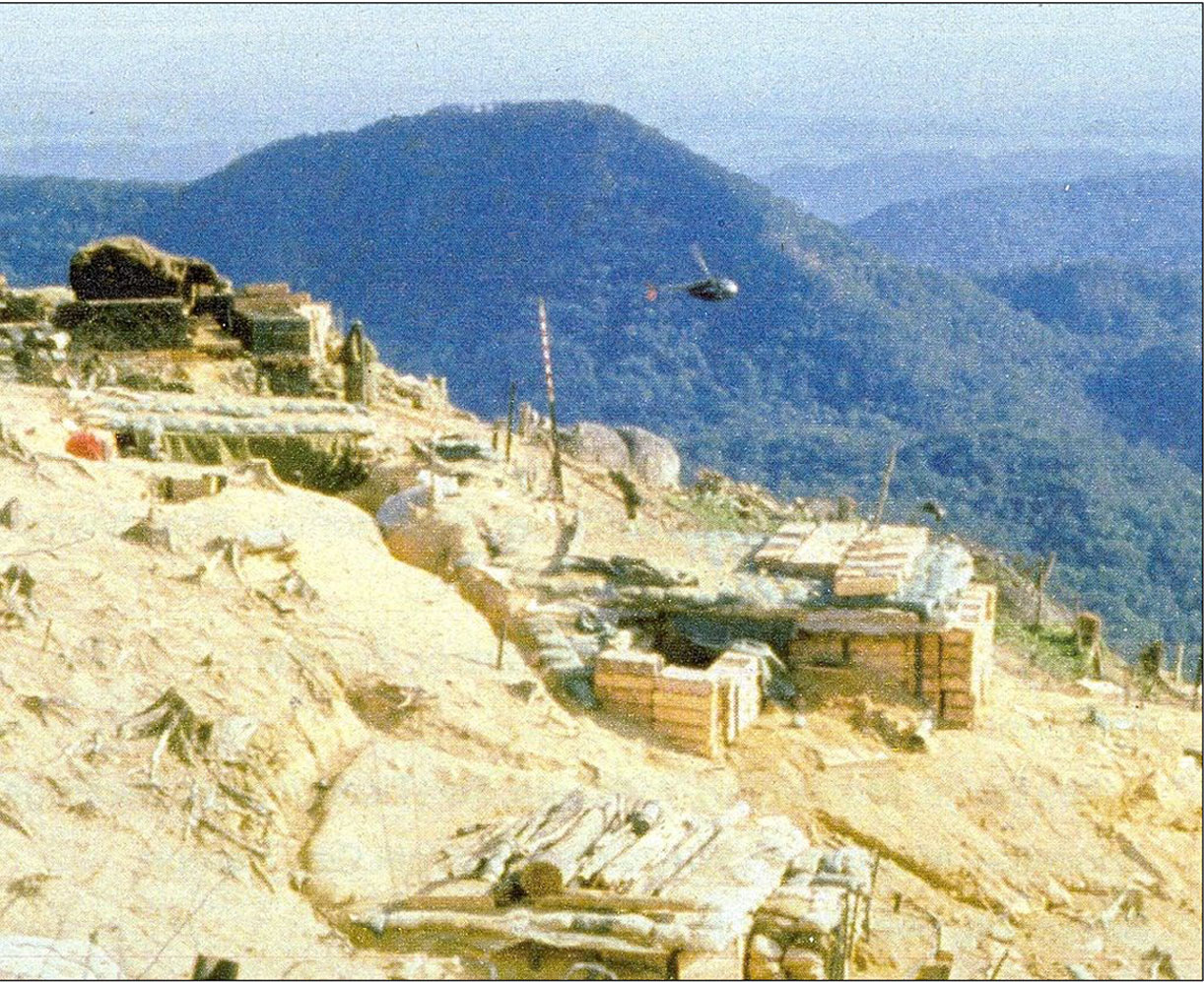
Aerial view of Fire Support Base Ripcord. (Signal History Collection)
install a 50-meter-wide perimeter of barbed wire as well as many land and claymore mines. The battalion TOC was built on the eastern slope near the top of the hill. Members of the HHC and battalion staff worked around the clock to improve the position with sandbags. Among those conducting that work were Darling and his signalmen. Later a separate communications center would be built, as the need for communications grew from squad level up to strategic aircraft to support the mission.
Amid the base development, on May 18, 1970, Darling boarded a UH-1 helicopter flown by C Company, 158th Aviation Battalion, that was on a resupply mission at Ripcord. He and Sgt. Harry J. Stone hitched a ride so they could take a new radio to A Company back at Camp Evans, and then Darling was supposed to begin his Rest and Recuperation leave the next day. However, during the flight, the UH-1 was hit by enemy groundfire. And although the pilot tried to make a forced landing, the aircraft crashed and rolled down a steep hill and out of sight due to the thick jungle canopy.
Three crewmen were killed along with Darling and Stone. The crew chief managed to jump from the UH-1 prior to the crash and was found the next day. Not knowing the exact whereabouts of the aircraft, a rifle platoon was inserted to conduct a search but was not able to find the UH-1 due to nightfall. It was not until May 31 that the aircraft was found, and the bodies, including Darling, were recovered. On June 2, 1970, the Army declared 23-year-old Darling to have been killed in action.
Darling’s life had an impact on those who knew him then and long after the battle. The battalion chaplain’s assistant, Rick Blythe, wrote about his experiences at Ripcord. In a letter home on May 25, 1970, he included the comment, “Our communications officer was found. His chopper was all shot up. Only the crew chief survived. He’s in a state of shock. Lieutenant Darling was well-liked by everyone.”
One of Darling’s signal Soldiers, Ernie Claxon, remembered, “We called him ‘the Duke.’ He acted like John Wayne. He was a good man, straight-up honest good guy. He led by leading.” Another Soldier in HHC said, “Darling was a Soldier’s Soldier. He was an Airborne Ranger. He was a West Point graduate. I thought he was an outstanding officer and Soldier.”

Plaque dedicated to 1st Lt. John E. Darling Jr. at Darling Hall, Fort Eisenhower (then Fort Gordon), Georgia. (Signal History Collection)
The last days of Ripcord began on July 18, when the PAVN shot down a CH-47 Chinook, which crashed into the artillery ammunition storage area, ignited the artillery ammunition, and destroyed six 105 mm howitzers and 2,238 rounds of ammunition. The next day, the PAVN attacked the base with mortar fire, and the 2/506th sustained 11 more wounded. At that point, 101st leadership decided Ripcord was becoming a liability and holding it did not justify further casualties. Orders were issued to abandon the base by July 23, and once all friendly personnel had left, B-52 bombers were sent in to obliterate anything remaining.
Though he did not serve long as the battalion S6 for the 2/506th Infantry at Ripcord, Darling should be remembered for his actions April 1, 1970, when he assumed command of an infantry battalion jump TOC, worked to save the lives of his fellow Soldiers, and direct firepower against the attacking enemy. Darling made a difference through his leadership during the chaos and applied all the training he had accumulated during that one day on an obscure hill in Vietnam. His untimely death May 18, 1970, ended his physical presence but not his memory.
Those who knew Darling remembered him as friendly, likable, and an all-around great guy in addition to being a skilled signal officer. Darling was posthumously awarded a Silver Star Medal, Bronze Star Medal, and Purple Heart.
On July 8, 1994, the 27th Chief of Signal, Maj. Gen. Robert E. Gray, dedicated the new Soldier Support Center and Garrison Headquarters, Building 33720, as Darling Hall, in honor of 1st Lt. John E. Darling Jr. Since that time, every Soldier who has attended training at the U.S. Army Signal School has passed through the doors of Darling Hall where several of Darling’s photos, medals, and Silver Star citation are displayed prominently in the lobby to serve as inspiration for signal Soldiers in the 21st century.

Located along Chamberlain Avenue a short distance from Main Gate, Darling Hall is often the first stop for Soldiers and their family members arriving at Fort Eisenhower, Georgia. (Signal History Collection)
Author
1st Lt. John E. Darling Jr. and the Battle for Fire Support Base Ripcord