Common Knowledge
By Claudia Flisi
Article published on: March 20, 2025 in the Spring 2025 edition of the Army AL&T Magazine
Read Time: < 13 mins

PILLAR 1 MAINTENANCE - The U.S. Navy submarine tender U.S.S. Emory S. Land arrived in Australia in August 2024 as part of an AUKUS exercise involving military from both countries. (Photo by 2nd Class Darek Leary, U.S. Navy)
Since 2021, the U.S., U.K. and Australia have been partnering to standardize and share battlefield sensor data.
Information is the ultimate weapon in the future of warfare. All the traditional equipment of war—whether offensive weapons such as guns and bombs, defensive devices like radar and light detection and ranging, known as LIDAR systems, or transport vehicles including tanks, planes, ships and submarines—depend more and more on information-generating sensors to carry out their missions.
Better, deeper, clearer and faster information is essential to a winning strategy as weapons become more powerful, defense devices become more advanced and vehicles become faster and more complex. Australia, the United Kingdom (U.K.) and the United States (U.S.), the three countries that make up the AUKUS alliance, are well aware of these changes in the military landscape and have joined together to adapt in coordinated fashion. AUKUS is working with the U.S. Army’s Program Executive Office for Intelligence, Electronic Warfare and Sensors (PEO IEW&S) to ensure that the information generated by each country’s sensors can be understood and shared by all partners.
The focus on interoperability began well before the creation of AUKUS in 2021, explained Christine Moulton, acting strategic integration manager for the Integration Directorate at PEO IEW&S. “Around 2013, we began discussing how to better use standards to provide true interoperability. We wanted configuration coordination to be able to connect systems and share information, at least on a basic level.”
That led to the development of Integrated Sensor Architecture (ISA), which will meet the challenge of combining unique technical requirements from various modalities of sensors, types of data, distinct platforms and specialized implementations. The Army began working on ISA in 2011 and had compiled significant experience within the DOD when the PEO IEW&S Integration Directorate was asked to assist with interoperability within AUKUS. ISA is designed to make systems and their capabilities accessible to Soldiers and platforms without prior training or specific integration and regardless of system type or ownership. This design maximizes access to useful data and functionality, while minimizing integration complexity and life cycle costs.
“We are well positioned to support whatever those future changes may be.”
PARTNERSHIP PILLARS
The AUKUS security partnership between Australia, the U.K. and the U.S. was officially announced on September 21, 2021, but its cultural, economic and military roots obviously have a much longer history.
The U.S. and the U.K. have a longstanding relationship dating back formally to World War I but informally since the mid-1800s. Following World War II, they formed a bilateral partnership (UKUSA) for intelligence sharing in 1946. A decade later, this had developed into the Five Eyes (FVEY) alliance, with the addition of Canada, Australia and New Zealand. FVEY focuses on the gathering and sharing of intelligence information gleaned through signals (or signal intelligence), as well as electronic, cryptographic and other means.
AUKUS became a natural extension of UKUSA thanks to geography, as Australia’s location in the Pacific makes it ideally suited for intelligence gathering in that part of the world. Its key objective is to improve the quality of decision-making by commanders in the three countries, as measured in speed, accuracy and effectiveness.
The partnership is defined by two pillars. The first pillar, according to DOD, is “to enable Australia’s acquisition of a conventionally armed, nuclear-powered submarine capability,” and, in fact, the Australia Defence Force is currently scheduled to receive eight nuclear submarines starting in the 2030s.
The second pillar expands on this arrangement, acknowledging that the combined capabilities of the three countries make them stronger in a region where China’s emergence as a global power is perceived as a security threat. Its purpose is to ensure cooperation to develop and provide advanced capabilities to promote security and stability in the Indo-Pacific region. These advanced capabilities encompass artificial intelligence (AI), quantum computing, hypersonic and counter-hypersonic weapons, undersea warfare and cybersecurity.
QUANTUM AS SENSORY SUPERPOWER
Quantum computing, in particular, will play a major role in the future development of sensors and its importance cannot be overstated. Complex computations that would take a “traditional” supercomputer 47 years can be done by a quantum computer in mere seconds.
This will make it possible for AUKUS to realize the detection of microscopic changes in magnetic or electric fields, so that enemy missiles, aircraft, submarines or underwater mines can be identified much earlier than was previously possible. It will enable more precise navigation systems, including those in environments where GPS cannot function. Quantum power will bring about more accurate mapping of enemy territories and contested environments, improving intelligence, surveillance, target acquisition and reconnaissance capabilities. More secure encryption will also be possible, facilitating ultra-secure communications among allies. Perhaps most significantly, commanders will be able to make better decisions based on real-world conditions and complex scenarios involving land, air, sea, space and cyberspace simultaneously.
In recognition of this potential, AUKUS has an official Quantum Arrangement focusing specifically on positioning, navigation and timing.
AUKUS INTEROPER ABILITY
In addition to countering military risks in the Pacific, AUKUS focuses on coordinating interoperability among its three partners and working together on advanced technology innovations that will strengthen the defenses of all three countries. Increasingly, customized battlefield sensors, integrated into U.S. Army architecture, are key to these innovations.
This trilateral partnership among allies also fosters the development of a “Common Tactical Picture” system, enabling commanding officers to reach better, faster and more coordinated decisions. Commanders have clearer and more complete information at their disposal, they have it faster so they can reach decisions more quickly and they can share this information instantaneously with their counterparts in AUKUS.
STRENGTHS IN PARTNERSHIP
Each partner brings its own expertise to the program. The U.S. has deep research capabilities in quantum technologies, AI and autonomous systems such as drones. The U.K. has a well-regarded quantum research program, as well as expertise in electronic warfare and command and control systems. Australia also has strengths in quantum physics but is now focused on developing undersea sensor capabilities through the AUKUS Undersea Robotics Autonomous Systems project.
By sharing research findings, the three partners can pool their resources and avoid costly duplication while optimizing resource utilization. They can also share data in the development and testing of new sensors across varied domains—land, maritime, air and cyber. This makes sense for large-scale projects in technological innovation, which require specialized equipment and multimillion-dollar investments.
The challenges they face may be new, but they have been facing common threats for more than a century. Shared information about these threats can only work to the benefit of AUKUS. This shared data needs to be communicated smoothly and synchronously, utilizing a common standard to maximize interoperability. Hence the need for sensors that are compatible across their respective military forces, which happens when they are developed jointly.
“Our partners can provide updates and additions to the standard, and the implementation to make it better in a dynamic way, which is always a good thing to have in collaboration,” Moulton noted.
Equally important, system standardization should not affect operators in the three countries. “Once standardization has been implemented, Soldiers using the equipment, the end users, will operate their systems as they have always done,” observed Moulton. “The functionality of ISA is unobtrusive. All ISA does is provide additional ways to pull in data and information. It works behind the scenes for the Soldier.”
THE NATURE OF SENSORS
Sensors have existed in nature for millions of years. Dolphins and bats use echolocation, a specialized form of sonar. Sharks use electroreception, sensing the electric fields of their prey. Pit vipers use infrared radiation. Birds use the earth’s magnetic field to navigate during migration. Bees use ultraviolet light to find food.
Humans have been trying to catch up over the last two millennia, starting with primitive devices like weather-vanes and water sensors developed by ancient Romans. Scouts or reconnaissance patrols were the original human sensors, serving as eyes and ears ahead of an advancing army. Automated sensors for commercial use became important during the Industrial Revolution and for military applications during World War I. With the advent of World War II, the speed of innovation increased, and radar, sonar, infrared and magnetic sensors became indispensable for fighters on land, sea and air.
The Cold War accelerated sensor innovation, especially for radar systems. However, the most dramatic changes came with the digital revolution. By the 1990s, military strategists were incorporating vastly improved temperature, pressure, infrared, motion, acoustic, seismic, environmental, electro-optical and biometric sensors in their operations. Digital technology has made possible increasingly accurate laser guidance systems; multi-spectral imaging; improved sonar systems; cyber sensors; chemical, biological, radiological and nuclear sensors; and electronic warfare sensors. The latter is used to detect, analyze and often confound enemy signals.
The concurrent rise of Internet of Things and—more recently—artificial intelligence and machine learning have resulted in the development of unmanned aerial vehicles, or drones, and other independent or semi-independent devices. These new technologies, reliant on ever-more-sophisticated sensors, are continuing to change the nature of warfare.
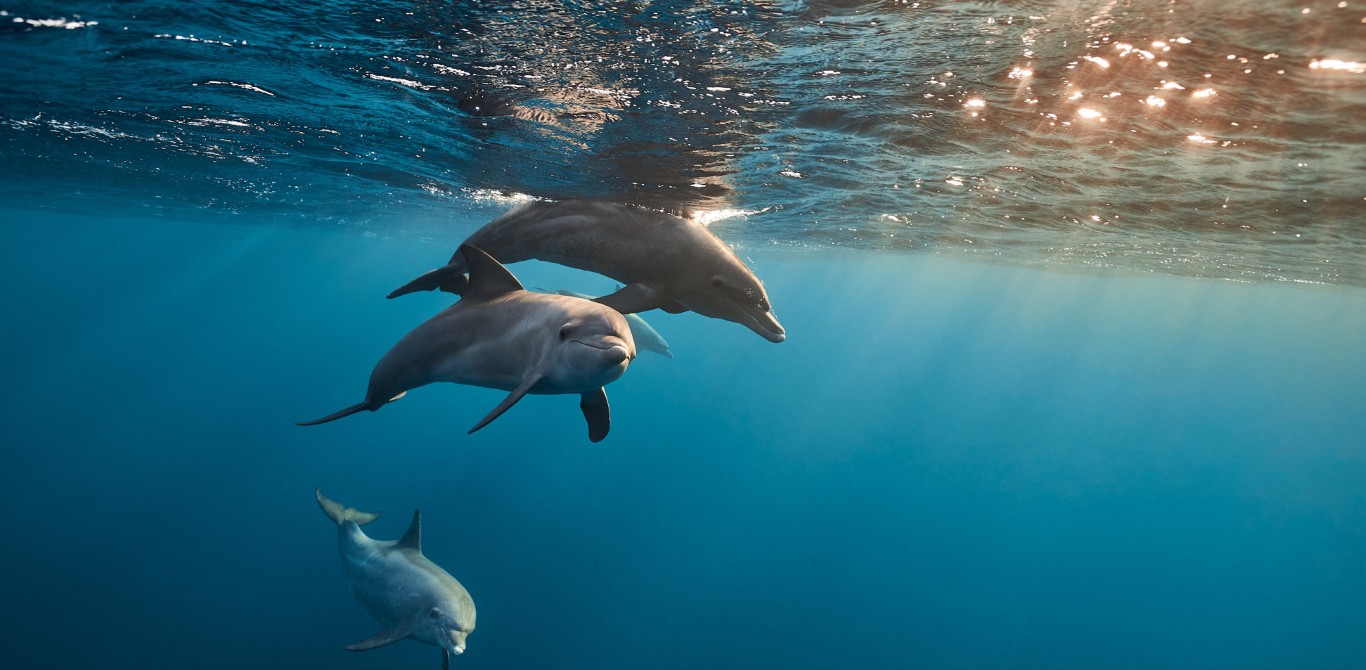
SPECIALIZED SONAR - Dolphins have been practicing sophisticated echolocation for millions of years. (Photo by Tetsuo Arada, Shutterstock)
Complex computations that would take a “traditional” supercomputer 47 years can be done by a quantum computer in mere seconds.
AVOIDING DATA OVERLOAD
A potential problem of sensor standardization in AUKUS is the danger of data overload. “We could have more data than the network could support and more information than an operator can digest,” acknowledged Moulton.
To avoid this issue, operators don’t automatically receive all the data from the system’s capabilities. Only the information and data that have been subscribed to or requested are sent. There are multiple ways to subscribe, such as geographically or by type, and the system has been designed dynamically, so adjustments can be made depending on need. “That in and of itself is going to help with data management, because, right from the beginning, not everyone is getting all the data that is available,” Moulton emphasized.
Interoperability has always existed among the three partners, but it had lacked “commonality.” According to Moulton, “It wasn’t as elegant or as seamless, and it definitely did not have dynamic connectivity. It was a lot more work and a lot more effort.” She is confident that the ISA standards that have been developed are flexible enough to accommodate new capabilities and new sensor technologies. “I think we are well positioned to support whatever those future changes may be.”
With the joint approach through AUKUS now entering its fourth year, Moulton looks forward to the contributions each partner can make to the standard and mutual understanding as a basis for additional improvements. “I look forward to the collaboration that we’re going to foster with AUKUS and the additions they can provide to the standard. The more it’s adopted, the better our understanding of how to improve it.”
For more information, go to https://peoiews.army.mil or https://www.defense.gov/Spotlights/AUKUS.
Authors
Claudia Flisi provides contract support to the U.S. Army Acquisitions Support Center as a contributing writer and editor for Army AL&T magazine and JANSON. Her writing has appeared in the International New York Times, Newsweek, Fortune and other publications, websites and books from four countries in three languages. She has an M.A. in international affairs from the Johns Hopkins School of Advanced International Studies and a B.A. in international relations with distinction from Mount Holyoke College.