Retaining Expertise Through Lost-Cost Opportuinity, Innovation, and Modernization
By CW4 Phillip J. Hall, Special Forces
Article published on: April 1, 2025 in the Warrant Officer Journal April 2025 Edition
Read Time: < 7 mins
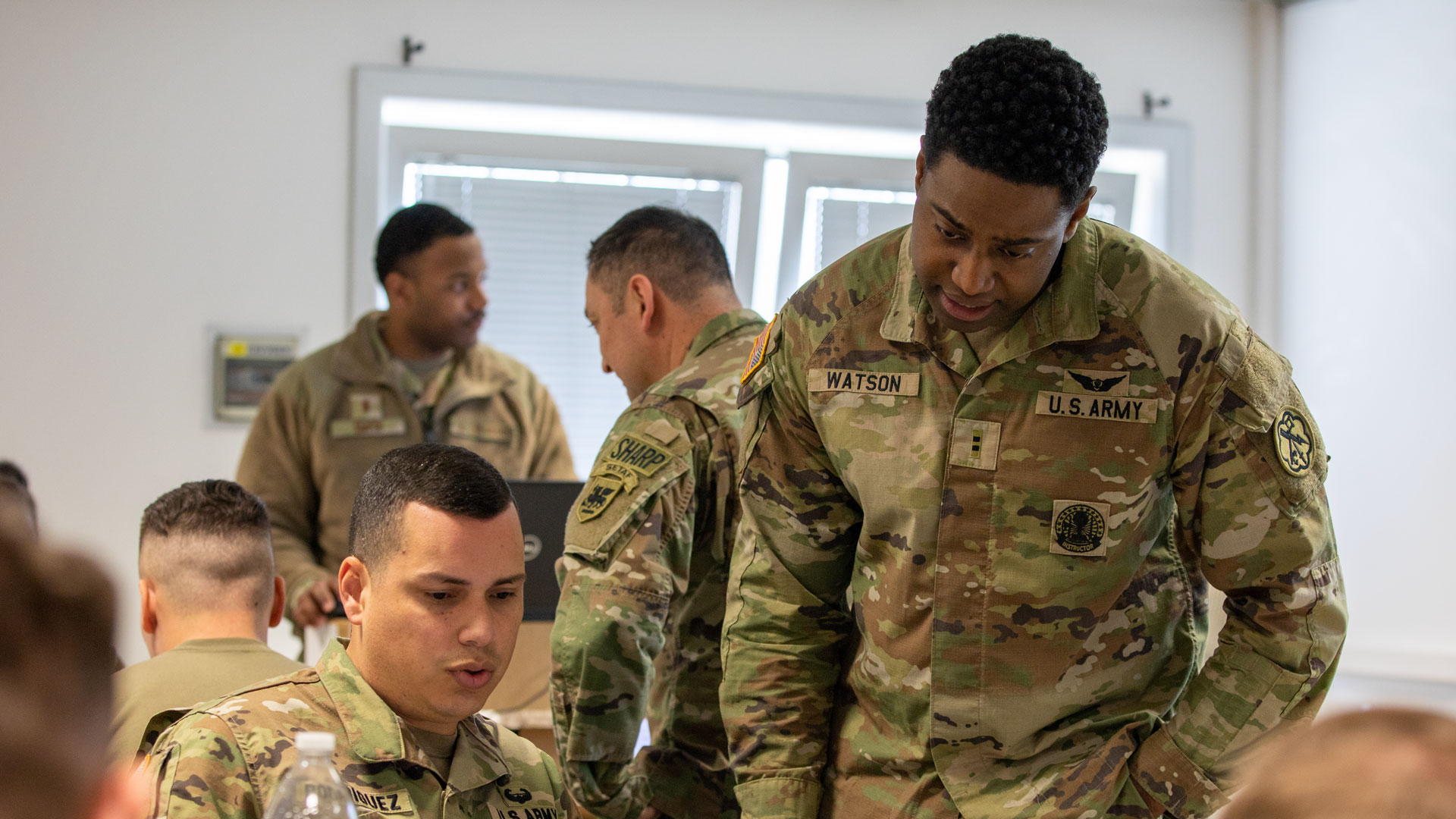
Chief Warrant Officers Felix Rodriguez and Michael Watson, geospatial intelligence tech
officers assigned to the 522nd Military Intelligence Battalion, 207th Military Intelligence Brigade
(Theater), participate in the U.S. Army Southern European Task Force, Africa (SETAF-AF) joint task force
validation command post exercise at Caserma Ederle, Vicenza, Italy on Mar. 16, 2023.
Introduction
Implementation of the Chief Warrant Officer Six (CW6) grade for select positions at the two-star level and above,
offers a cost-effective, innovative solution to retain expertise without adding additional force structure. The
military can maximize technical expertise and experience of senior warrant officers by capitalizing on their
unique skills, education, and years of experience as technical advisors, systems integrators, and senior
mentors. Implementing this grade by echelon ensures continuity of knowledge, experience, leadership while
strengthening operational and strategic level effectiveness.
The Retention Problem
The military invests considerable time and resources in its personnel, as people are the Department of
Defense's number one asset (Cisneros, 2022). The military services equip them with a wide range of skills
that can apply across different industries within the civilian sector. Warrant Officers are recognized as
technical experts in various specialized fields, including logistics, aviation, and cybersecurity. Warrant
Officer have leadership skills gained through operational experience; these veterans arrive ready to contribute
from day one.
Civilian Companies
Companies create strategies to maximize efficiencies and lower costs in today's competitive business
environment. One solution lies in recruiting experienced military veterans as they approach the end of their
careers. These individuals create a talent pool, bringing years of expertise and training acquired in
high-pressure, sometimes high-threat environments. They offer corporations a cost-effective substitute for
lengthy, expensive training programs.
Consider the cost of training an aviator with minimal experience versus hiring a veteran with years of experience
in military aviation, often on multiple platforms. Further consider expenses linked with developing and
maintaining leadership compared to hiring a former military officer competent in leading troops in high-stress
situations; these financial benefits become abundantly clear.
Most importantly, veterans are known for their strong work ethic, discipline, and commitment to mission
success-qualities instilled through years of rigorous military training. A strong work ethic equals higher
productivity, lower turnover rates, and a culture whose foundation is based on efficiency and results (Goozner,
2024).
Retirements
In 2023, approximately 1100 Warrant Officers retired between the grades of CW2-CW5, averaging 24 years of service
in the US Army (W. Tuchtenhagen, personal communication, March 10, 2025). These retirements are a significant
loss of expertise and a considerable financial blow to the Department of the Army. While a CW4 with 15 years of
aviation training averages nearly $27,000,000 in training (C. Carter-White, personal communication, March 10,
2025), other technical experts can average $300,000 per individual. This financial burden pales in comparison to
the irreplaceable experience of expertise walking out of the door.
These 1100 Warrant Officers represent 26,400 years of hands-on expertise and institutional knowledge translating
to a significant reduction in the military's ability to:
- Maintain complex systems: Warrant Officers possess technical proficiency, which is critical for
troubleshooting and ensuring the operational readiness of sophisticated equipment.
- Train and mentor personnel: Their experience is invaluable for shaping the next generation of junior
officers and warrant officers and for providing commanders with recommendations based on years of
experience.
- Develop and refine tactics, techniques, and procedures: Years of real-world experience contribute to
evolving practical strategies and operational procedures.
This loss of personnel creates a knowledge gap that will take years to fill and millions of dollars to replace.
Retaining this invaluable human capital through targeted incentives and creating additional opportunities is not
just fiscally responsible, it is essential for maintaining military strength.
Addressing the Solution: Force Management
The growth of the Warrant Officer cohort within the Department of the Army, from a mere 1,120 positions in 1920
to about 26,000 in 2025 (Winkler, 2023), highlights the increasing importance and contribution that warrant
officers' offer. This growth, however, leads to a stove pipe at the highest echelons of Warrant Officer
leadership. As of today, about 1,215 individuals wear the rank of CW5 (Department of the Army, 2025)
representing the peak of their technical expertise and leadership within a specialized field (Department of the
Army, 2019).
At times, this concentration of talent presents a challenge in terms of upward mobility and strategic influence.
A strategic opportunity presents itself by converting approximately 10% of existing CW5 billets at the two-star
command and above. This innovative shift would place highly experienced Senior Field Grade Warrant Officers in
positions to advise senior leaders and commanders on operational impacts and technical matters, influence policy
decisions, and shape long-term strategic planning and integration.
This approach recognizes the value of Senior Filed Grade Warrant Officers and incentivizes career progression,
minimizing the number of those looking to retire or ETS to join the civilian sector. This, in turn, would
strengthen the entire force by ensuring that the most experienced voices contribute to strategic decision-making
at the highest levels as the Department of the Army faces the Large-Scale Combat Operations dilemma.
Cost
Considering a fiscally constrained environment, when each dollar spent is imperative, the conversion of
approximately one hundred twenty CW5 billets to CW6 presents a cost-effective solution to combat retention
challenges and leverage senior Warrant Officers' experience. The projected annual cost of converting roughly
120 billets is less than $2.5 million. This investment is a fraction of the hundreds of millions of dollars
associated with losing personnel to the civilian sector and offers a high return on investment. CW6 will see a
monthly increase of $1,500 in base pay (see Figure 1).
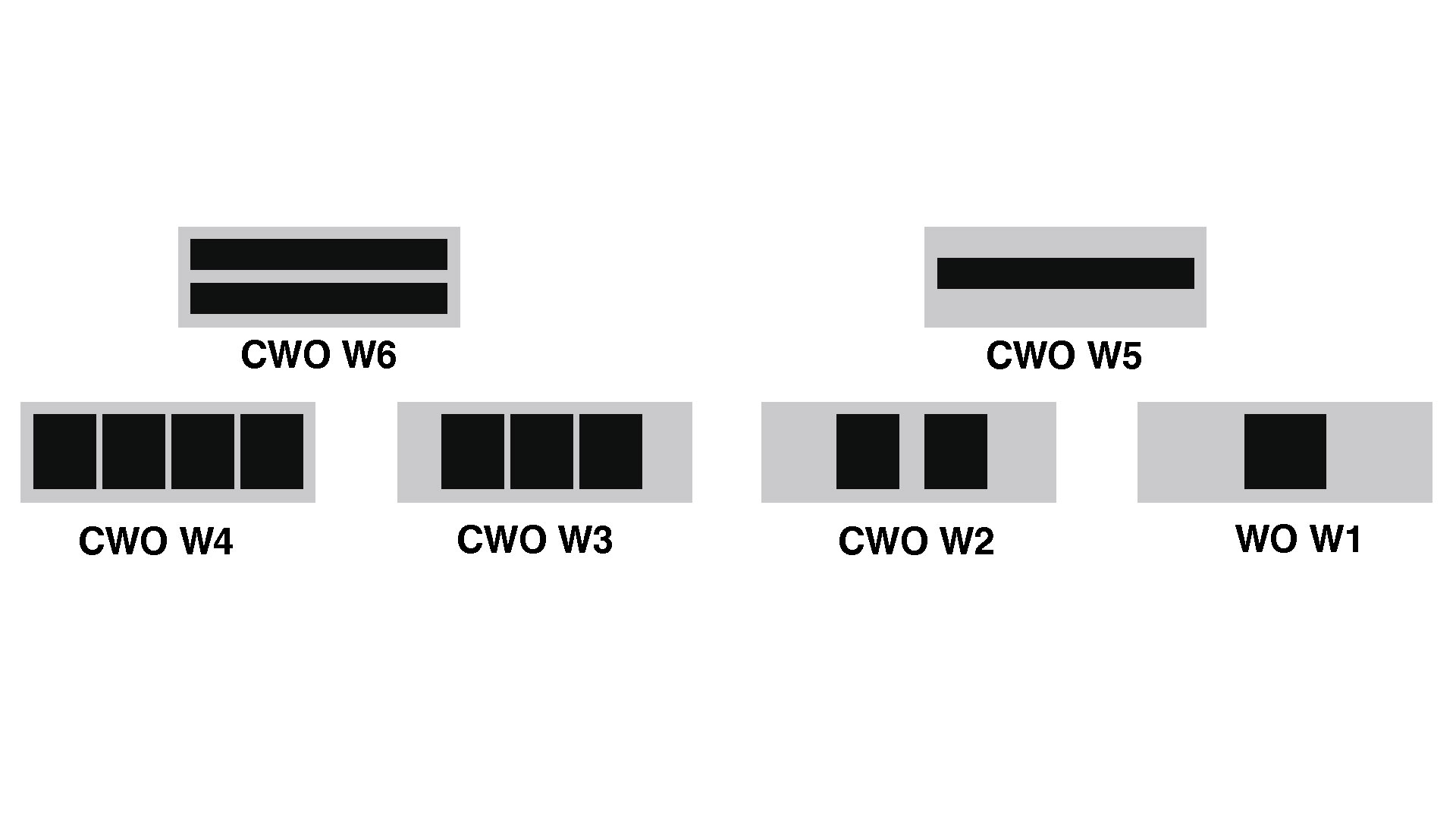
Warrant Officer Grade Insignia approved by Chief of Staff of the Army, 10 June, 1970. CW5 was
approved by Congress in 1991. CW6 was not approved by Congress.
| Pay Grade |
2 or less |
Over 2 |
Over 3 |
Over 4 |
Over 6 |
Over 8 |
Over 10 |
Over 12 |
Over 14 |
Over 16 |
Over 18 |
| W-6 |
|
|
|
|
|
|
|
|
|
|
|
| W-5 |
|
|
|
|
|
|
|
|
|
|
|
| W-4 |
5,273.10 |
5,671.50 |
5,834.40 |
5,994.60 |
6,270.60 |
6,543.60 |
6,820.20 |
7,235.40 |
7,599.90 |
7,946.70 |
8,231.10 |
| W-3 |
4,815.60 |
5,015.70 |
5,222.10 |
5,289.00 |
5,504.40 |
5,928.90 |
6,370.80 |
6,579.00 |
6,819.90 |
7,067.40 |
7,513.80 |
| W-2 |
4,260.90 |
4,663.80 |
4,787.70 |
4,873.20 |
5,149.20 |
5,578.50 |
5,791.80 |
6,001.20 |
6,257.40 |
6,457.80 |
6,639.00 |
| W-1 |
3,739.80 |
4,143.00 |
4,250.70 |
4,479.60 |
4,749.90 |
5,148.30 |
5,334.30 |
5,595.30 |
5,850.90 |
6,052.20 |
6,237.60 |
| Pay Grade |
Over 20 |
Over 22 |
Over 24 |
Over 26 |
Over 28 |
Over 30 |
Over 32 |
Over 34 |
Over 36 |
Over 38 |
Over 40 |
| W-6 |
10,875.60 |
11,351.10 |
11,705.70 |
12,097.20 |
12,097.20 |
12,628.20 |
12,628.20 |
13,183.50 |
13,183.50 |
13,769.10 |
13,769.10 |
| W-5 |
9,375.60 |
9,851.10 |
10,205.70 |
10,597.20 |
10,597.20 |
11,128.20 |
11,128.20 |
11,683.50 |
11,683.50 |
12,269.10 |
12,269.10 |
| W-4 |
8,508.30 |
8,914.50 |
9,248.70 |
9,629.70 |
9,629.70 |
9,821.70 |
9,821.70 |
9,821.70 |
9,821.70 |
9,821.70 |
9,821.70 |
| W-3 |
7,814.70 |
7,994.70 |
8,186.70 |
8,447.10 |
8,447.10 |
8,447.10 |
8,447.10 |
8,447.10 |
8,447.10 |
8,447.10 |
8,447.10 |
| W-2 |
6,856.20 |
6,998.70 |
7,111.80 |
7,111.80 |
7,111.80 |
7,111.80 |
7,111.80 |
7,111.80 |
7,111.80 |
7,111.80 |
7,111.80 |
| W-1 |
6,462.90 |
6,462.90 |
6,462.90 |
6,462.90 |
6,462.90 |
6,462.90 |
6,462.90 |
6,462.90 |
6,462.90 |
6,462.90 |
6,462.90 |
Figure 1. Example Military Pay Table with CW6 (based on 2025 Military Pay Table).
The Basic Allowance for Housing (BAH) with dependents of $110 and BAH without dependents of $164 (see Figure 2)
serve as powerful retention incentive, encouraging these highly skilled professionals to continue their service
and contribute to national security at the highest levels.
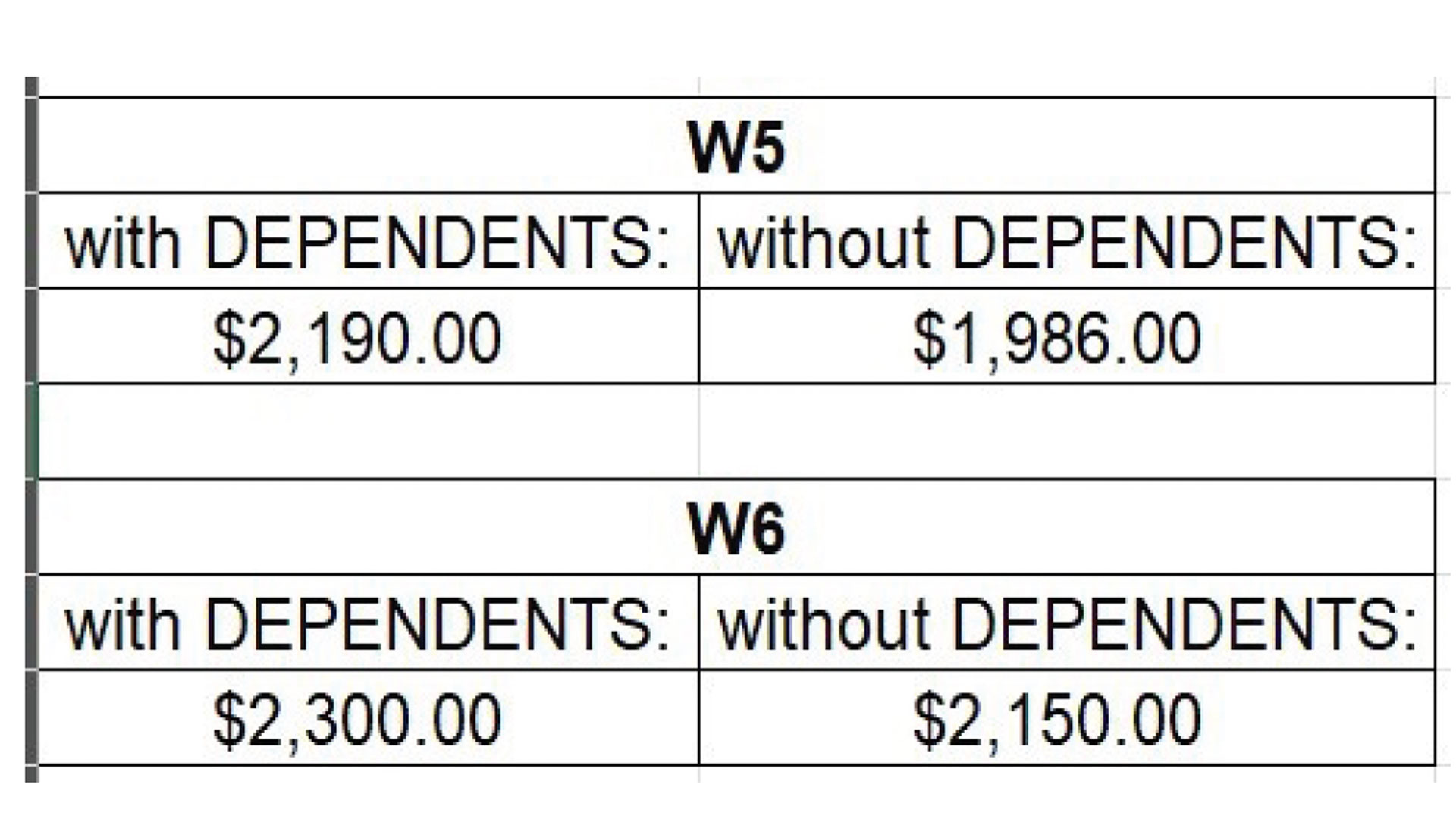
Figure 2. Chart showing BAH rates for W5 and W6, with and without dependents.
Requirements and Restrictions
To attract the most qualified individuals, all positions converted should be strictly nominative. Warrant
Officers should not be able to achieve Chief Warrant Officer Six (6) through the traditional time-inservice or
time-in-grade requirements. Eligible CW5s who are interested will be vetted and selected based on their
performance, leadership, and strategic knowledge. Furthermore, each CW6 CCWO position should be designated as an
"up-or-out" assignment, requiring the selected warrant officers to either progress to higher roles or
transition out of the military. This approach will prevent stagnation and ensure a constant flow of highly
qualified Senior Field Grade Warrant Officers at the highest levels, mitigating the risk of the "stovepipe
effect" discussed earlier and reducing the chance of complacency and adaptability.
Structural Changes
The Department of the Army should intentionally assign the proposed CW6 positions to key leadership and
operational units across the Army, including each of the 54 states and territories within the Army National
Guard, the National Guard Bureau, and the Office of the Chief of the Army Reserve. Additionally, each of the 11
Combatant Commands and the 17 Chief Warrant Officers of the Branch positions will have dedicated CW6 positions.
Understanding the importance of Professional Military Education (PME), the US Army Warrant Officer Career
College and other TRADOC entities requiring Command Chief Warrant Officers or Commandants must also establish
these positions. Finally, the Chief Warrant Officer of the Army and select positions within the Warrant Officer
Council ensure representation for strategic input at the highest level.
Professional Military Education
In 2023, TRADOC mandated the modernization of Warrant Officer Professional Military Education. (J. Young,
personal communication, March 7, 2025). The US Warrant Officer Career College has reorganized and developed a
new curriculum from the Warrant Officer Candidate School through the Warrant Officer Master Course, specifically
designated for Senior Field Grade Warrant Officers for those identified to serve in select nominative positions.
Feedback from over a dozen current and former CCWOs from the O6 - O10 level provided valuable insight on topics
they would have benefited from, including Defense Planning Guidance; Budget Estimate Submission; Program,
Planning, Budget Execution, Manning; and recruiting/retention (J. Young, personal communication, March 7, 2025).
The Warrant Officer Master Course will function as PME for these executive level CW6 positions and, if required,
be modified to add additional content.
Conclusion
Congressional approval of the Chief Warrant Officer Six (CW6) rank represents a practical solution to retain our
military's technical experts while strengthening leadership at strategic levels. This straightforward change
would help prevent the exodus of experienced warrant officers to civilian corporations, provide commanders with
specialized expertise, and acknowledge the critical contributions of our warrant officer cohort-all at minimal
cost to taxpayers. We must engage in meaningful dialogue about this opportunity at upcoming leadership forums,
professional development sessions, and branch conferences as military professionals dedicated to force
readiness. I urge you to share your perspectives on implementing the CW6 rank with your chain of command and
congressional representatives, as collective advocacy from those who understand the operational impact will
ultimately drive this long-overdue advancement for our warrant officer corps and the military's technical
leadership capabilities. Strength in Knowledge. This We'll Defend.
Editor's Note:
Phillip J. Hall is a Chief Warrant Officer Four (CW4) in the Alabama Army National Guard and currently serves
within the G3 division of the Joint Forces Headquarters (JFHQ). He has 27 years of experience, 22 of which
in Special Forces, and has worked at the ODA, Company, BN, Brigade, Division, and TSOC levels.

Official emblem of The Warrant Officer Journal featuring a stylized eagle surrounded by laurel
leaves, encircled with the motto "Strength in Knowledge: The Warrant Officer Journal."
References
Cronk, T. (2022, April 27). DOD's Great Strength Is its People, Undersecretary Says. US Department of
Defense News.
Goozner, M. (2004). Higher skills, fewer jobs: with advanced technology and skilled workers, America can keep
a strong manufacturing sector, but rising productivity equals a smarter--and smaller-- work force. The
American Prospect, 15(1), 42+.
US Army. (2023, July 7). Fort Liberty celebrates the 105th anniversary of the Army Warrant Officer Corps. US
Army.
https://www.army.mil/article/268200/fort_liberty_celebrates_105th_anniversary_of_army_warrant_officer_corps
US Army. (2019). Office Professional Development and Career Management (DA PAM 600-3).
Winkler, D. (2022, January 6). AFC warrant officer achieves CW5 rank. US Army.
https://www.army.mil/article/263117/afc_warrant_officer_achieves_cw5_rank