What is Protection in 2040?
By Mr. Michael J. Martori
July 1, 2023 | Protection, 2023 Annual Issue
Read Time:
< 6 mins
“The protection warfighting function is essential to preserving future
capabilities in multidomain operations.”
—D. Scott McKean1
Protection has always been a complicated and complex warfighting
function—from the War on Terrorism (when protection was defined by base
defense, barriers, physical security, persistent ground surveillance, and
blimps, which are inherently passive and reactive) to today’s need for
dispersion, sensor-to-shooter interactions, and robotics, which shift the
focus to active measures that provide overmatch. If you ask 10 different
people what they think protection is, you will likely get 10 different
answers. So, what is protection?
As the Army modernizes through its signature systems and adaptive
formations, leaders and Soldiers must understand protection in 2030 and,
more importantly, operationalized protection. Approving U.S. Army Futures
Command (AFC) Pamphlet (Pam) 71-20-7, Army Futures Command Concept for
Protection 2028,2
in 2021 was a significant first step in realizing these goals. Fast forward
to today; and now, it is AFC’s mission to deliver the Army of 2030 and
design the Army of 2040. Protection in 2030 must include ways to preserve
critical capabilities, assets, and activities against threats in all
domains; deny the enemy freedom of action; and enable access so that
commanders can apply maximum combat power to defeat the enemy. Protection
capabilities must deny, degrade, and disrupt enemy positions of advantage,
freedom of action, and abilities to destroy friendly critical capabilities,
assets, and activities across the operational environment, including the
homeland.
In speaking about the ever-changing character of warfare, General James E.
Rainey, AFC Commanding General, makes these three points:3
-
There is a paradigm shift from “conducting fires to maneuver” to
“conducting maneuver to fire.” Some of you may be shaking your heads, but
think about our future fight and how fires will shape that fight—even more
than troops on the ground will. General Rainey says, “I personally think
fires is going to move back up ahead of maneuver to the top slot. We’re
going to maneuver to place fires versus using fires to condition
maneuver.”
-
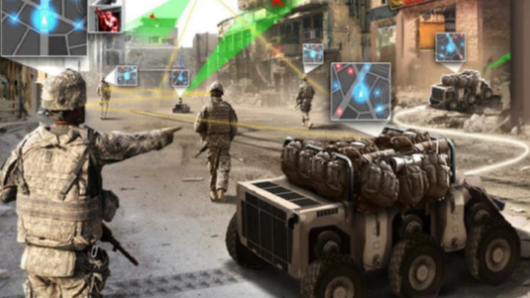
There is a need for capable formations that are enabled by human-machine
integration. The Army fights by formation, and capable formations—with all
the systems, personnel, and training necessary to fight and win our
Nation’s wars—are required. Through human-machine integration, robotic
systems will become our forward line, or “first contact,” if you will.
-
We must “figure out” protection. It’s this point that keeps me up at
night. Hearing a senior Army leader say that we must “figure out
protection” is scary. Large-scale combat operations are very different
than operations conducted during the last fight. On a battlefield where
you can be killed if you can be seen, and you can be seen; well . . . you
fill in the blank. In that fight, protection is more critical than ever.
Although artificial intelligence, machine learning, dispersion, deception,
signature systems, and capable formations will all provide protection,
more must be done.
For protection to truly be understood in 2040, commanders must change the
way they think about it. Think about the last warfighter exercise in which
you were involved and about the role of the protection cell in that
exercise. How did the protection coordinator influence the fight—or even
make him- or herself be heard, outside of providing the commander with a
Protection Prioritized List (PPL)? Too often, protection personnel talk
about protection with other protection personnel, which is mildly
interesting but not very useful. The protection cell is responsible for
preserving the effectiveness and survivability of mission-related military
and nonmilitary personnel, equipment, facilities, information, and
infrastructure deployed or located within the division operational area. If
the PPL were integrated as a product to synchronize operations for the next
72–96 hours—along with the air tasking order framework that fires personnel
use to plan air support, indirect fires, and aviation attacks—into
centralized planning, that would be useful! Integrating the PPL into the air
tasking order cycle would allow for thorough staff analysis and coordination
to maximize resources, while also enabling the commander to assess risk to
the mission during decisive operations. Like the fire support coordinator
who (with the targeting team) provides approved guidance, the high-payoff
target list, the attack guidance matrix, and target selection standards in
relationship to the intelligence and operations situation briefings, the
protection coordinator provides guidance on resources needed to protect the
approved PPL, assesses task force capabilities and the availability of
resources, and then deconflicts future PPLs—all while coordinating resources
for decisive operations 72–96 hours before an operation. Protection must be
engrained in commanders’ thought processes and integrated into the
operations process.
If protection in 2040 resembles what it does today, our Army risks failure.
Although opinions differ, most leaders can describe what protection
currently looks like, what enables it, and what effects it has on mission
success. If you ask those same leaders about those same three aspects of
protection in 2040, I wonder if you would get any answer at all—never mind
differing opinions.
In closing, I offer this description of protection in 2040: “Protection in
2040 will be fully integrated into the operations process through the
commander’s decision boards, enabled by machine learning and algorithms that
fuse data and information to assist commanders in making informed,
real-time, risk-based decisions and by systems supported by human-machine
integration that provide protected maneuver to enable precision fires.”
Endnotes
1. AFC Pam 71-20-7, Army
Futures Command Concept for Protection 2028, 9 April 2021.
2. Ibid.
3. General James E.
Rainey, Association of the United States Army Global Force Symposium and
Exposition, Huntsville, Alabama, 28 March 2023.
Authors
Mr. Martori is the chief of the Requirements
Determination Division, Maneuver Support–Capability Development
Integration Directorate, Futures and Concept Center, AFC.