The Future Fight
Employing Robots in Tactical Formations
by Captain Leland Lancaster
Article published on: April 16, 2025 in the Military Intelligence Continuous Transformation Special Edition
Read Time: < 9 mins
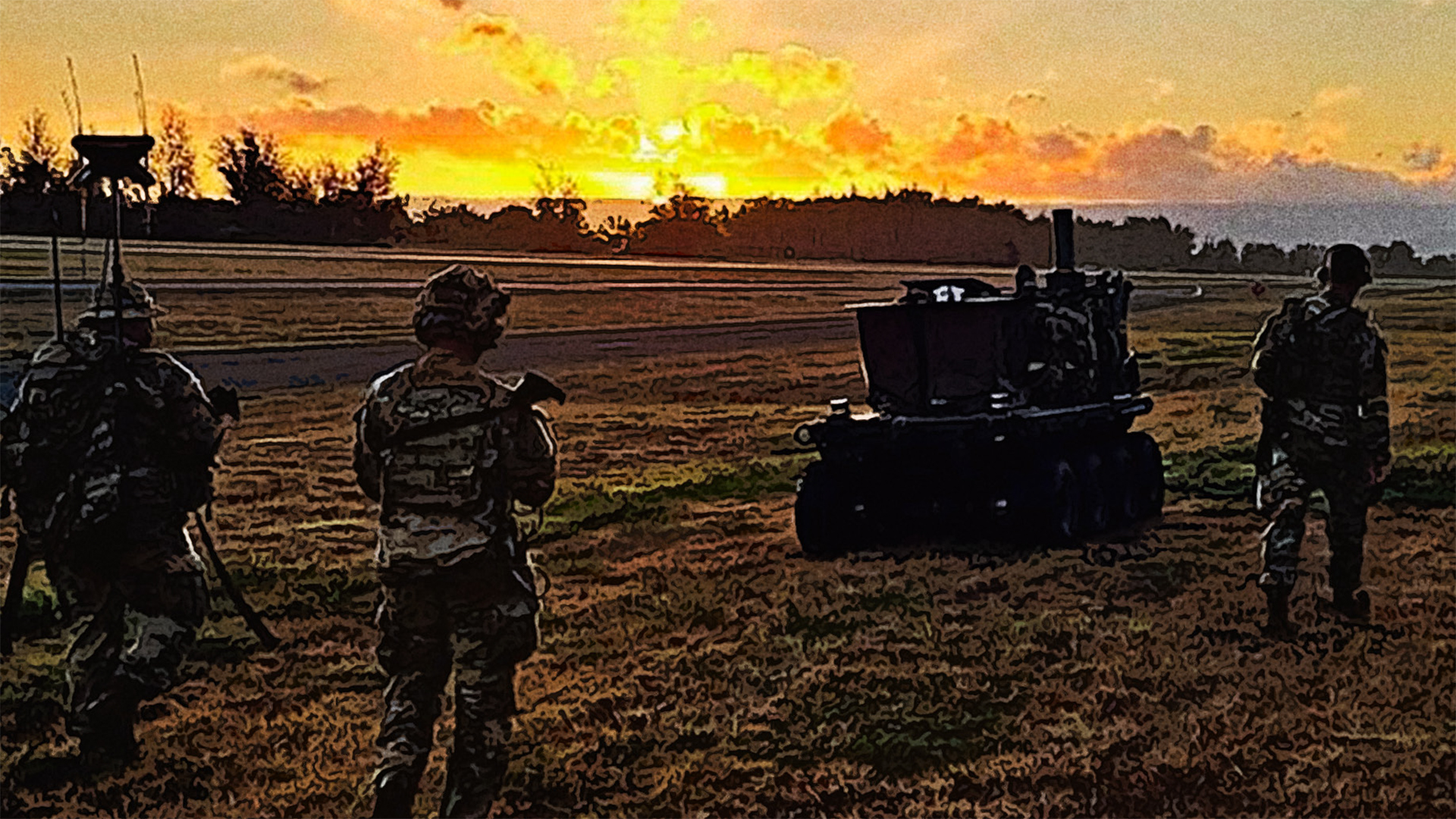
Bravo Detachment Soldiers conduct a tactical movement with the Multi-Domain Reconnaissance platform. (Photo courtesy of the author)
Introduction: Project Context
Military intelligence (MI) formations require collection assets capable of finding the enemy and supplying target data in a timely manner. Refining the sensor-to-shooter process is critical to enabling freedom of maneuver on the ground, and this refinement is primarily contingent on technological advances. The Rapid Defense Experimentation Reserve is one of the U.S. Department of Defense’s (DOD’s) primary means of quickly modernizing the force, and equipping Soldiers with robotic combat vehicles (RCVs) is one of their current lines of effort.1 After the DOD allocated funds toward developing autonomous RCVs, leaders from the U.S. Army Combat Capabilities Development Command (DEVCOM) contacted tactical intelligence units within the U.S. Indo-Pacific Command to coordinate testing.
In August 2024, as part of this larger DOD initiative, the 125th Intelligence and Electronic Warfare Battalion (IEW BN) at Schofield Barracks, Hawaii, fielded and experimented with four fully autonomous Small Multipurpose Equipment Transports, or S-METs,2 RCVs provided by the DEVCOM Ground Vehicle Systems Center. One was equipped with a Common Remotely Operated Weapon Station (CROWS) lethality system, 3 capable of mounting and autonomously firing crew-served weapons; this unit would provide direct-fire support. The remaining three robots came equipped with a tethered unmanned aerial system (TeUAS) on top of each platform capable of direction finding and full-motion video; these would provide deep sensing in support of targeting.
After agreeing to the project, the 125th IEW BN tasked its Bravo Detachment to conduct the experiment. Bravo Detachment serves as the battalion’s expeditionary element, and experimenting with RCVs gave the detachment additional equipment to support its signals intelligence (SIGINT) and processing, exploitation, and dissemination mission. Of note, none of the equipment used during this experiment is organic to the 125th IEW BN. Bravo Detachment primarily employs man-packable SIGINT systems in conjunction with small unmanned aircraft systems (UASs) to enable targeting, and they are the first unit in the Army to field this experimental equipment package.
The Ground Vehicle Systems Center provided three weeks of new equipment training; then, during the experimentation phase, the battalion tested these systems in the field during a brigade training exercise. For context, equipping infantry units with RCVs is not uncommon, but units typically use these robots to transport equipment. Employing RCVs as a collection platform gave Soldiers in the 125th IEW BN an additional tool capable of providing timely and accurate intelligence. Ultimately, this experiment provided valuable feedback on what worked, what didn’t, and how to utilize the platform effectively in the future to enable Soldiers on the ground.
Mission and Specified Tasks
The overall mission was simple: remotely maneuver multiple unmanned autonomous RCVs ahead of the forward line of own troops to achieve a sensing capability. The goal was to get RCVs into the hands of Soldiers to employ in a tactical scenario. Within that scenario, project developers planned to test the command and control of multiple vehicles, payloads, and sensors. Ideally, system operators would direct each autonomous RCV to its hide site, remotely launch the TeUAS, and populate target data on the end user’s common intelligence picture. Executing this project required an extensive equipment list, primarily four RCVs and one workstation (known as the Global Expeditionary Miniature Mission Interface, or GEMMI4) designed to control all four platforms simultaneously.
Three Multi-Domain Reconnaissance (MDR) RCVs. These platforms were the primary focus of the battalion’s testing, and each platform consisted of the following:
- Eight-wheeled robotic S-MET capable of obstacle avoidance.
- TeUAS equipped with a full-motion video and direction-finding payload (300-foot tether).
- Extended range tactical communications.
- Beyond line-of-sight (BLOS) sensing and targeting capability via Starlink.
- Line-of-sight (LOS) sensing ahead of human maneuver
- Electro-optical/infrared sensing to detect and identify targets.
- Counter UAS sensing; capable of small UAS detection and defeat.
- Handheld remote capable of LOS driving.
- Operator control unit tablet capable of route mission planning, LOS driving, and TeUAS flight operations control.
One Direct-Fire Lethality RCV. Soldiers from the 125th IEWBN and the 25th Infantry Division’s 2nd Light Brigade Combat Team (2LBCT) received new equipment training on this system but did not employ it in a tactical scenario. This platform consisted of the following:
- Eight-wheeled robotic S-MET capable of obstacle avoidance.
- Lethality Platform–M152 CROWS capable of mounting most crew-served weapons.
- 15-foot mast capable of providing Soldiers with an added visual tool (i.e., sight over tall obstacles).
- Extended range tactical communications.
- BLOS sensing and targeting capability via Starlink.
- LOS sensing ahead of human maneuver.
- Handheld remote capable of LOS driving.
- Operator control unit tablet capable of route mission planning, LOS driving, and TeUAS flight operations control.
Global Expeditionary Miniature Mission Interface (GEMMI). This is an open, high-performance, low-footprint ground control workstation with the following capabilities:
- Computer display kits allowing Soldiers to operate the RCVs’ BLOS via Starlink.
- Autonomous RCV control.
- Autonomous TeUAS launch, flight, and landing.
- Ability to receive full-motion video from the three MDR RCVs.
- Ability to receive lines of bearing from the direction-finding sensor.
- Ability to fire crew-served weapons BLOS (not evaluated during this iteration).
Execution
The 125th IEW BN experimented over six weeks in three phases: new equipment training, tactical employment, and a distinguished visitor demonstration.
Phase One—New Equipment Training (three weeks). After nearly a year of planning and preparation, new equipment training began in mid-July with the arrival of civilian personnel and all experimental equipment at Schofield Barracks. Approximately 30 contractors and DOD civilians flew to Oahu from all over the continental United States to help facilitate this fielding. Over three weeks, project leads assembled the robots, and Bravo Detachment Soldiers received four sequential blocks of instruction. The training progression covered RCV mobility, TeUAS flight, lethality employment, and GEMMI BLOS autonomous operations. Each Soldier in Bravo Detachment’s signals collection teams (SCTs) certified on driving the RCVs, flying the TeUAS with handheld remotes, and passing control of the system to GEMMI operators. The detachment’s SIGINT operations cell (SOC) additionally certified on GEMMI BLOS operations, which included passing target data to end users via tactical communications. New equipment training also covered maintenance, initial equipment inventories, and S-MET towing operations with military vehicles. It took longer than initially expected to get the equipment assembled and online, so operations started slowly. Despite these initial hiccups, the detachment’s SCTs deployed to the field in time for the exercise kickoff.
Phase Two—Exercise Execution (two weeks). Bravo Detachment integrated its SOC and three SCTs into two weeks of 2LBCT’s company situational training exercise lanes in early August. The project’s civilians also spent time in the field observing testing and providing maintenance and technological support. Bravo Detachment trained and operated at the same location as 2LBCT during the exercise. However, it did not truly embed with a maneuver unit simply because the project was still in its initial stages. Despite some system limitations, testing the equipment in a live environment gave project managers valuable feedback.
The exercise began with the detachment’s SOC postured at 2LBCT’s headquarters at Schofield Barracks and the SCTs established in hide sites positioned in training areas across the island. The SCTs in the field received onsite assistance from both civilian contractors providing system support and Pacific Foundry supplying Stratomist emitters that allowed sensors on the TeUASs to obtain lines of bearing. For the duration of the exercise, Bravo Detachment Soldiers utilized the three MDR RCVs to provide force protection support to 2LBCT elements.
During tactical employment, SCT Soldiers on the ground maintained primary control of the system. Operators used the operator control units to move the RCVs during mounted and dismounted operations, and the SCTs conducted handovers with SOC operators manning the GEMMI in the rear while halted. Once at a standstill, the operator, either on the ground or using the GEMMI, flew the TeUAS to its desired altitude. At altitude, operators processed the full-motion video feed, controlled the electro-optical/infrared payload, and tasked the direction-finding payload to receive lines of bearing. By the end of the exercise, all three systems functioned as one unit to geolocate targets up to five kilometers away and pass data back to the SOC in the rear.
Initial feedback from the detachment’s Soldiers was primarily positive, but there was concern about the RCV’s lack of mobility. Testing revealed that the system has difficulty navigating jungle terrain and cannot be driven with the TeUAS mounted on top. Despite these limitations, our Soldiers found value in fielding the equipment to an MI formation. The platforms allowed the SCTs to position themselves in the brigade’s rear area while simultaneously collecting on targets ahead of the forward line of own troops. Once RCV mobility improves and project engineers correct technological bugs in the GEMMI and TeUAS, the system will certainly enhance an MI formation’s ability to collect and pass targetable data.
Phase Three—Distinguished Visitor Demonstration (one week). Experimentation concluded with a distinguished visitor demonstration to two Senate Appropriations Committee Defense Staff members and a senior leader delegation from the U.S. Army Pacific. Bravo Detachment Soldiers rehearsed for one week before execution, and the briefing concluded with a live demonstration during which Soldiers highlighted the capabilities, limitations, and real-world implementation of each system. The distinguished visitors were particularly interested in how the GEMMI passed information to fires elements, whether there is a plan to have a direct-link connection to a direct fire system, and whether there are plans to improve RCV mobility moving forward. There are plans to address all three of these issues, and project leads have taken the distinguished visitors’ feedback for action.
Conclusion
The Army’s first iteration of RCV testing at the tactical level was a resounding success. The system is not deployable in its current form; improvements are needed to make the platform more mobile, durable, and technologically dependable. Nevertheless, the 125th IEW BN’s experimentation allowed program developers to assess the system’s performance during live training in a harsh jungle environment. Feedback from maneuver commanders, senior intelligence professionals, and Bravo Detachment’s Soldiers will allow project leads to make improvements, and the detachment will continue experimenting with this equipment. Adding SIGINT equipment to the top of the platform’s mast, conducting sling load operations with the RCVs, and improving the system’s BLOS communications are just a few ideas for improvement moving forward.
Author’s Note: After this article was written, Bravo Detachment, 125th IEW BN, and 25th Infantry Division’s Combat Aviation Brigade conducted sling load testing on the MDR platform. Testing consisted of a CH-47 Chinook air assaulting the MDR platform and an SCT hide site at two landing zones on Schofield Barracks, Hawaii. This training was the first time the Army conducted sling load operations with the robotic MDR platform, and it was one of the first external sling load operations for the S-MET. Testing confirmed that sling loading the MDR platform is an efficient and realistic method of maneuvering this system across the battlefield. Bravo Detachment’s SCTs rigged the load at hide sites in under 15 minutes; subsequent internal and external load operations with a CH-47 took under 5 minutes.
Overall, these RCVs enhance a tactical MI formation’s ability to sense deep while reducing risk to the force. It’s encouraging that the 125th IEW BN could field these robots, receive training from subject matter experts, and implement the equipment in an exercise over a few short weeks. The system needs upgrades; nevertheless, this project enabled transformational innovation at the tactical level and could potentially add intelligence value to maneuver units in the near future.
Endnotes
1. Department of Defense, Office of the Under Secretary of Defense for Research and Engineering, Assistant Secretary of Defense for Mission Capabilities, “Rapid Defense Experimentation Reserve,” https://ac.cto.mil/pe/rder/.
2. Robin Porter and James Jahnke, “General Dynamics Land Systems Delivers S-MET, the U.S. Army’s First Robotic Infantry Support Vehicle,” News, General Dynamics Land Systems, November 2, 2022,https://www.gdls.com/gdls-smet22/.
3. “Common Remotely-Operated Weapon Station (CROWS),” Pioneering Decisive Solutions, 2016, https://pideso.com/common-remotely-operatedweapon-station-crows/.
4. “StratFac Digital Engineering Environment,” Solutions, Parry Labs, 2023, https://parrylabs.com/stratfac/.
Author
CPT Leland Lancaster is the Bravo Detachment Commander for the 125th Intelligence and Electronic Warfare Battalion, 25th Infantry Division, Schofield Barracks, HI.