Modern Problems Require Modern Mortars
By LTC John Leisinger
Article published on:
April 1, 2026 in the Spring 2026 of Infantry
Read Time:
< 16 mins

A mortar stowage kit system with 120mm mortar affixed is placed in a
ISV-Utility instead of a trailer during a recent Joint Pacific
Multinational Readiness Center rotation. (Photo by LTC John Leisinger)
The Army’s new mobile brigade combat team (MBCT) design embodies the
imperative of transforming while in contact. Smaller, faster, and leaner
than the legacy infantry brigade combat team (IBCT), the MBCT prioritizes
dispersion, depth, speed, and layered lethality as the primary light
formation for ground maneuver. A host of unmanned aerial systems — some
currently fielding, some still in development — afford the MBCT an
unprecedented degree of precision lethality and situational awareness at
ranges previously accessible only to a division or higher. The capability
that needs to catch up is mass, specifically the agile and responsive mass
fires provided by organic mortar systems.
It would be inaccurate to say that evolutionary work is not being done to
advance mortar capability. The Enhanced 81mm Mortar (E81) along with the
Infantry Battalion Mortar System (IBMS) are quickly winding their way
through the acquisitions process and offer an increase in mortar lethality
not seen since the introduction of the M120 mortar system in 1991. Perhaps
more evolutionary than qualitative lethality, these capabilities offer to
fundamentally alter how mortars can be employed. The purpose of this
article is to spark discussion on what those changes could look like to
influence future iterations of transformation-in-contact (TiC)
experimentation.
A parallel to the question of how to organize and employ modern mortars
traces back to another crew-served weapon: the machine gun. During World
War I, American divisions of the expeditionary force organized machine
guns into unique machine-gun battalions, with one aligned to each two
organic infantry brigades and a third retained as a divisional asset. Each
machine-gun battalion consisted of four machine-gun companies of three
platoons each, and each platoon possessed four machine guns. Machine-gun
companies would typically attach to infantry battalions to support
offensive or defensive maneuver through massed suppressive direct or
indirect fire. The Second World War with combatants’ advances in mobility
saw a return to maneuver warfare and the diffusion of machine guns of
various types down to the battalion, company, platoon, and even squad
levels. The infantry battalion would typically be equipped with two
machine-gun platoons within a heavy weapons company, while rifle companies
fielded two light machine-gun squads within a weapons platoon. Rifle
squads themselves each fielded a Browning Automatic Rifle. The diffusion
of machine guns from dedicated battalions in 1918 down to company,
platoon, and even squad levels less than 30 years later reflected the
value of their suppressive capability to small unit maneuver. All it took
was a few small advances in technology adjacent a logical refinement in
small unit tactical doctrine. This is the space our Army finds itself in
presently with mortars: The technological advancements are here, but how
should we evolve employment doctrine to best support small unit tactical
action within ground maneuver?
Like the ubiquitous machine gun, mortar systems have been a staple for
maneuver formations since they became small enough to be carried by
Soldiers and light vehicles. Unlike the sheer destructive mass of field
artillery, which can sometimes hinder small unit tempo due to ponderous
coordination measures and lengthy emplacement times, mortar systems
organic to the battalion and company offer responsive and dynamic fires,
trading destructive volume for speed and agility of employment. Army
Techniques Publication (ATP) 3-21.90,
Tactical Employment of Mortars, succinctly states that “[mortars]
provide commanders with organizationally responsive lethal indirect fire
that all maneuver units in close combat need to defeat an enemy.”
Doctrinally, mortars serve to destroy, neutralize, suppress, and isolate
enemy forces; support direct fire engagements of enemy armor by reducing
armored vehicles’ situational awareness and mobility; enable ground
maneuver by providing freedom of movement; and cover friendly obstacles
with indirect fire. Like the machine gun, the doctrinal purpose of mortars
won’t necessarily change, but with technological advances, perhaps it’s
time to relook the volume, type, and organization of mortars to do for
tomorrow’s maneuver formations what the distribution of machine guns did
for battalions, companies, and platoons 80 years ago.
Unlike the sheer destructive mass of field artillery... mortar systems
organic to the battalion and company offer responsive and dynamic fires,
trading destructive volume for speed and agility of employment.
Army Transformation
Looking to the near future in light of the new Army Warfighting Concept
and the potential evolution of ground maneuver, light infantry formations
will require organic means to leverage massed indirect fires more than
ever. The MBCT gained unparalleled mobility through the introduction of
the family of Infantry Squad Vehicles (ISVs) but lost organic control of
tube artillery. Evolving employment concepts will possibly see MBCTs
responsible for an area of operations akin to what a division previously
would own, with up to 40 kilometers in depth from the MBCT’s forward line
of troops to the coordinated fire line marking the start of the division’s
deep area. While the MBCT certainly now has the mobility to control such
an area, maneuver without fires is suicide, to quote the conventional
wisdom. Indirect fires assets now held at the division-artillery level are
not guaranteed to be in direct support of any given MBCT, especially if
they find themselves as a supporting effort; the MBCT requires its own
massed fires capability to realize its part in future ground maneuver.
Observations from recent TiC rotations at combat training centers (CTCs)
reveal a hard truth: The current types and organization of mortar systems
within the MBCT’s battalions and companies are insufficient. Infantry
battalions are currently equipped with four 120mm M120 heavy mortars
within the mortar platoon, which also maintains four M252 81mm medium
mortars for use in situations unsuitable to the heavier M120. M120 mortars
transported on mortar stowage kits (MSKs) either towed by ISVs or mounted
directly in the back of ISV-Utility variants are too slow to emplace and
displace, averaging several minutes for each action. Minutes to emplace
means fires are not always responsive enough for a platoon requiring
immediate suppression. Minutes to displace frequently results in
neutralization by rapid enemy counterbattery fire, a risk geometrically
increased by the growing presence of enemy intelligence, surveillance, and
reconnaissance (ISR) and strike unmanned aircraft systems (UAS). Static
mortar firing points established in support of deliberate operations fare
little better, as their unique visual signature is quickly acquired by
threat UAS.
The M252 81mm mortar is quicker to emplace and displace than the
MSK-mounted M120, but at the cost of lethality. Current M120 mortars can
range out to 7,000 meters with a high explosive (HE) mortar round
delivering a 65-70 meter blast radius. Current M252 mortars on the other
hand have a maximum range of 5,790 meters, producing only a 38-meter blast
radius. Quicker still is the M224 60mm mortar, two of which are organized
within a rifle company’s organic mortar section, ranging out to 3,490
meters and producing a 28-meter blast radius. Rifle company mortar
sections, now equipped with an ISV, are certainly agile enough to support
platoons in the close fight, and likely not high enough to the enemy’s
high payoff target list to immediately warrant counterbattery fire, but at
the tradeoff of limited range and destructive ability. Two 60mm mortars
supporting three platoons maneuvering in an area that will likely eclipse
the M224’s maximum range cannot guarantee the mass required for a platoon
to fix, suppress, or neutralize a defending or attacking enemy force. Our
adversaries face the same calculus; the People’s Liberation Army opts
instead to issue six 60mm mortars to each light rifle company, with ranges
exceeding those of our comparable M224. While a company-to-company
comparison in a vacuum would be naïve, the relative comparison is clear.
One final disadvantage to our current mortar paradigm is magazine depth.
While mortar rounds are relatively inexpensive and simple to produce
(barring the more intricate precision-guided varieties), MBCTs remain
light formations, and even with the introduction of the ISV, space remains
limited to store bulky mortar rounds of any caliber. The MSK for example
holds a mere 34 stowed rounds, enough for approximately four suppression
missions, assuming the mortar squad eschewed all other round types for HE.
Support vehicles to carry extra stowed rounds exist or are improvised, but
this does no favors for the mortar element’s visual signature or
emplacement and displacement times, which have already been identified as
critical vulnerabilities in large-scale combat. Shifting briefly to a
logistics perspective, three different calibers of mortar require three
different supply chains of ammunition, each with their own varieties of
HE, precision-guided rounds, smoke, and illumination. This arrangement
seems to run counter to the mentality of the MBCT, which was designed to
make light infantry formations leaner and faster.
Enter the E81 and the IBMS. The Enhanced 81mm Mortar System is an
evolution of the existing M252. The keys to the system’s evolutionary
nature are its design and ammunition, enabling the E81 to outrange the
current M120. The develop-mental 81mm mortar rounds themselves demonstrate
a larger blast radius than existing 120mm mortar rounds, indicating a
holistic increase in lethality. What happens inside that blast radius is
even more impressive; unlike the torn steel blast pattern produced by
current mortar rounds wherein explosive force rends the steel shell to
send twisted metal fragments in unpredictable lethality patterns, the
E81’s HE round employs a system to create a uniform and predictable
lethality pattern. The mathematical comparison is clear: The experimental
E81 outperforms all other current mortar systems in the U.S. arsenal.
The Infantry Battalion Mortar System is the capability that truly allows
the E81 to surpass our current mortar systems. The IBMS is essentially an
articulated armature with a non-settling baseplate securing the E81 to a
vehicle, in the case of the MBCT that vehicle would be the ISV-Utility.
The system is modular and includes stowage for 70 81mm mortar rounds
(compared to the current M120 MSK’s 34 stowed rounds). The articulated
armature enables the mortar squad to leverage Lightweight Handheld Mortar
Ballistic Computer (LHMBC) software on their organic devices, namely
Android Team Awareness Kit (ATAK), to receive a fire mission, direct the
E81 cannon to mechanically lay on the target, and then manually hang and
fire the rounds. The use of a non-settling baseplate allows the IBMS to
fire from terrain not suitable to current settling baseplate systems, such
as uneven rocky ground, sodden areas, or pavement. The speed at which this
can occur is the IBMS’s key advantage; within seconds from receipt of a
fire mission, a mortar squad equipped with the IBMS can emplace the system
and fire the first round. Recall that the MSK-mounted M120 takes minutes
for a trained mortar squad to accomplish the same. Adjustments to
subsequent rounds are also much faster due to the mechanical nature of the
IBMS’s articulated cannon-aiming armature. From a survivability
perspective, the IBMS can displace and be on the move within seconds of
firing the last round. In the event the host vehicle becomes incapacitated
or is unsuitable for a given mission, the E81 can be dismounted to fire
from a traditional bipod, sacrificing rapid emplacement and displacement
times for dismounted mobility but retaining its advantages in lethality.
The superiority of the developmental E81 and IBMS over current MSK-mounted
M120 and dismounted M252 mortar systems in terms of lethality,
survivability, and mobility seems undeniable. But this conclusion is not
the purpose of this article. The E81 and IBMS are just a single
capability, that if proven through continued TiC experimentation may come
to replace all or some of our existing heavy and medium mortars. The
discussion the Army needs to have instead is, if this or some related
capability comes to fruition, will it simply replace existing systems in
their existing configurations? Or should we begin to relook the
organization and basis of issue for mortar systems at battalion and even
company levels to best optimize formational lethality, much like the
evolution of machine guns resulted in their dispersion from unique
battalions to ubiquitous systems down to the rifle squad level?
If the E81 and IBMS is adopted as a program of record, regardless of how
it is distributed, the doctrinal role of mortars should not change. While
it is true that advances in precision and near-precision weapon systems
such as loitering munitions, Purpose Built Attritable Systems (PBAS), and
long-range precision strike missiles are introducing a level of precision
strike at the lower tactical level previously reserved for divisional or
joint assets, these capabilities are unlikely to ever provide a commander
one thing: mass. With the removal of tube artillery to the division level,
brigade, battalion and company commanders have only their mortars to rely
on to provide timely, agile massed fires to enable maneuver in a dynamic
tactical environment. A strike missile may destroy the enemy command tank,
but a brigade’s magazine depth of these missiles will not enable the
destruction of the enemy’s entire armored company. A PBAS may vector into
an enemy trench, destroying a machine gun preventing a friendly squad from
maneuvering, but a Soldier can only operate one at a time. A loitering
munition may destroy an enemy engineer asset maneuvering to reduce a
friendly obstacle, but it is vulnerable to enemy electronic attack. A
brigade’s mortars possess significant magazine depth, even more so if the
larger 120mm family of munitions is replaced with the smaller, lighter E81
family of advanced munitions. Mortars — firing as individual squads,
sections, or a platoon — can send dozens of rounds downrange before a
single PBAS can acquire a target. Mortars also cannot be jammed or
grounded due to unfavorable environmental conditions. The advent of
precision weapon systems at the brigade, battalion, and even company level
is a welcome evolution, to be sure. But the role of the mortar in
providing dynamic, responsive massed fires endures.
Organization
So what could the organization of mortars look like in the near future,
given the E81 and IBMS are realized and commanders’ arsenals include a
variety of precision short-and long-range munitions? One might argue that
although mortars remain essential, the introduction of various precision
systems and increases to individual mortar systems’ lethality and
survivability indicate we need fewer mortars. After all, in a
resource-constrained environment, shouldn’t we seek to do more with less?
The evolving state of ground maneuver, the likely increase to brigade,
battalion, and company areas of operation, and initial observations from
TiC formations at CTCs would seem to indicate that in fact we need more
mortars. To be clear, insufficient observational data currently exists to
authoritatively demand an increase of mortar systems and the 11C Soldiers
who operate them, but we need to begin experimentation now with different
configurations to optimize formational lethality once the E81 and IBMS, or
similarly advanced systems, become available to the force.
One potential experimental mortar allocation is an increase of each
battalion mortar platoon to six mortar squads equipped with IBMS systems,
supplanting the current four-squad model equipped with MSK-mounted M120s
and dismounted M252s. Potential efficiencies found in the automated nature
of the IBMS could feasibly lower the requirement of a mortar squad from
four Soldiers to three, leaving a delta of just two 11Cs per battalion
mortar squad requiring a billpayer. This experimental formation would be
optimized to operate in three mortar sections, enabling the battalion to
plan for two sections in position and ready to fire at any given time,
with a third section transitioning to a subsequent mortar firing point.
Currently, mortar platoons at CTCs struggle to service dynamic fire
missions as one section is in position ready to fire but dedicated to a
pending deliberate fire mission while another is in transition. Or,
occasionally, both sections are conducting survivability moves. Three
mortar sections would largely mitigate this gap at the cost of two
additional Soldiers per battalion. Hypothetically, three mortar sections
enable the battalion to allocate one section per rifle company in direct
support for operations where dynamic fires are more prevalent than
deliberate fires, such as a movement to contact. An increase to six
battalion mortar squads likewise optimizes the battalion to control the
larger areas of operation portended by the Army Warfighting Concept, which
the four-gun current mortar platoon would be unable to range should
companies disperse.

Figure 1 — Current MBCT Mortar Allocation
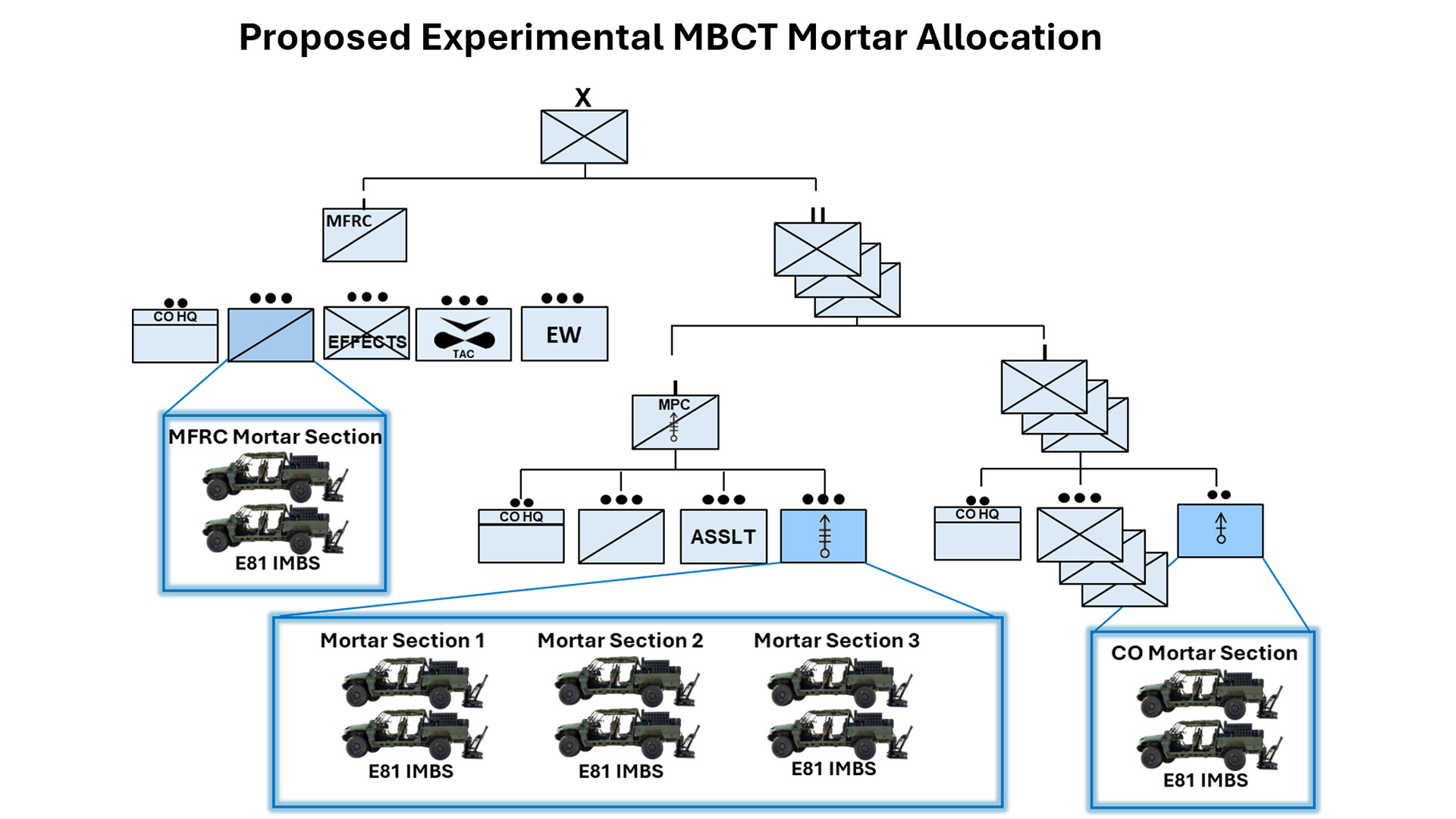
Figure 2 — Proposed Experimental MBCT Mortar Allocation
The mobility and survivability of the IBMS supports another emerging gap
within the MBCT: organic mass fires for the multi-functional
reconnaissance company (MFRC). While IBCT cavalry squadrons possess
organic 120mm mortars in each mounted troop, the current MFRC with its
sole reconnaissance platoon depends upon adjacent battalions for mortar
support. The MFRC would benefit enormously from an organic mortar section
consisting of two IBMS to provide deliberate or dynamic fires in support
of reconnaissance and security operations. This allocation would reduce
brigade commanders’ risk when deploying their reconnaissance platoon
forward of the forward line of own troops (FLOT) to conduct reconnaissance
or security tasks, knowing they have the ability to receive massed fires
within seconds in the event of compromise or locating a high-value target.
At the rifle company level, we must likewise experiment with replacing or
augmenting the existing 60mm M224 mortar with the IBMS. Currently, the
rifle company mortar section transports their two M224s on two ISV-Utility
variants; the platform is already required and authorized so why not
modify it be an IBMS? 60mm mortars should be retained for their
versatility as a handheld system for close support and their mobility
during airborne and air assault operations, but with the trend toward
greater dispersion of companies and longer observable distances due to
company-level medium-range reconnaissance (MRR) UAS, perhaps it’s time to
give rifle companies a bigger mortar. Equipping each rifle company with
two IBMSs would not incur a manpower cost, as company mortar sections
already consist of two teams of three 11C Soldiers. Standardizing the E81
as the primary mortar system across all brigade mortar formations vastly
simplifies the supply chain for mortar ammunition. The transition of LHMBC
functionality to a software application on ATAK flattens the coordination
between mortar squads and the existing fire direction control centers.
Technological advances are presenting us the opportunity to evolve how we
organize and employ a capability that has existed for generations, and we
need to consider the possibilities as our TiC continues.
So how could this proposed mortar organization experiment play out in a
Joint Readiness Training Center (JRTC) TiC rotation? Replacing 12 heavy
120mm mortars, 12 medium 81mm mortars, and 18 light 60mm mortars with 38
medium E81-equipped IBMS would, on paper, more than double a brigade’s
quantifiable lethal capacity. The MFRC reconnaissance platoon is able to
organically support its own reconnaissance and security tasks forward of
the FLOT without decrementing an adjacent battalion’s mortar capacity, or
depending on long lead time precision weapon systems during a dynamic
break-contact battle drill. Infantry battalions, now possessing six
mortars instead of four, echelon their massed mortar fires with organic
precision munitions targeted by scout platoons and long-range
reconnaissance (LRR) UAS to shape the enemy long before rifle companies
engage in direct fire contact. Precision weapons strike command and
control (C2), fires, and sustainment targets, while massed mortar fire
disrupts enemy concentrations, fixes maneuvering enemy companies, and
suppresses close targets for hand-off to company fire and maneuver. Rifle
companies, now equipped with a mortar that can range exceeding seven
kilometers, have an organic massed fire capability to match their new
organic MRR ISR capability, and are no longer entirely reliant on limited
battalion heavy mortar support. Rifle companies begin suppressing and
fixing enemy targets well outside direct fire ranges, freeing battalion’s
mortars to continue shaping at their maximum effective range. The risk
from counterbattery fire, while never eliminated, is significantly reduced
as every IBMS is on the move to a subsequent firing position within
seconds after firing their last round. The brigade’s 38 mortars, likely
operating in 19 sections, are able to cover nearly every
square kilometer of the JRTC training area. The opposing force (OPFOR)
can’t effectively suppress them because they transition too quickly and
would struggle to impose a fires prioritization dilemma upon brigade or
battalion commanders, as each echelon has its own equally lethal massed
fires. The OPFOR also can’t take advantage of bad weather grounding UAS
and most precision munitions, because mortars fly in any weather. The
brigade’s supply burden of past years, balancing movement of 81mm, 120mm,
105mm, and 155mm munitions to gun crews, is simplified to managing a
single family of enhanced 81mm ammunition. If emerging precision weapon
systems are a commander’s sniper rifle, then mortars are the commander’s
shotgun: providing mass where it is most needed.
The technology enabling advancements in mortar lethality, survivability,
and agility is here and being experimented with. Experimentation thus far
only leads us to conclude that developmental mortar systems such as the
E81 and IBMS far surpass current fielded mortar systems. Similar to the
diffusion of machine guns to lower tactical levels once the technology
supported it, the Army would benefit from experimenting with novel ways to
organize and employ mortars to enable the MBCT to dominate the extended
battlefield as the light ground maneuver component within a joint task
force. Adopting the IBMS as a standard mortar system and increasing basis
of issue to include rifle companies, enlarged battalion mortar platoons,
and the MFRC would be a worthy experiment to test just how much more
lethal the MBCT could become. It’s not enough to replace existing mortar
capabilities with a better system; we must evolve through experimentation
how we organize and employ these systems to transform our formations’
lethality before the next contact. We won’t learn unless we try.

Soldiers assigned to 1st Battalion, 502nd Parachute Infantry Regiment
fire an 81mm mortar system during an exercise near Alexandroupolis,
Greece, on 5 June 2025. (Photo by MAJ Joe Legros)
Author
LTC John Leisinger currently serves as the chief of the
Doctrine, Training and Leader Development Division of Transformation and
Lessons Learned Manager – Infantry at Fort Benning, GA.