OACOK, OKOCA, or OCOKA?
Reframing Terrain Analysis for Cyberspace
By Maj. JC Fernandes and Maj. Alexander Master
Article published on: July 1st, 2025 in the Gray Space
Summer 2025 Edition
Read Time:
< 8 mins
 Figure 1: Modified combined obstacle overlay highlighting the key aspects
of terrain analysis.
Figure 1: Modified combined obstacle overlay highlighting the key aspects
of terrain analysis.
OACOK, OKOCA, or OCOKA? While they may debate the ordering, every Soldier is
familiar with the mnemonic for terrain analysis. The concepts of
Observation and field of fire, Cover & concealment, Avenues of approach, Obstacles, and Key terrain, provide a framework through which Soldiers consider the
significant aspects of the terrain and their potential impacts to the
operation. While OACOK is a natural starting point for Army personnel, the
effort required to translate these land domain concepts to computer networks
outweighs the convenience of the mnemonic. Cyberspace is a distinct domain
of warfare with its own logic. As such, we have no assurance that elements
of OACOK can serve as meaningful analogs for the operationally relevant
aspect of cyberspace terrain. Instead, this paper proposes features that may
be worth considering for operating in cyberspace without attempting to draw
a direct comparison. The intent of this contribution is to be a conceptual
linkage between military mission analysis and the robust body of
cybersecurity resources (e.g., the NIST Cybersecurity Framework, the MITRE
ATT&CK Framework, the Cyber Kill Chain) already available for analyzing
specific aspects of cyberspace.
Why not OACOK? Unique Characteristics of Cyberspace
Before considering specific features for analysis, it is worth discussing
why analysis of cyberspace is unique from terrain analysis in the land
domain. Cover and concealment have a direct and personal meaning for
Soldiers on the battlefield. They dictate if friendly forces can be seen and
shot by the enemy, and, conversely, if they can shoot the enemy. While
militaries might cut an undersea cable (Chutel, 2024) or fire artillery
rounds at a key transmission node, we do not shoot kinetic munitions within
cyberspace. Instead, we primarily manipulate and transmit data in very
specific ways to cause effects, gain sensitive information, and defend our
use of cyberspace.
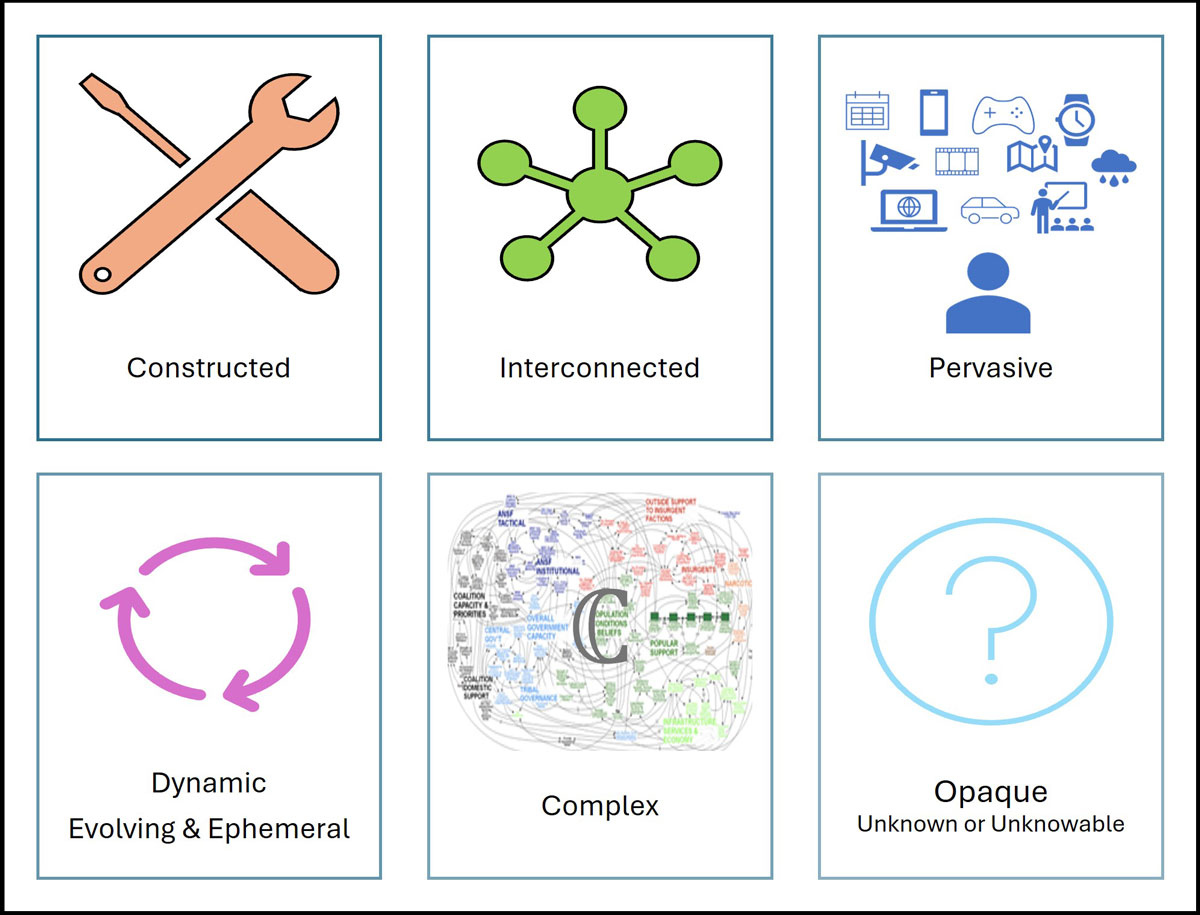 Figure 2: The unique characteristics of cyberspace.
The select characteristics below exemplify the unique logic of cyberspace
and its unique consequences for a planner’s ability to understand the
aspects of the cyberspace operational environment. These characteristics are
not meant to be a comprehensive description of the fifth warfighting domain
but rather illuminate why we must evaluate the operational environment for
cyberspace differently than we analyze physical terrain.
First, cyberspace is a man-made, constructed domain.
Cyberspace comprises a multitude of software and hardware components,
produced by a range of companies, organizations, and individuals across
decades, and configured together in a variety of ways. This constructed
nature contributes to an opaque, dynamic, and complex environment. It also
blurs the distinction between terrain analysis and analysis of friendly or
enemy forces. The closest military analog is dense urban environments.
Opaque: Because of overhead satellites and global imaging,
Army units can generally analyze physical terrain anywhere in the world.
However, like the interior of buildings, the cyberspace terrain is often
opaque from the outside. Many aspects are known only to those who build and
maintain that portion and their design is often confidential intellectual
property. Even those who use or interact with the terrain know a limited
amount about it.
Dynamic -- Ephemeral and Evolving While mountains tend not
to move and buildings do not change quickly or often, cyberspace changes at
the speed of electrons. Change is often an integral part of our use of
cyberspace. An IP address assignment may only be relevant for a period of
hours, or less. Modern phones maintain connectivity because they can
traverse cellular towers and WiFi networks. Similarly, we install new
applications and create accounts for new services. Beyond usage, a patch can
be pushed out and change networks across the world in a matter of minutes
(e.g., CrowdStrike patch in 2024; Burgess), and hardware components are
upgraded and replaced. Network diagrams are only one configuration change
away from obsolescence.
Complex Similarly, cyberspace is incredibly complex.
Through abstraction, components built by many different people are combined
and interoperate together without any one person understanding all the
intricacies of each of the elements.
Second, cyberspace is an interconnected domain.
Logical-layer connections between nodes define proximity in cyberspace,
often in ways independent of geographic proximity. Action in one portion of
cyberspace can have impacts across the globe, exponentially increasing the
scope of the relevant terrain and extending it beyond the authority bounds
of the unit, be it defined by geography, organizational ownership, or some
other factors.
Finally, cyberspace has become increasingly pervasive with
a subsequent increase in the diversity and scale of cyberspace terrain that
may be relevant for an operation. Internet-connected devices are
increasingly prolific throughout society. This pervasiveness also makes
understanding the cyberspace terrain increasingly relevant to units and
commanders who traditionally only need to concern themselves with the land,
sea, or air domains. Because of these characteristics, cyberspace operations
involve an environment whose potential scope is both extremely broad and
deep, where much about the environment is unknown or unknowable.
Features for Analysis
Given the challenges of understanding the full scope of the cyberspace
operational environment, we do not seek to provide an exhaustive list of
items for the planner to analyze in order to understand the environment. The
breadth and depth of possible analysis quickly dwarfs the staff’s capacity
to do so, and any exhaustive checklist would be out-of-date before it was
finished being written. Likewise, content delivery networks, DNS servers,
and similar facets of the domain preclude frameworks that rigidly
distinguish between terrain and actors (since the domain is constructed), or
rigidly define what is external to the network of interest (given its
interconnected nature). Instead, we provide a list of relatively general
questions – grouped into three broad thematic areas:
organizational context, network design and functioning and
security posture. Just as the layout of a house may be of
little consequence to someone planning a corps envelopment but is of utmost
criticality when planning a raid to extract hostages, so too does the
mission impact the nature and granularity of analysis appropriate for
analyzing cyberspace terrain. Planners may consider these questions in the
context of their mission and echelon to decide where deeper analysis is
required.
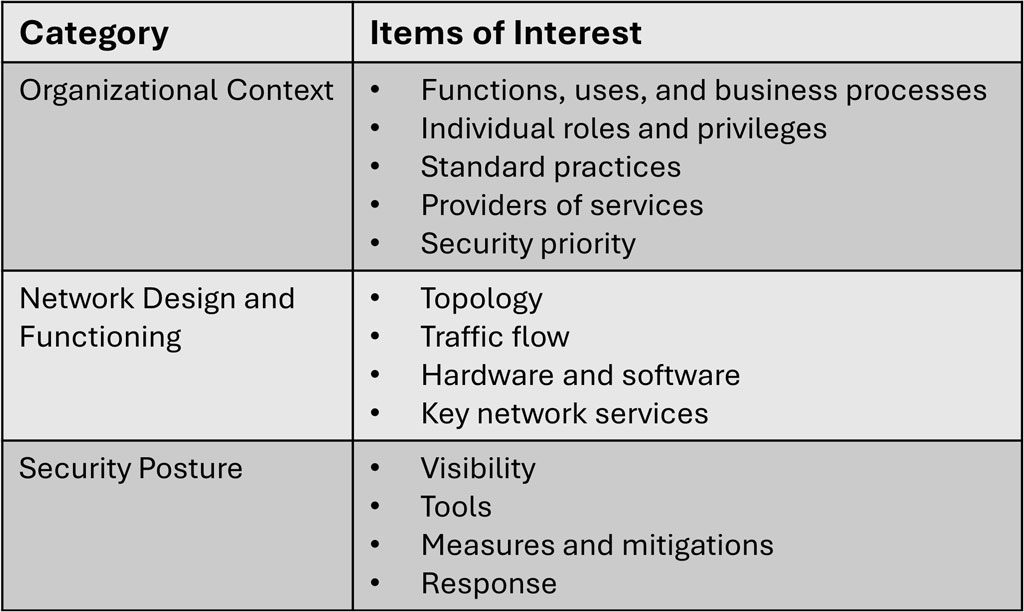 Figure 3: Category and analysis questions to help determine OCOKA for
cyberspace.
Figure 3: Category and analysis questions to help determine OCOKA for
cyberspace.
There are many different possible names or features that could be selected
and groupings for each. However, with any grouping there are edge cases and
interrelated aspects. Our concern was not that we had the perfect list of
individual questions, but rather that the aggregate list would prompt the
planner to consider the salient aspects for their operations and the
corresponding implications.
Organizational Context:
Functions, Uses, and Business Processes: For what does the
organization use cyberspace?
-
What is the significance of each use? Which uses are most important? What
happens if it breaks? Are there redundancies within or outside cyberspace?
-
How are these functions performed? What steps, components, and individuals
are involved in the different uses?
Individual Roles and Privileges: Who does what, with which
authorities?
-
Who has privileges for the network, content, devices, applications, etc.?
Standard Practices: What are the standard practices?
-
Are there standard naming conventions for users, systems, sites, and
organizational units?
-
Are there standard times, locations, or people for certain tasks?
Providers of Services: How are the cyberspace capabilities provided
and maintained?
-
What is provided “as service” and under what conditions? (service level
agreements (SLA), responsibilities)
-
To what degree does change occur and what is the process for it?
-
Are individuals providing their own devices (bring-your-own-device, BYOD)?
Security Priority: How is security valued by the organization and its
individuals?
-
Are there regulatory, legal, or other security and notification
requirements?
- Has the network been compromised in the past?
Network Design and Functioning:
Topology: What are the different portions of the network and what are
they used for? (subnets/IP space, VLANs, DMZs, user space – wireless, wired,
VPN)
-
What is the public-facing footprint? (Across layers: applications,
domains, IPs, servers, etc.)
Traffic Flow: What is the network traffic and how does it flow?
-
How does it flow between internal/public facing servers, internal/external
hosts, and the Internet?
-
What is the volume, type (applications, services, protocols), and patterns
(in time and direction)?
-
What additional factors impact or complicate traffic? (VPN concentrators,
DNS, routing rules, traffic prioritization, caching, load balancing,
fail-over, etc.)
Hardware and Software: (host and network; public-facing and internal)
-
What hardware and software are used on the network? (version, patch level,
configuration)
- Where are they?
- What purpose are they used/authorized for?
-
What is the process for approval, patching, and updating?
Key Network Services: What are they and how do they function?
Security Posture:
Visibility: What data is collected about traffic and endpoints and
what is its lifecycle? (Collection, transmission, storage, access, removal)
Tools: What endpoint and network security solutions are present?
-
What are the settings for endpoints and network traffic?
-
What are the capabilities, gaps, and limitations of the implementation?
Measures and Mitigations: What technical and policy mitigations are
in place?
-
What system and user behavior is explicitly permitted or prohibited?
- What rules are in place for network traffic?
-
How does authentication occur for users and services?
- How is data protected within the organization?
Response: How does the organization respond to alerts and incidents?
-
What are the business response actions and the technical incident response
actions?
These questions allow the planner to connect the broader operational context
to the multitude of guides, techniques, procedures, and other resources
available for analyzing specific aspects of networks and cybersecurity. In
particular, the organizational context helps planners understand the
significance of the cyberspace terrain and its integration with the broad
joint or national context. When answering the questions, planners should
consider all aspects - physical, human, and technical - holistically, rather
than focusing exclusively on one domain, to ensure a more complete
understanding of the implications.
Existing Frameworks and Approaches
Industry and the military offer various models that informed our selection
of the above features and can complement their analysis. They provide
insights into the questions we should ask, the processes we should use to
ask them, and the details we should consider when answering them.
First, we proposed that cyberspace, as a complex constructed terrain with a
significant human presence, is more closely analogous to a dense urban
environment than wooded or rural environments. Given this premise, ASCOPE
(Areas, Structures, Capabilities, Organizations,
People, and Events) provides a related conceptual framework.
Just as a planner cannot exhaustively analyze these elements in a large
urban setting (ATP 3-06), so also do the characteristics of cyberspace
preclude exhaustive analysis of the environment. However, we must view the
concepts of areas and structure differently in cyberspace. Similarly, the
relevant capabilities, organizations, people, and events in cyberspace may
differ from those in an urban environment. Key people may include network
administrators, while events may include holidays (when no one is working),
but also scheduled downtime and upgrade periods.

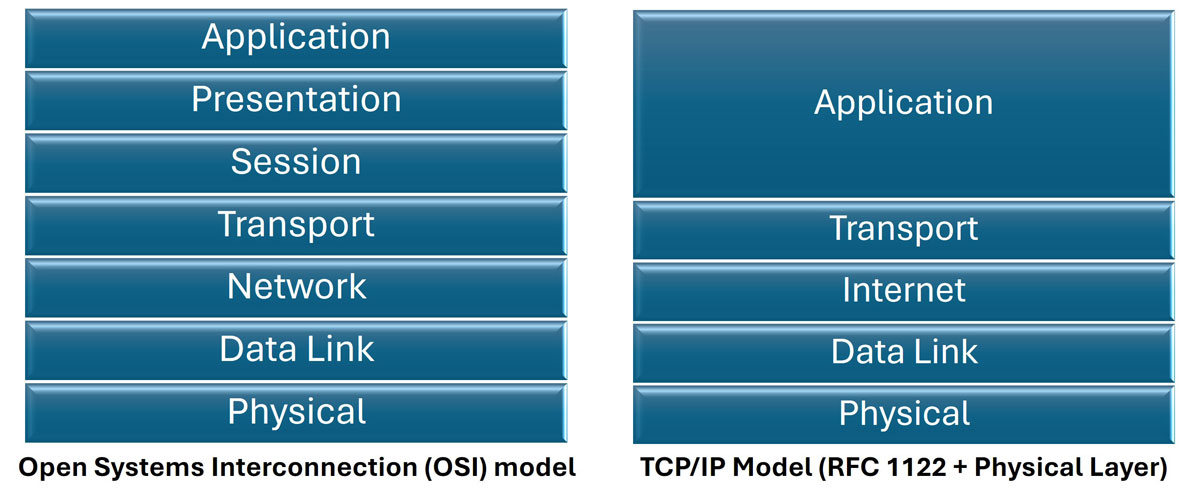 Figure 4: A depiction of the three interrelated layers of cyberspace, the
Open Systems Interconnection model, and the Transmission Control
Protocol/Internet Protocol.
Figure 4: A depiction of the three interrelated layers of cyberspace, the
Open Systems Interconnection model, and the Transmission Control
Protocol/Internet Protocol.
Second, doctrine and industry also provide several common models to
conceptualize cyberspace at higher levels of abstraction. JP 3-12 (OJCS,
2018) defines the interrelated layers of cyberspace – physical, logical, and
person – while the Open Systems Interconnection (OSI) model (Day &
Zimmerman, 1983) or the related Transmission Control Protocol/Internet
Protocol (TCP/IP) model (History of Computer Communications, 2021) defines
protocol layers to promote the understanding of networking. While extremely
useful, the layers of these models are not features of the terrain itself
but rather a lens through which to view an element of cyberspace. They are
layers of abstraction that provide scope and context. While not a direct
analog, they provide similar utility to the land domain practice of
analyzing terrain before, on, and after the objective. For example, in
cyberspace, one might consider the physical device(s) running a web service
in addition to the MAC address(es), IP address(es), and URL(s) of the
server(s). Planners can consider the different layers when asking the
questions proposed earlier.
Given the answers to questions proposed earlier, planners may determine
additional analysis is required. They can turn to the rich body of
cybersecurity resources from industry and government sources to dive deeper
into specific aspects, such as configuration of endpoint agents,
vulnerabilities of certain software, penetration testing web applications,
and technical security controls.
Finally, JP 3-0 introduces the concept of a “systems perspective” for
understanding the operational environment. This perspective and the related
concepts of functional mission analysis (FMA), mission threads (TC
3-12.2.90), failure modes and effects analysis (FMEA), and dependency
analysis, provide an approach that planners can use to focus their analysis
and guide their selection of which elements to analyze.
Concluding Thoughts
We would be remiss if we failed to acknowledge that cyberspace operations do
not occur in a vacuum. People use and depend on cyberspace for a variety of
functions, but there can also be analog alternatives to cyberspace. The
physical layer of cyberspace resides in the domains of land, sea, air, and
space. It can be destroyed and impacted by power outages, extreme
temperatures, electronic attack, and other physical factors. The information
within cyberspace is part of the information environment and can interact
with the cognitive dimension as it shapes human thoughts and behaviors -
which may have subsequent impacts on users’ activities in cyberspace. To
conduct joint, multi-domain operations that achieve synchronized effects in
time and space, cyber planners must not only understand the cyberspace
terrain but also how it fits into the broader operational environment and
operational objectives. The organizational context provides the means for
planners to do just that.
References
Burgess, M. (2024). Microsoft outage caused by CrowdStrike takes down
computers around the world. WIRED.
https://www.wired.com/story/microsoft-windows-outage-crowdstrike-global-it-probems/
Chutel, L. (2024). Finland Says Vessel Suspected of Cutting Cable May Be
Part of Russia’s ‘Shadow Fleet’. The New York Times.
https://www.nytimes.com/2024/12/26/world/europe/finland-estonia-cables-russia.html
Day, J. D., & Zimmermann, H. (1983). The OSI reference model.
Proceedings of the IEEE, 71(12), 1334–1340.
https://doi.org/10.1109/PROC.1983.12775
History of Computer Communications. (2021). The Department of Defense,
OSI, and TCP/IP.
https://historyofcomputercommunications.info/section/14.5/The-Department-of-Defense-OSI-and-TCP-IP/
Strom, B., Applebaum, A., Miller, D., Nickels, K., Pennington, A., &
Thomas, C. (2018). MITRE ATT&CK: Design and philosophy. MITRE
Corporation.
https://attack.mitre.org/docs/ATTACK_Design_and_Philosophy_March_2020.pdf
Lockheed Martin. (2011). Cyber kill chain. Lockheed Martin Corporation.
https://www.lockheedmartin.com/en-us/capabilities/cyber/cyber-kill-chain.html
NIST. (2024).
The NIST Cybersecurity Framework (CSF) 2.0.
National Institute of Standards and Technology.
https://doi.org/10.6028/NIST.CSWP.29
Office of the Joint Chiefs of Staff. (2018). Joint publication 3-12:
Cyberspace operations. U.S. Department of Defense.
https://www.jcs.mil/Doctrine/Joint-Doctrine-Pubs/3-0-Operations-Series/
OWASP. (2025). The OWASP Risk Assessment Framework. Open Worldwide
Application Security Project (OWASP).
https://owasp.org/
Ullrich, S., & Moriarty, S. (2024). Lessons learned from the Ukrainian
Territorial Defense Forces: Command post survivability. United States
Army.
https://www.army.mil/article/273510/lessons_learned_from_the_ukrainian_territorial_defense_forces_command_post_survivability
U.S. Army. (2022). ATP 3-06: Urban Operations. U.S. Department of the
Army.
https://armypubs.army.mil/ProductMaps/PubForm/ATP.aspx
U.S. Army. (2024). TC 3-12.2.90 Mission Thread Defense. U.S. Department of
the Army.
https://armypubs.army.mil/ProductMaps/PubForm/TC.aspx