Real-World Challenges for Low-VHF Direction Finding
A Case Study in Multipath Interference and its Impact on Tactical Operations
By Maj. Caleb Hill
Article published on: September 1, 2025 in the Gray Space Fall 2025 Edition
Read Time: < 4 mins
Introduction: From Classroom to Battlespace
The Training Objective:
This paper details a field experiment conducted during Cadet Basic Training at the United States Military Academy. The primary objective was to provide a dramatic, real-world demonstration of radio-based direction finding (DF) to emphasize the critical need for electromagnetic spectrum (EMS) discipline. This was intended to parallel existing training in physical cover and concealment by introducing the concept of “EM concealment,” thereby extending cadets’ understanding of their operational environment. Cadets were shown their location being found in real-time by radio transmissions, displayed on a large screen via ATAK. This demonstration worked exceptionally well, and the training objective was met with highly positive results, but in the process, additional, unexpected training lessons were uncovered.

Figure 1 - Real-Time Direction Finding Demonstrated to USMA Cadets
The Unintended Discovery:
While the demonstration successfully accomplished its training objective, the rigorous effort to optimize the experiment revealed a critical, unplanned lesson. The severity of multipath interference at low Very High Frequency (VHF) proved to be far more significant than anticipated. This poses a direct threat to the accuracy and reliability of direction-finding capabilities in cluttered environments, a challenge corroborated by external research on frequency-specific radio propagation.
Thesis:
This paper will outline the experimental setup, detail the observed effects of environmental factors on DF accuracy, and argue that these findings have critical implications for Army and Department of Defense (DoD) priorities related to lethality, force modernization, and continuous transformation.
Methodology: A Ground-Based DF Experiment
Equipment:
The experiment utilized a KrakenSDR receiver, configured as a uniform circular array. This array incorporated five stake-mounted vertical antennas, each meticulously set with an antenna analyzer to achieve optimal impedance match at the specific test frequencies. Transmissions originated from both PRC-150 and RT-1523F tactical radios.
Test Environment and Site Selection:
The primary transmission site was Trophy Point, located on West Point. The final receiver site was established approximately one mile north of the transmission point, positioned on the east side of the train track along the riverbank, at an elevation approximately 130 ft lower than Trophy Point.
Initial site attempts included the Grant neighborhood overlooking the river. While preliminary tests at higher frequencies (146.52 MHz) were successful from this location, this site was abandoned due to severe multipath issues encountered in the low VHF range (34-46.9 MHz). For instance, when the array was positioned about 30 meters from a brick housing wall, direction of arrival (DOA) calculations were as much as 170 degrees off. This extreme error indicated that the reported direction of arrival was entirely the wrong direction, effectively the opposite direction, as the ground-based antennas appeared to receive stronger reflected energy than direct propagation energy. Common errors of up to 30 degrees were observed when the array was placed within 10 meters of guard rails or large rock faces. Attempts to maximize distance (several wavelengths away) from potential reflectors were made, but given the limited available space at the site, these efforts proved insufficient to overcome the severe multipath. The Beast+ system was also evaluated at the Grant site to validate these low VHF challenges, and experienced similar issues which are believed to be a result of various nearby reflecting surfaces at longer wavelengths.
A Successful Counter-Example:
In contrast, a separate array placed at Redoubt 4, which offered a clear line-of-sight path from the Monument Point training location, demonstrated successful mitigation of multipath. The antennas were strategically positioned such that the propagation path going uphill obscured many large surfaces that would likely have caused problems for horizontally propagating waves. This site illustrated that a favorable geometric relationship with the terrain and transmitter can significantly reduce multipath interference, underscoring the environment’s active role in radio propagation.
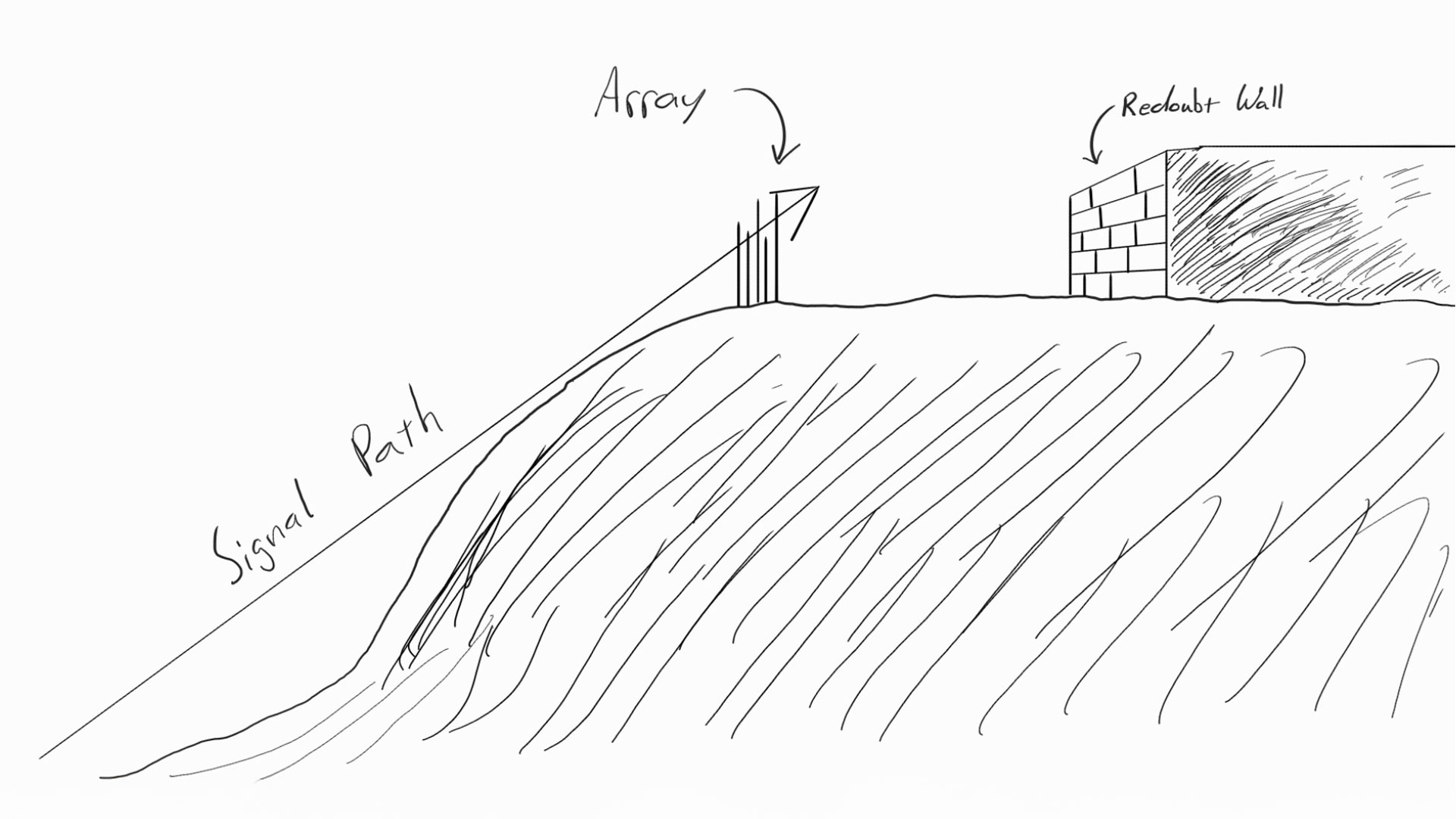
Figure 2 - Planning diagram that was used to illustrate antenna site selection at Redoubt 4
Observations: Environmental Factors as Force Multipliers

Figure 4 - Reflections from container ships in the Hudson River shift signal DOA
Wave Guiding from a Train:
During testing, the presence of a train passing on the west side of the receiver array consistently caused the reported DOA to shift westward by approximately 11.5 degrees. This effect immediately vanished as the train moved past the array. This observation suggests a potential “wave guiding” effect, where the train’s large metallic mass, comparable in size to the longer wavelengths of the low VHF signal, influenced the radio wave’s propagation path.

Figure 3 - DOA shifted by presence of a train on the track
Reflection from a Container Ship:
Similarly, large container ships transiting the Hudson River to the east of the array caused the reported DOA to shift eastward by approximately 15 degrees. This is a classic example of multipath reflection, where the ship’s significant reflective surface created a secondary signal path that interfered with the direct
The Pervasive Nature of Multipath:
The observed effects were not limited to these large, moving objects. As evidenced by the initial site tests in the Grant neighborhood, multipath from static structures such as housing walls and guard rails also severely degraded performance at low VHF frequencies. These instances, alongside the train and ship observations, demonstrate that multipath is a fundamental and widespread challenge in cluttered environments.
Analysis and Strategic Implications
The DOA Challenge:
These observations highlight a critical vulnerability: ground-based DF systems operating in the low VHF range (30−88 MHz), a common band for military tactical radios, are highly susceptible to environmental clutter. The longer wavelengths characteristic of this band means surfaces which appear jagged or uneven at higher frequencies can act as relatively smooth reflectors, leading to strong and unreliable DOA data.
Overlap with SECDEF and Army Priorities:
I. Lethality: Inaccurate DOA data undermines reliable targeting information, compromising lethality and tactical decision-making. Errors of 11.5 to 170 degrees could cause targeting errors of thousands of feet at operational distances, risking mission failure or friendly forces. This vulnerability undermined DoD goals of integrated deterrence and precision targeting, per the 2022 National Defense Strategy, and remains critical for lethality under the forthcoming 2025 strategy.1
II. Force Modernization & Continuous Transformation: This research provides empirical data to justify divestment from ineffective legacy systems and investment in innovative solutions. It aligns with Army priorities for advanced EMS technologies and multi-domain convergence, per the 2020 DoD Electromagnetic Spectrum Superiority Strategy and Multi-Domain Operations concept, enduring under future strategic guidance.2
Recommendations: Towards a Resilient Solution
New Capability:
Based on these findings, the Army should prioritize the development and fielding of aerial, drone-based DOA systems. An elevated system would bypass most ground-level clutter, providing a clearer line-of-sight and more reliable Line of Bearing (LOB) data, thus ensuring the accuracy of a critical warfighting capability
Doctrine and Training:
The Army must also adapt its training to account for these environmental factors. Cadets and Soldiers should be taught that the physical environment is an active participant in radio propagation and that EMS discipline is a nuanced and complex skill set that must be integrated into every mission plan.
Conclusion
The experiment, while successful in its primary training objective of instilling EMS discipline in cadets, uncovered a profound lesson: the accuracy of ground-based direction-finding at low VHF is far more fragile than often assumed. The unpredictable effects of multipath from common environmental elements present a significant challenge to the Army’s ability to generate timely and accurate intelligence. By embracing this lesson and investing in modern, resilient solutions like aerial DOA platforms, the Army can ensure its continued lethality and maintain a decisive advantage in the electromagnetic battlespace of the future.
References
1. Department of Defense, National Defense Strategy (2022).
2. Department of Defense, Electromagnetic Spectrum Superiority Strategy (2020); U.S. Army, TRADOC Pamphlet 525-3-1, The U.S. Army in Multi-Domain Operations 2028 (2021)
Author
MAJ Caleb Hill is an Electronic Warfare Research Scientist at the Army Cyber Institute at West Point. His professional journey, which includes serving as an enlisted Precision Measurement Equipment Laboratory technician in the U.S. Air Force, has provided him with a unique, inter-service perspective on technical and communications challenges. Following his commission into the U.S. Army Signal Corps, he gained extensive experience in network operations and tactical communications, leading to his selection as a Functional Area 26A Network Systems Engineer. MAJ Hill holds a Bachelor’s degree in Computer Science and a Master’s in Electrical Engineering from the University of Colorado, Colorado Springs. His expertise, cultivated through both formal education and practical experience in the amateur radio community, is focused on bridging the gap between theoretical knowledge and real-world tactical challenges in the electromagnetic spectrum.