No Sacrifice Too Great
The 1st Infantry Division In World War II
Reviewed by Timothy A Willging
Article published on: June 1, 2024 in the Army History
Summer 2024 issue
Read Time:
< 6 mins
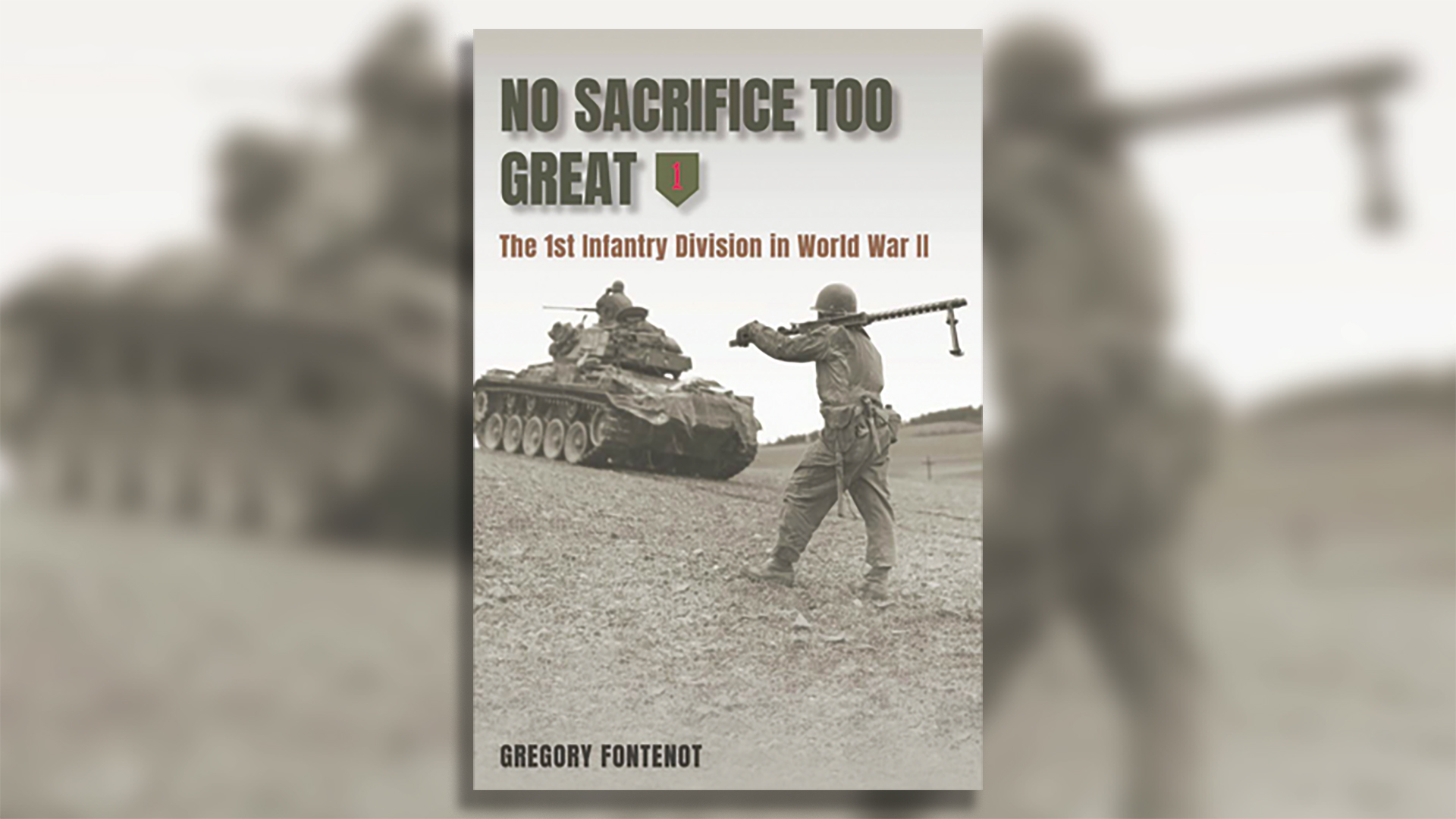
No Sacrifice Too Great: The 1st Infantry Division In World War II. By
GreGory Fontenot, University of Missouri Press, 2023 Pp. xxi, 571. $37
The 1st Infantry Division is the oldest continuously serving division in the
U.S. Army and is among its most heralded. Although the unit has amassed an
impressive combat record stretching from World War I through the Global War
on Terrorism, it is perhaps best known for its achievements in World War II.
The division features prominently in the works of such eminent authors and
historians as Stephen Ambrose, Rick Atkinson, and John C. McManus. However,
it is surprising that it has taken more than eighty years for a serious
academic study of the unit to appear on the market. Retired Col. Gregory
Fontenot’s timely study thus fills a significant void in the historiography
of the American Army in World War II. Fontenot makes a compelling argument
in this exceptional unit history that the 1st Infantry Division succeeded by
absorbing lessons learned and proving itself adept at adapting to rapidly
changing battlefield circumstances and situations.
The author is eminently qualified to write this history of the 1st Infantry
Division during the largest conflict in the Army’s history. Fontenot
commanded a tank battalion within the division during Operation Desert
Storm. He is also a gifted author and historian whose previous works include
On Point: The United States Army in Operation Iraqi Freedom (Combat
Studies Institute Press, 2004),
The 1st Infantry Division and the U.S. Army Transformed: Road to Victory
in Desert Storm, 1970–1991
(University of Missouri Press, 2017), and the exceptional unit history
Loss and Redemption at St. Vith: The 7th Armored Division in the Battle
of the Bulge
(University of Missouri Press, 2019).
Fontenot’s narrative comprises fifteen chapters. The first chapter explains
the context of the interwar period, including the development of doctrine,
the enhancement of professional military education, and the organization and
sustainment of units. Chapter 2 focuses on how the 1st Infantry Division
trained for war and deployed to Europe. The subsequent twelve chapters
contain the meat of the author’s narrative, chronicling the division’s
actions in the Mediterranean Theater of Operations. Finally, Chapter 15
details the division’s transition into occupation duty and the outcomes of
various individuals highlighted in the narrative, and offers the author’s
conclusions.
The 1st Infantry Division served more than fourteen months in combat during
World War II, fighting in nine separate campaigns and suffering more than
20,000 casualties. In each campaign, the division learned and grew as an
effective combat force. Fontenot writes that “for those in the 1st Infantry
Division, learning, training, and adaptation were continuous processes
because they had to be” (3). After the division’s first successful assault
landing in Operation Torch, the unit suffered reverses at the beginning of
the Tunisian Campaign. Despite these setbacks, the 1st Infantry Division
persevered, learning the importance of digging in and conducting effective
reconnaissance, with the unit’s performance consequently improving by the
Battle of El Guettar and the final drive on Tunis.
The 1st Infantry Division built on its experiences in North Africa during
Operation Husky, the Allied invasion of Sicily. Fontenot observes that in
this campaign, the division first functioned as the “combined arms team the
army had intended it to be” (175). The Big Red One also had to adapt to
wildly changing terrain, from coastal plains to rugged mountains, while
simultaneously confronting a determined enemy. Although the unit was praised
for its performance in Sicily, most notably in repulsing a German
counterattack on the beachhead, there remained room for improvement, such as
the need to employ suppressing fire effectively rather than only engaging
observed targets.
Fontenot efficiently describes the transition in division command between
Maj. Gen. Terry de la Mesa Allen and Maj. Gen. Clarence R. Huebner. The
division’s soldiers loved and respected Allen so much that they were not
particularly warm toward their new commander. Huebner is perhaps underrated
but proved an exceptional division commander. Fontenot describes how Huebner
strove to enhance discipline within the 1st Infantry Division and to improve
marksmanship and physical fitness, while also encouraging lower-level
leaders to demonstrate initiative. These efforts paid dividends when the
division next saw combat.
In the weeks and months after its famous assault landing at Omaha Beach, the
division constantly transitioned between confronting an entrenched
enemy—first in the Normandy hedgerows and later in the streets of Aachen and
the forbidding Hürtgen Forest—and the fast-paced open warfare during the
race across France and the drive into Germany in 1945. Amid these varied
operations, the division faced high turnover because of casualties and the
consequent need to incorporate a steady stream of replacements. Fontenot
notes that Huebner instituted a school for replacements that instilled
esprit de corps and taught marksmanship, and that NCOs imparted “tribal
wisdom” and supervised on-the-job training at the company level and below
(519). Fontenot convincingly assesses that the 1st Infantry Division
achieved the status of an expert division because it effectively used
learning to change its behavior to succeed on the dynamic modern
battlefield.
The book is well-written, superbly organized, and impeccably researched.
Authors and historians will find value in mining Fontenot’s notes and
bibliography when conducting their research. The author also includes an
exceptional photo essay that will help both casual readers and more
experienced scholars visualize the division’s wartime experience.
Additionally, the author includes many maps throughout the work, which aid
in understanding complex military operations. These maps depict operations
at various echelons, from battalion through army group, and experienced
military professionals and historians will find them invaluable. However,
more general readers may struggle with the complexity of maps depicting
higher-echelon operations.
Although No Sacrifice Too Great certainly sets a new standard for
divisional histories, it also reveals opportunities for further research.
Limitations on size and scope limit Fontenot’s ability to examine closely
the extent to which the 1st Infantry Division may or may not have been
unique in its ability to absorb lessons learned and adapt to changing
battlefield circumstances. Some readers may emerge curious as to whether
other units with similarly extensive combat records, such as the 3d and 9th
Infantry Divisions, possessed an ability to adapt to dynamic combat
conditions in a manner comparable to that of the Big Red One. In 2010, Mark
E. Grotelueschen released
The AEF Way of War: The American Army and Combat in World War I, a
groundbreaking study examining how four American divisions in World War I
adapted to combat on the Western Front. Although historians such as Michael
D. Doubler and Peter R. Mansoor have examined how the Army learned during
World War II, a study covering American divisions in the European Theater of
Operations during World War II, like that of Grotelueschen’s book, certainly
would find an avid readership.
Fontenot’s first-rate history of the 1st Infantry Division will prove
invaluable for scholars and general readers interested in understanding the
U.S. Army’s experience in the Mediterranean and European Theaters of World
War II. Moreover, this work should be required reading for Army leaders at
all levels, as it compellingly depicts how an excellent unit trains for
combat and continually adapts to the ever-changing battlefield.
Author
Timothy A. Willging served for seven years in the Regular
Army as a field artillery and military intelligence officer, including two
deployments in support of Operation IraqI Freedom. He currently serves in
the District of Columbia Army National Guard and is a Department of
Defense civilian. He earned his bachelor’s degree in history from Radford
University, a master’s degree in military history from Norwich University,
and a master’s degree in diplomacy, also from Norwich University.