Building in 3D
Additive Construction program provides capabilities to 3D print concrete structures for
the U.S. Army and DOD-wide.
By Rebecca Wright
Article published on: April 1st, 2025, in the Spring 2025 Issue of Army AL-T
Read Time: < 9 mins
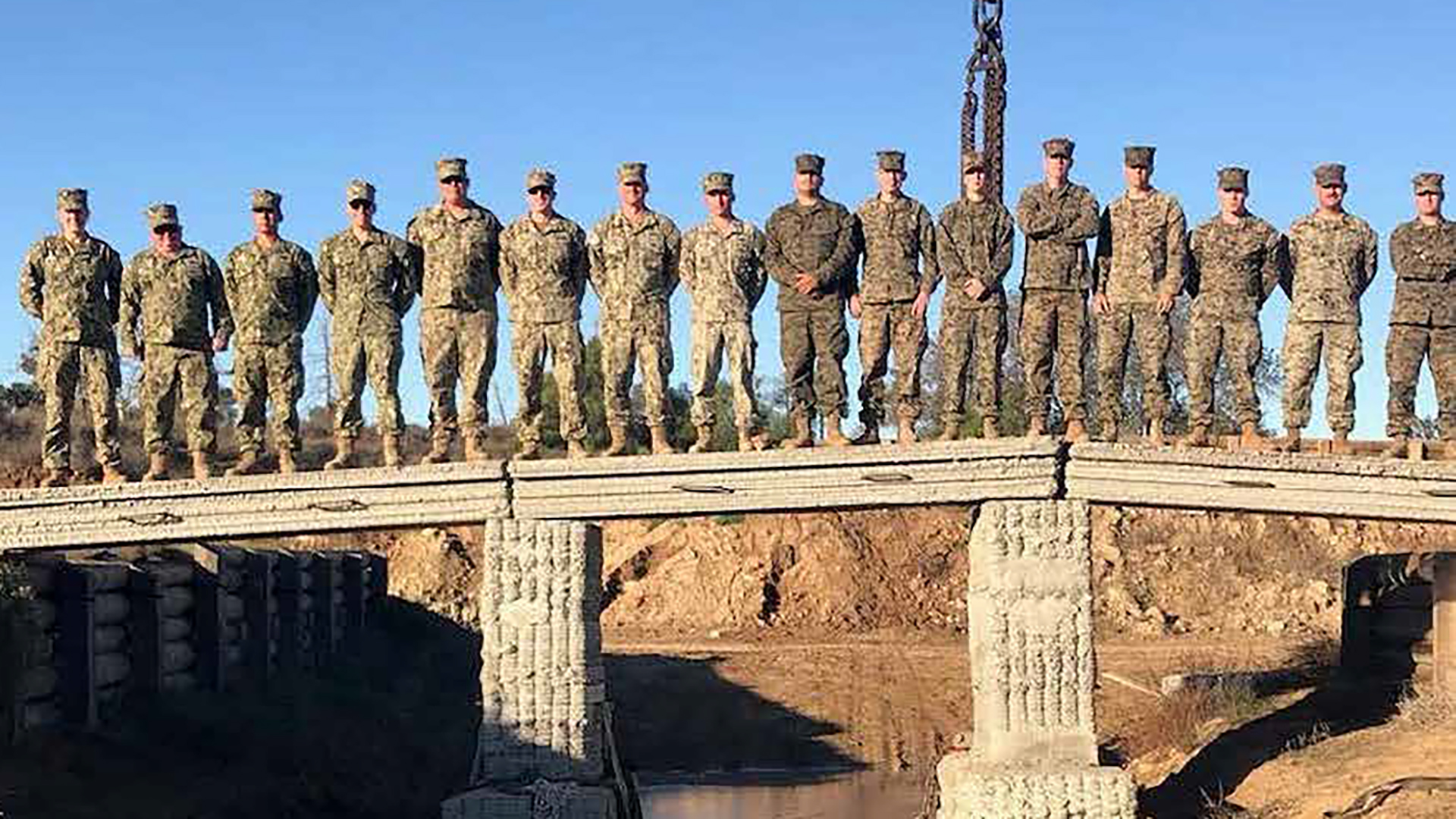
Bridging The Gap The first prototype printed bridge in the Americas,
constructed (and reinforced) with 3D printed double-T beams made of concrete. The ability to 3D print materials
on-site and on demand can reduce logistical burdens and delays to the Soldier. (Photo by Megan Kreiger,
USACE-ERDC-CERL)
The development of 3D printing has revolutionized the manufacturing industry, enabling the creation of highly
customized products through rapid prototyping and allowing for more flexibility and reduced production costs
across multiple industries—from the commercial sector to the Army.
In 1983, Charles “Chuck” Hull invented the first 3D printer called the SLA-1, a name derived from the term
stereolithography—a 3D printing technique that hardens liquid photopolymers into hardened plastic using an
ultraviolet laser. 3D printing, also referred to as additive manufacturing or rapid prototyping, is the process
of creating an object, usually layer by layer, from a digitally created design.
Since it was first invented in 1983, 3D printing has come a long way—with various methods of 3D printing
available (stereolithography, selective laser sintering, fused deposition modeling, etc.), an assortment of
printer models offered on the market and more affordable options available. The first 3D printer cost
approximately $300,000 in the early 1980s and now they are commercially available from as little as $200. There
are a number of options of 3D printed materials, including plastic (the most common), metals (such as aluminum
and steel), resins and carbon fiber, as well as construction materials such as wood and concrete.
Widely used across the automotive, medical, consumer and aerospace industries, 3D printers manufacture a variety
of products, including parts, jewelry, home décor, medical prosthetics (like arms and legs), dental implants and
more.
3D Printing In The Army
Over the last decade, the military began engaging in 3D printing technologies and its many applications, with
early involvement beginning in 2012 and gaining more momentum in 2016. Supply chain issues, lengthy logistic
processes, the inability to transport large quantities of parts or the transport of bulky items are just a few
of the challenges facing the military. The capability to 3D print could eliminate many of these obstacles.
When deploying to austere environments, Soldiers may need to set up temporary structures, either for housing or
storage of military equipment, or create a location to conduct operations protected from the weather elements.
The U.S. Army Corps of Engineers’ Engineer Research and Development Center, Construction Engineering Research
Laboratory (ERDC-CERL) realized this need for Soldiers in these types of environments with limited resources.
So, ERDC-CERL launched the Additive Construction program, which provides training exercises to military members
on how to operate 3D printers to print concrete buildings and other force protection structures on location
using locally available materials. “Our real goal as a program is to produce expeditionary structures on demand
in the field by Soldiers using locally available materials,” said Megan Kreiger, research mechanical engineer
with ERDC-CERL and additive construction expert for the Department of Defense. “As a program … we initially
developed our own printing systems, our own material formulas, our own printing methodologies and really went
through and developed this technology with the idea of eventually using it in expeditionary environments.”
Beginning With The B-Hut
One of the initial projects in the Additive Construction program was the Automated Construction of Expeditionary
Structures (ACES), with the main objective to custom-build an expeditionary building on-site with a minimum
number of service personnel. “The ACES project was the first project … The entire goal of that project was to
see if we could do custom-designed expeditionary structures on demand in the field using locally available
materials,” Kreiger said.
In 2017 under the ACES project, a 512-square-foot building called a barracks hut, or B-Hut, was constructed with
a printer and printing methodology developed by ERDC personnel. “That very first project was to produce what’s
called a B-Hut,” Kreiger said. “This initial project was really where Additive Construction initiated within the
Department of Defense.” B-Huts are temporary housing structures built for military personnel that are typically
constructed of a wood frame and plywood walls and are expected to have a short life expectancy (about five
years). So, what makes the 3D printed B-Hut different aside from the way it is manufactured? It is constructed
of layered concrete beads, in unique geometries, and a previously untrained team on the technology was able to
print all four walls of the building in less than 48 hours. The structure was the first full-scale printed
concrete building in the Americas combining traditional techniques with modern ones. After completing this first
concept, the focus shifted to producing structures in short timeframes with military personnel.
In August 2018 at ERDC-CERL in Champaign, Illinois, members of the ACES team trained a group of Marine Corps
members to 3D print a second 512-square-foot B-Hut, known as the “Chevron” B-hut, using a printer called ACES
Lite. The ACES Lite—produced in partnership with Caterpillar under a Cooperative Research and Development
Agreement and using printing methodologies developed by ERDC for the first structure— fits in a 20-foot shipping
container and can be set up in less than one hour. The “Chevron” B-Hut exhibits two and a half times the
strength of a straight-walled printed B-Hut due to its geometry.
After successfully printing two B-Huts at ERDC-CERL, the team took the capabilities to the field. Subsequent
training exercises took place in Guam in June 2022—training a group of Marines and Navy Seabees (construction
forces)—and again at Camp Atterbury, Indiana, in July through August 2023, training a group of Soldiers, Marines
and Airmen. Both groups were trained on how to operate the ACES Lite printing system. Several force protection
structures were printed in Guam, while at Camp Atterbury the service members printed a 512-square-foot B-Hut
structure. The training that took place in Guam used only locally sourced materials. “The major advantage of the
ACES printing system is that it reduces the logistical burden of transporting materials into that theater of
operation; you’re not having to ship conventional building materials such as wood or CMU [concrete masonry unit]
blocks or any other required building materials. You’re able to get the materials from local quarries, local
providers or suppliers and be able to create printable mixtures in order to produce whatever type of
infrastructure you need on site,” Kreiger said. Most importantly, those structures printed in Guam and Camp
Atterbury underwent blast and ballistic testing to help inform force protection capabilities, showing potential
for future applications of the technology.
Building Blocks
The Additive Construction program isn’t stopping at the B-Hut. During another demonstration, also held at
ERDC-CERL, military personnel were trained to 3D print a gap crossing. Printing the gap crossing consisted of 3D
printing seven box beams—each a rectangular structure that is reinforced as you print upwards— that are then
reinforced together to create a bridge over a gap.
Building The B-Hut Military personnel received training to operate the ACES
Lite printing system and completed construction of one of the first ever 3D printed concrete buildings at Camp
Atterbury, Indiana, in July through August 2023 (top) and a second printed B-hut in Champaign, Illinois, in July
2018 (bottom). The concrete construction offers a B-Hut that is more structurally sound than those traditionally
made from plywood. (Photos by Megan Kreiger, USACE-ERDC-CERL)
“You can make a bridge utilizing this technology. Over 30 of these [box beams] were printed over a span of three
days,” Kreiger said. Seven box beams were able to create a crossing over a 40-foot gap designed to carry a
fully-loaded heavy expanded mobility tactical truck.
There are 3D printing abilities available also for small structures, such as Jersey barriers, small bunkers and
culverts. Kreiger added that during a test event they were able to print one Jersey barrier in less than an hour
and up to six Jersey barriers in approximately three hours.
“Our real goal as a program is to produce expeditionary structures on demand in the field by Soldiers
using locally available materials.”
The Additive Construction program currently has more than 12 printers in different stages of development—the
ACES Lite is the most used and has gone through several version iterations based on feedback and field use.
Kreiger emphasized the many options that the program offers such as the type of materials that can be used to
mix the concrete and the type of concrete mixer used to print. “The idea is that you work with whatever military
equipment is already available. So, you’re not having to have some customized mixer and some customized
material,” Kreiger said. “You’re trying to use those locally available materials and your local equipment assets
in order to get the job done.”

concrete Customization Close up of the ACES Lite system printing concrete
gap crossing sections. The ACES 3D print system allows the user to customize the shape, thickness and
patterns of what they need. (Photo by Jared Eastman, USACE-ERDC)
Additionally, users are not restricted by their geographic location and can choose where the 3D printing is
performed, whether that is on-site or in a warehouse, and then deliver the product (whole or in sections,
depending on the size). Users also have opportunities to design the size and shape of the product. “You can
start getting into more exciting applications like what can you do with the exterior of an object now that you
have increased complexity in design with little added cost,” Kreiger said. “What do you want your buildings to
look like? Now you can have improved and modern infrastructure because the printer will not care about the
complexity of the design and print out exactly what the design file dictates. This extends even to internal
geometries of objects as well, such as print structures with solid or zigzag infill patterns [concrete is laid
down in chevron lines], and we do all of it depending on what the application is.”
Work Smarter Not Harder
A major benefit of additive construction is that it reduces both time and the number of military personnel
compared to conventional construction. It is a well-known fact that conventional construction requires a
substantial amount of physical labor. It also requires specialized skills, and not all military personnel may
have the necessary training. “Really where the limitations came in is when people are producing structures in
expeditionary environments, they’re often in harsh and austere conditions. They have personnel, but they’re
limited if people are not devoted to construction; then that’s taking up their time that they could be doing
other activities,” Kreiger said.
She explained that military personnel who are provided with the proper 3D printing tools to build structures
(whether temporary or semi-permanent) can do so with limited manpower. She described that, depending on which
printing system is used, a crew between two to eight personnel working in rotation can 3D print and construct an
entire 512-square-foot building in 24 to 48 hours, stating that the most labor-intensive part of the process is
mixing the concrete. “It’s a much better environment for people in construction to be able to produce structures
with limited physical activity,” Kreiger said. “Basically, the only physical activity aside from the mixing is
laying reinforcement.”
On top of reducing the amount of physical labor needed for construction, the use of concrete materials instead
of plywood enhances the structural integrity of the building. Concrete structures are more resilient in extreme
weather conditions and can offer better protection from potential enemy attacks. And since the buildings can be
designed to suit a unit’s needs, military personnel can tailor the size and shape of the building, modify the
thickness of the walls, customize reinforcement, add insulation and more.
Conclusion
Additive construction can streamline construction operations, improve efficiency, reduce the logistical burden,
reduce material costs and lessen the physical burden of manual labor on military personnel. “The idea is, let’s
make construction easier and reduce the amount of manpower and overall labor, all while using locally available
materials,” Kreiger said. “People are not physically worn out in the same way that you would be if you were
constructing a building using conventional methods.” By constructing buildings and other structures using 3D
printing methods and reducing the amount of physical labor needed, military personnel can save both time and
energy to focus on other responsibilities in expeditionary environments.
The use of 3D printing in the military is still a work in progress; and the Additive Construction program is
continuing with improvements to benefit the warfighter. Kreiger explained that she would like to see the program
expand, aiming to provide military units with better access to 3D printing equipment and thoroughly train in its
operation at the various engineer service schools.
“What I want to see going forward is this technology to be used for applications that truly benefit the
warfighter. Not just doing demonstrations or small prints, but ones that provide a lot of military utility that
improve their basic day-to-day activities and make it easier for them to be in more expeditionary environments,”
Kreiger said. “My priority right now is to ensure that proper development of this technology as it transitions
into the hands of the users and military personnel that'll be taking this forward into the field as a new
capability. So, a lot of what we’re trying to work on is getting printing systems stationed with different units
for them to be able to operate independently from any of the engineers or researchers that do this as a day job
and get them to start incorporating it into their normal activities.”
For more information, go to https://www.erdc.usace.army.mil/Locations/CERL
Author
Rebecca Wright is a writer and editor with Army AL&T and the U.S. Army Acquisition
Support Center at Fort Belvoir, Virginia. She has more than 15 years of experience writing and editing for
DOD and the U.S. Department of Justice.